



School administrators face a consistent question from alumni, athletes, and community members: how do we permanently honor the athletic legends who built our program’s competitive reputation? An athletic hall of fame serves as the definitive answer—creating systematic recognition that preserves institutional memory, inspires current athletes toward exceptional achievement, and strengthens connections between past excellence and future aspirations.
Yet launching and maintaining hall of fame programs presents substantial administrative challenges. Selection criteria must balance fairness with meaningful standards. Display formats need to accommodate decades of future growth without exhausting facility space. Content requirements demand biographical depth that traditional plaques cannot provide. And ongoing maintenance must fit within realistic staff capacity and budgetary constraints.
This complete guide walks school administrators through every decision point in athletic hall of fame program development—from establishing mission statements and selection criteria through implementing recognition displays and managing long-term program sustainability. Whether launching a new recognition program, revitalizing an outdated system, or exploring how modern technology expands celebration capacity beyond physical constraints, you’ll discover proven administrative frameworks that transform athletic recognition from occasional acknowledgment into permanent institutional infrastructure.
Athletic hall of fame programs deliver measurable value beyond simple recognition. Schools with established programs report 34-47% stronger alumni engagement, increased athletic fundraising, enhanced recruiting appeal citing program tradition, and measurable improvements in current athlete motivation toward achievement benchmarks made visible through systematic recognition.

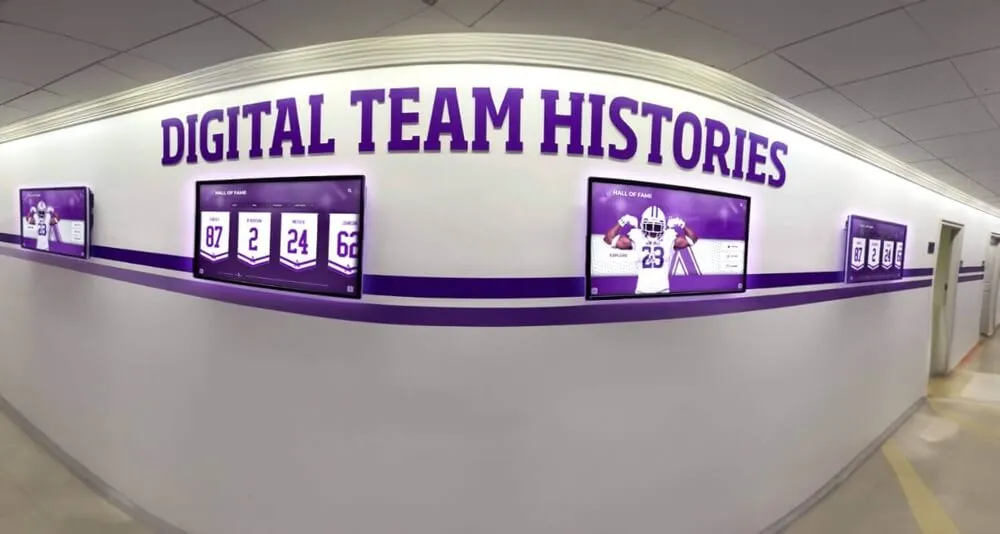
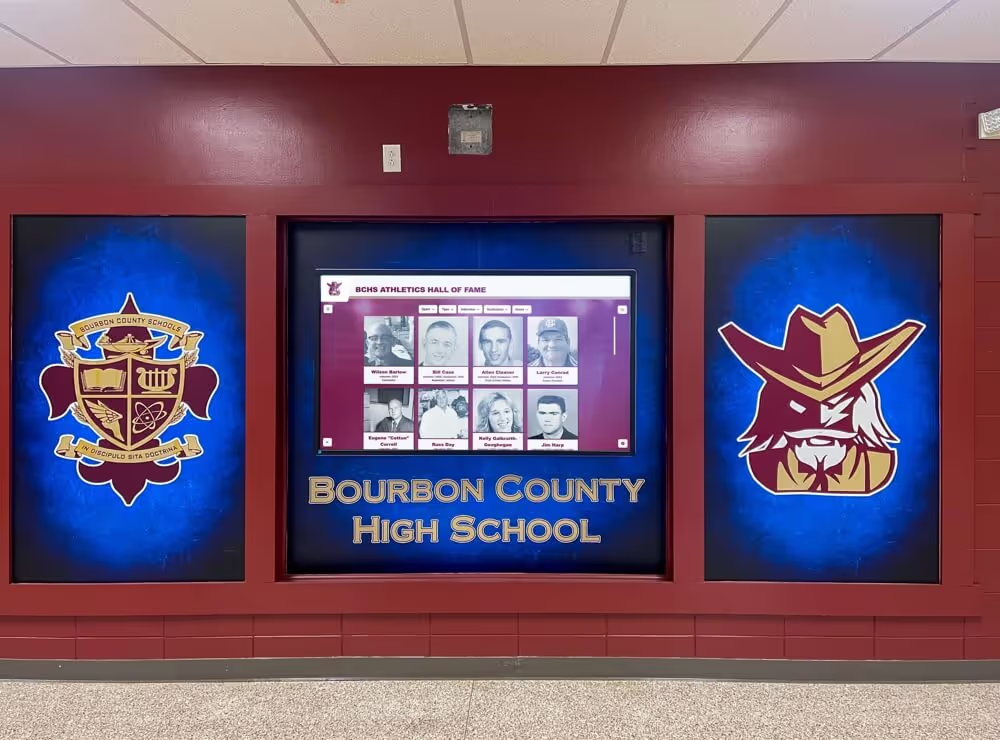
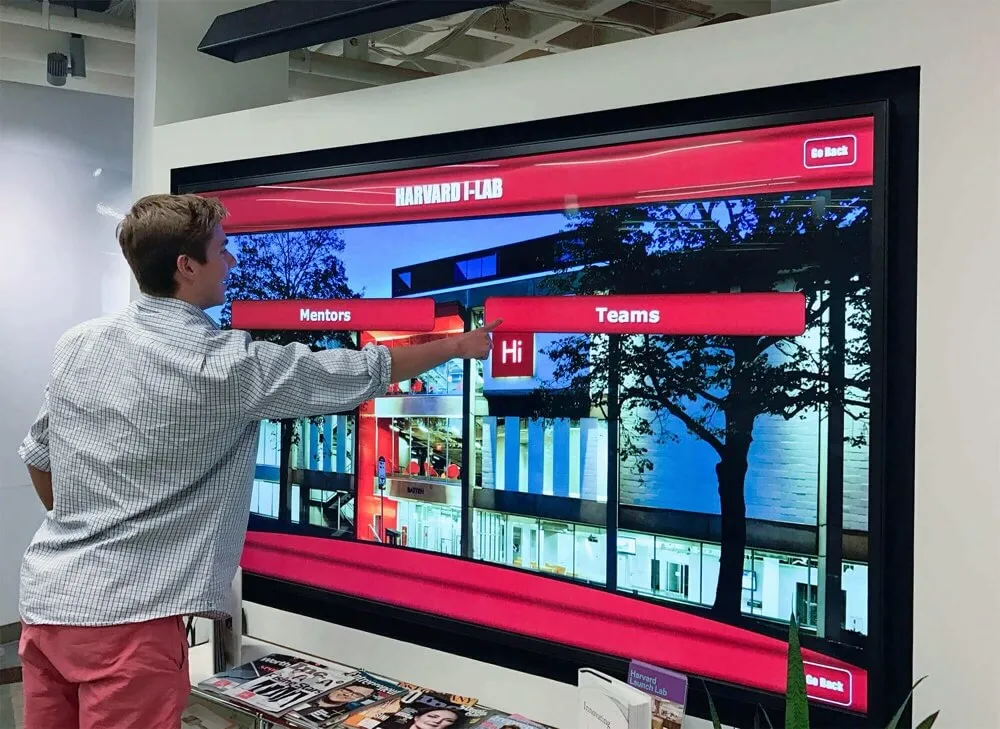
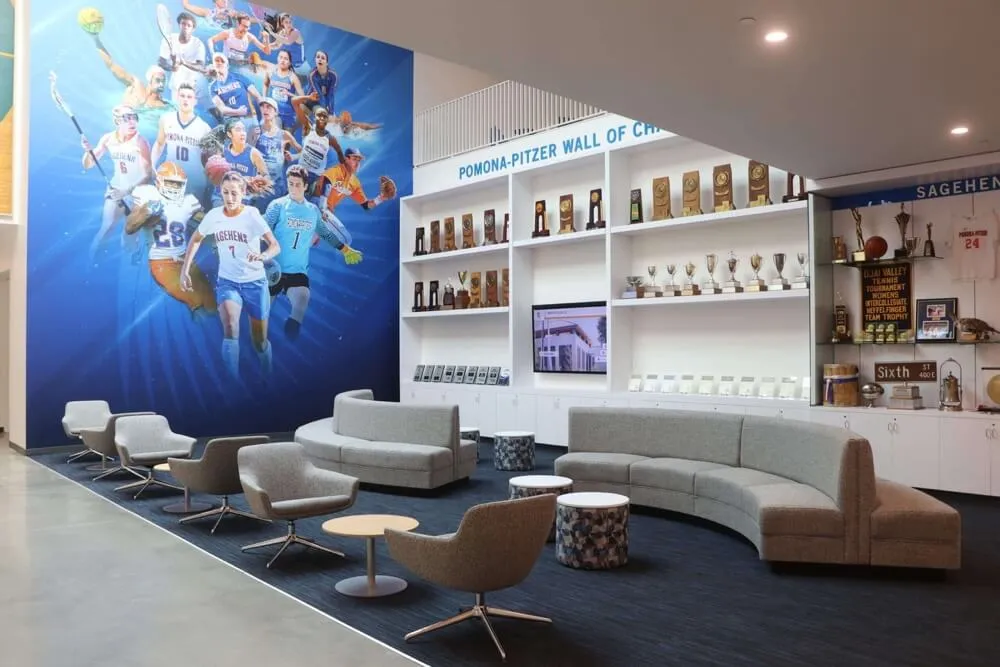
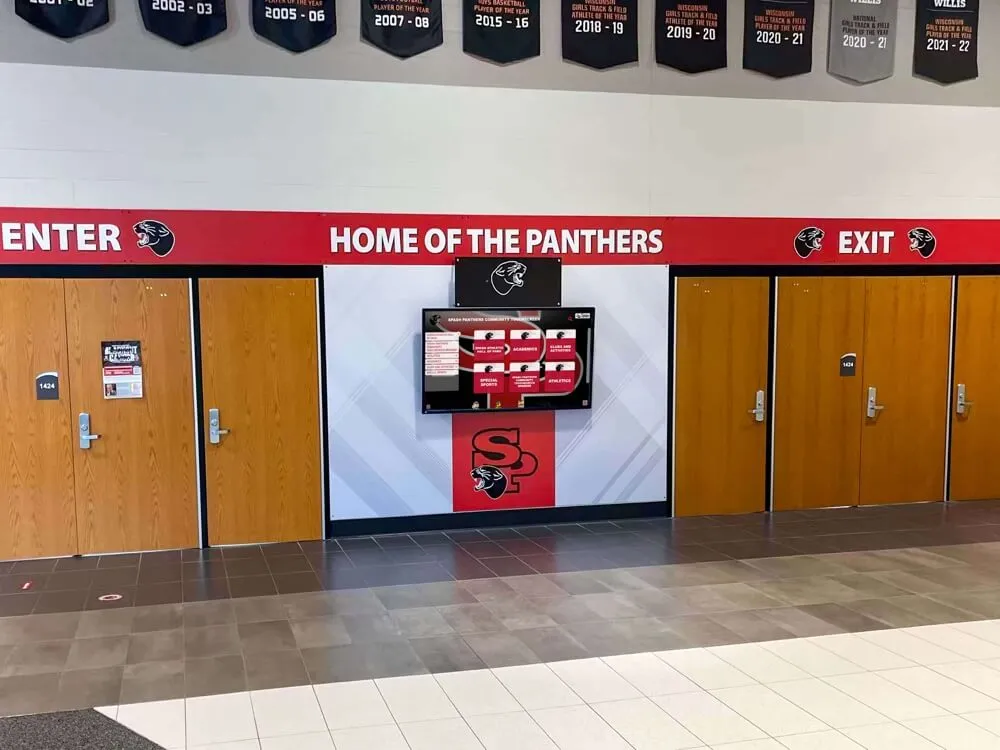
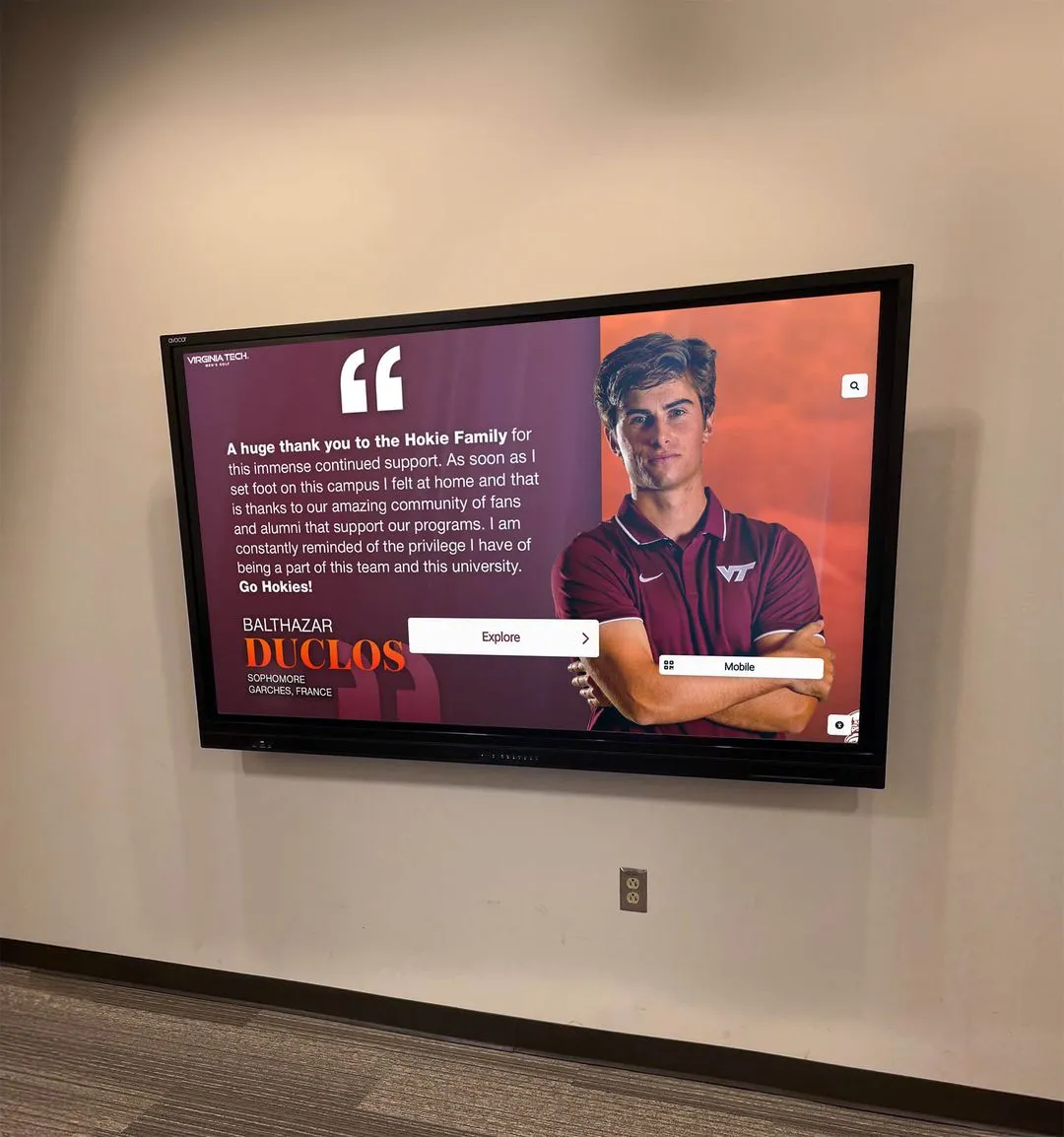
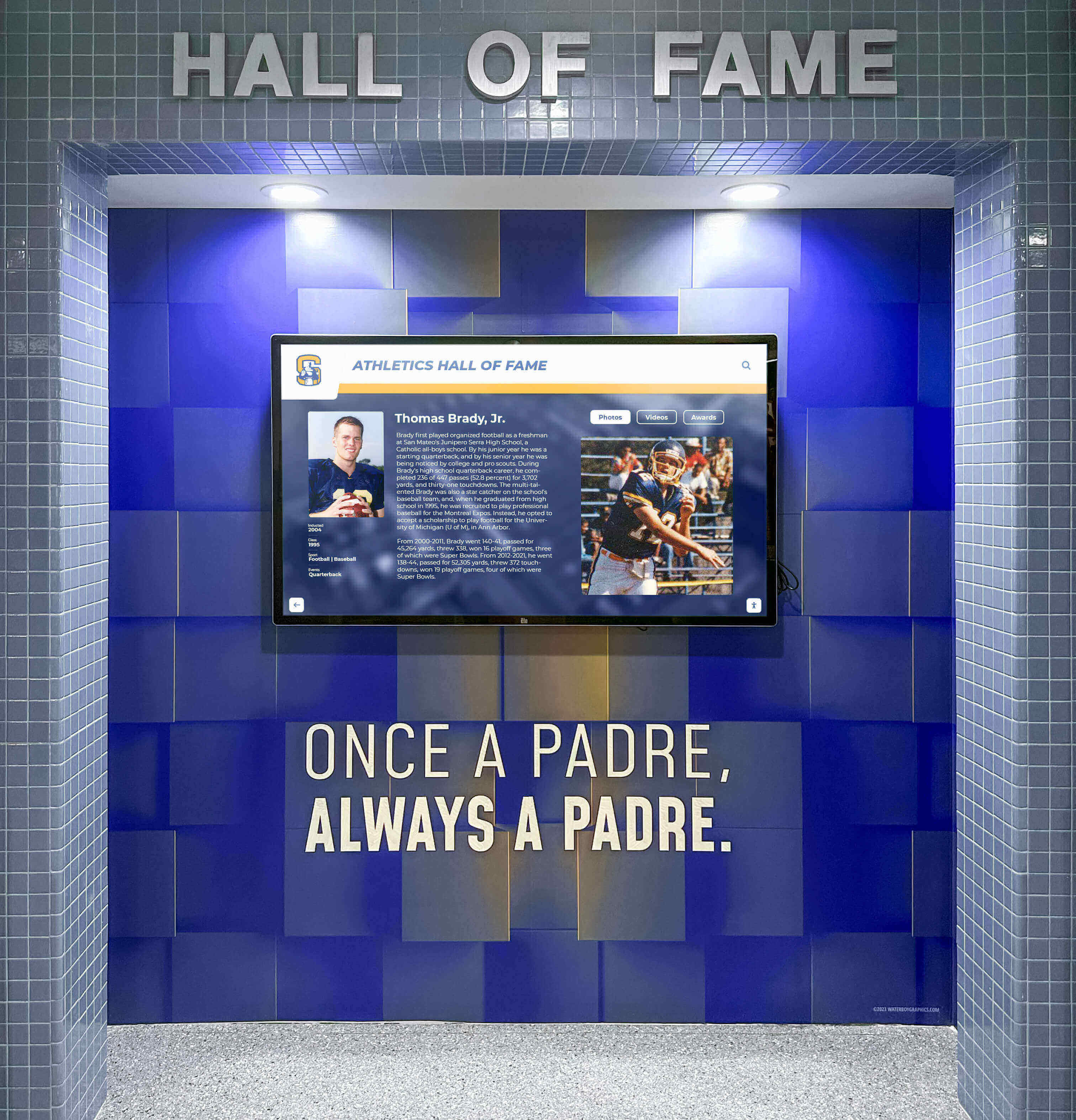
Strategic placement in high-traffic athletic corridors ensures hall of fame recognition reaches all facility visitors regularly
Establishing Clear Program Purpose and Mission
Successful hall of fame programs begin with articulated purpose statements guiding all operational decisions.
Defining Recognition Philosophy
Athletic directors must determine what their hall of fame programs will celebrate:
Honoring Individual Athletic Excellence
Most programs focus on exceptional individual achievement—athletes who demonstrated sustained performance excellence, competitive dominance within conferences or regions, leadership impact on team culture and success, and character standards reflecting institutional values. Individual recognition creates aspirational examples current athletes can study and emulate.
Administrators should establish whether recognition extends only to varsity athletics or includes club sports, intramurals, and non-competitive athletic participation that nonetheless demonstrated commitment and community contribution.
Celebrating Team Achievement
Beyond individuals, many programs recognize exceptional teams—particularly championship squads or historically significant seasons demonstrating unprecedented program elevation. Team recognition acknowledges that athletic success emerges from collective effort rather than individual performance alone.
Consider whether team recognition occurs alongside individual inductions or through separate ceremony tracks preventing any single induction class from becoming unwieldy.
Recognizing Coaching and Leadership Contributions
Comprehensive programs honor coaches, athletic directors, trainers, and administrative leaders whose contributions enabled competitive excellence. These individuals often shape programs across decades through athlete development, strategic vision, and infrastructure building that transcends any single season or team.
Coaching recognition criteria typically evaluate career longevity, championship achievement, winning percentages, player development evidenced by college placements and individual honors, and program building establishing sustained competitive elevation beyond inherited circumstances.
Resources on college athletics hall of fame development demonstrate comprehensive recognition philosophies applicable across educational levels.
Setting Institutional Scope and Scale
Administrators must determine hall of fame program boundaries:
Sport Coverage Decisions
Single-sport halls of fame focus exclusively on one athletic program—typically football or basketball at schools with prominent programs and substantial historical depth. Focused approaches enable specialized criteria and deep content development but risk alienating other sports feeling undervalued by institutional recognition priorities.
Multi-sport halls of fame recognize excellence across all athletic programs. Comprehensive approaches demonstrate equitable commitment to all athletes while presenting logistical challenges managing diverse achievement standards across sports with different competitive contexts, statistical metrics, and historical documentation availability.
Most administrators prefer multi-sport approaches preventing political complications inherent in elevating specific programs while diminishing others within single institutional athletic departments.
Gender Equity Considerations
Title IX compliance requirements extend to recognition programs. Administrators must ensure selection processes, ceremony visibility, and display prominence provide equitable recognition for female and male athletes. Unbalanced historical induction totals favoring male athletes—often reflecting pre-Title IX program histories—require intentional correction through selection criteria adjustments or separate recognition tracks ensuring current gender equity despite historical disparities.
Documentation of selection deliberations showing systematic equity consideration protects programs from potential discrimination claims while ensuring recognition programs genuinely honor excellence across all athletic programs equally.
Timeline Coverage Parameters
Most programs recognize achievement from program founding forward, creating substantial historical research obligations documenting decades or centuries of athletic tradition. Alternative approaches establish recognition thresholds—honoring only athletes from specific eras or requiring minimum elapsed time since graduation ensuring historical perspective before evaluation.
Administrators should assess institutional archive quality and research capacity before committing to comprehensive historical coverage potentially requiring years of biographical research, statistical verification, and content development for athletes from eras lacking systematic documentation.
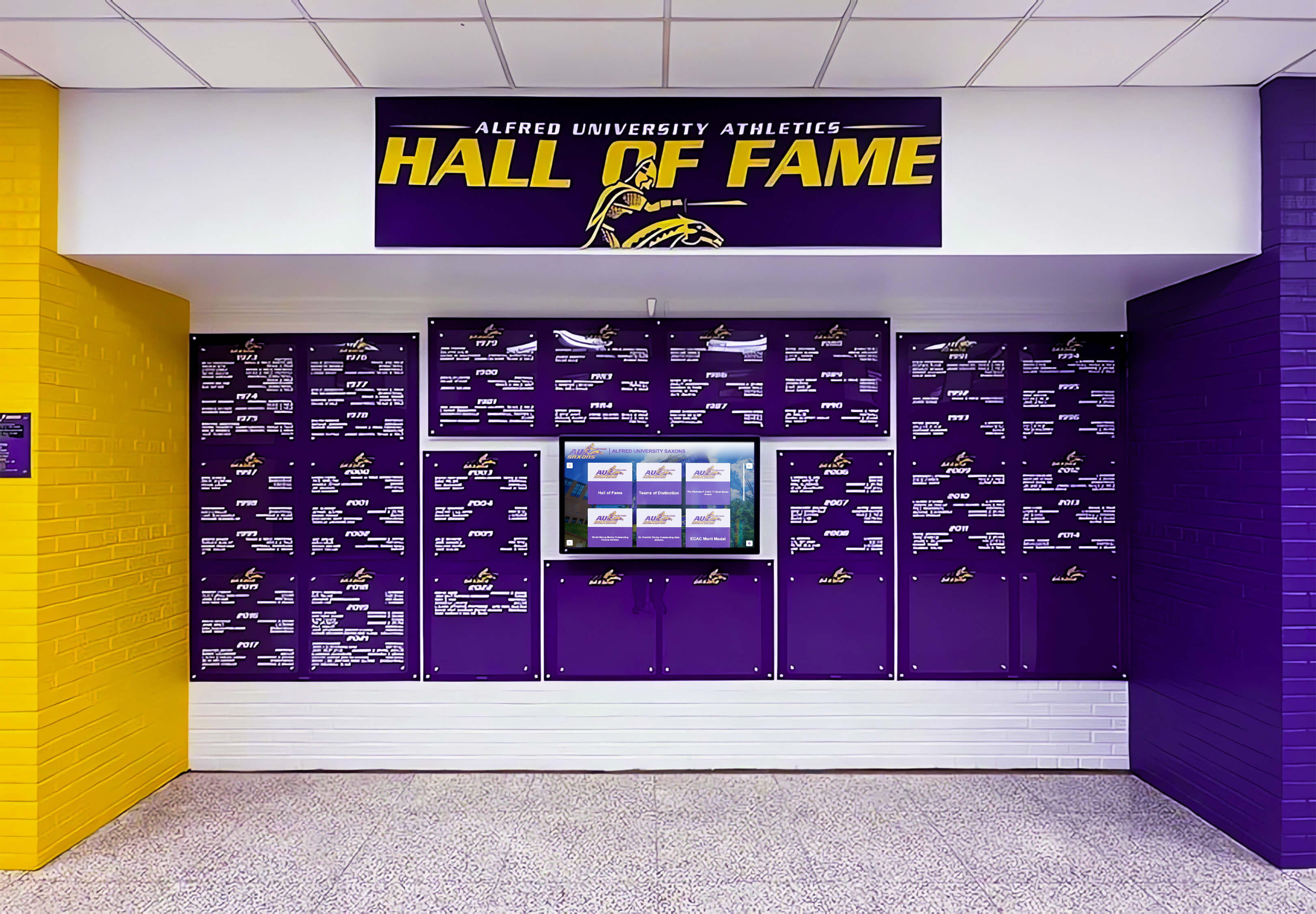
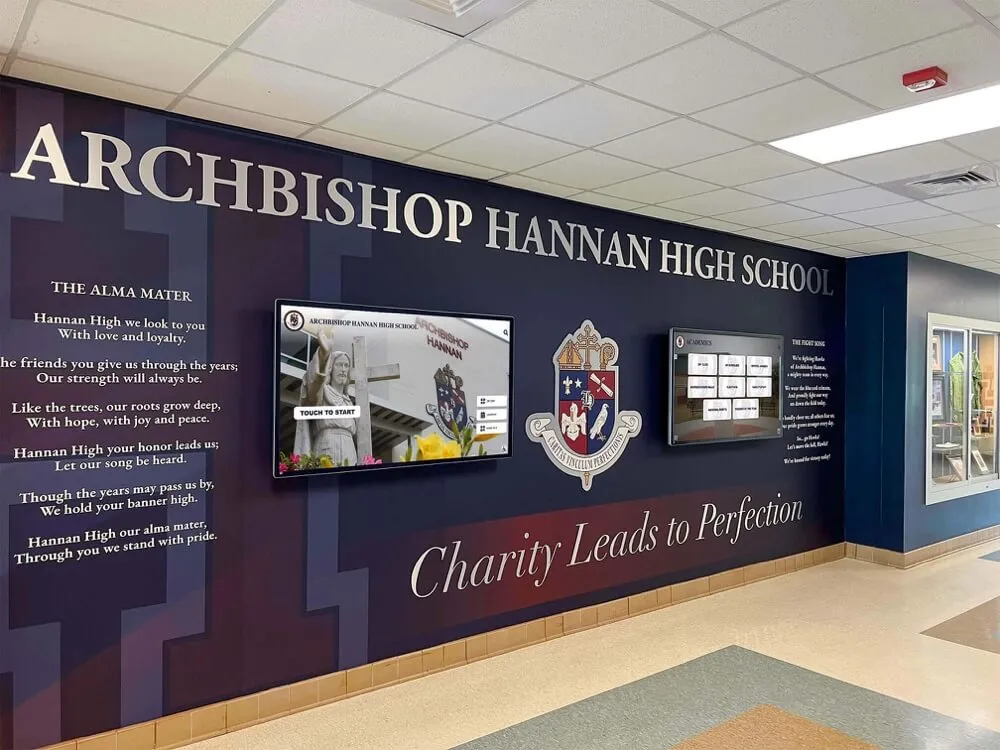
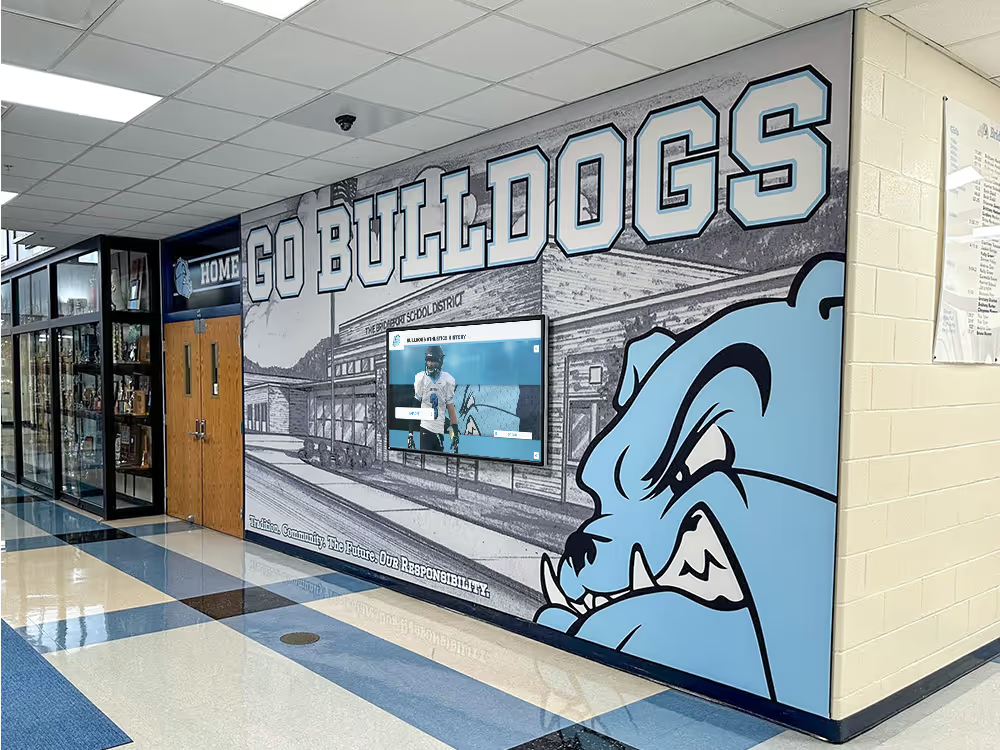
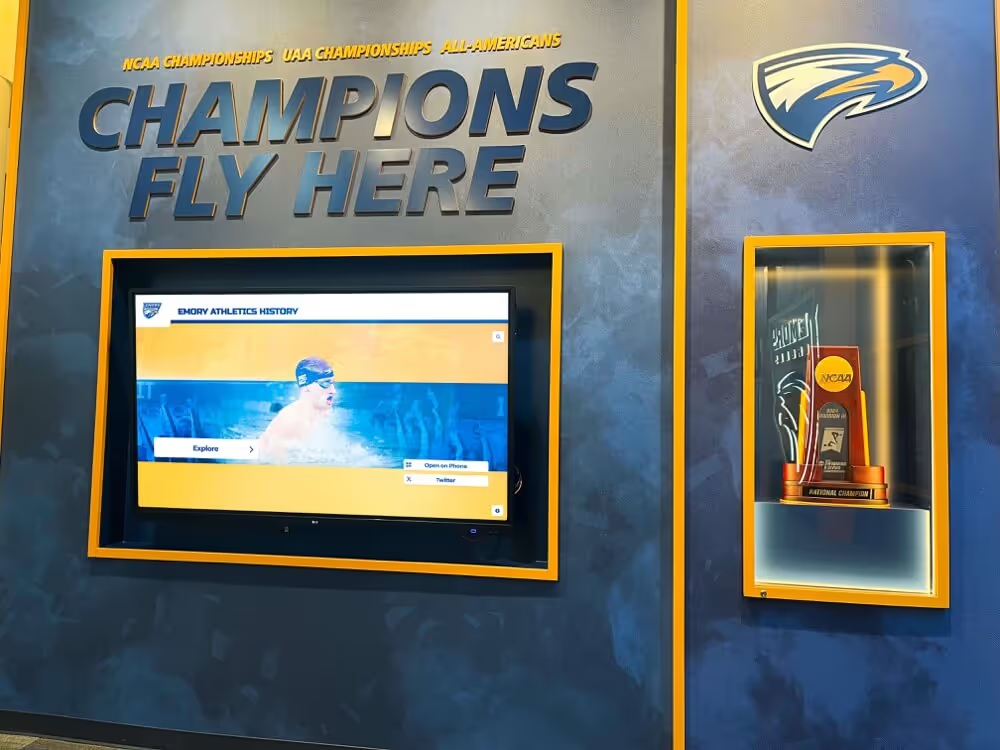
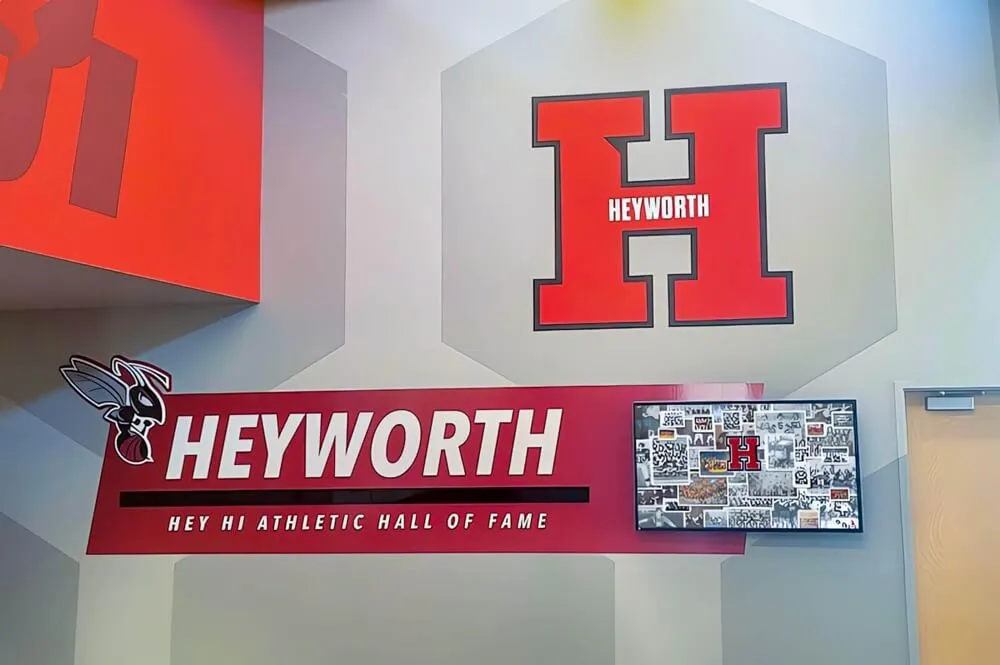
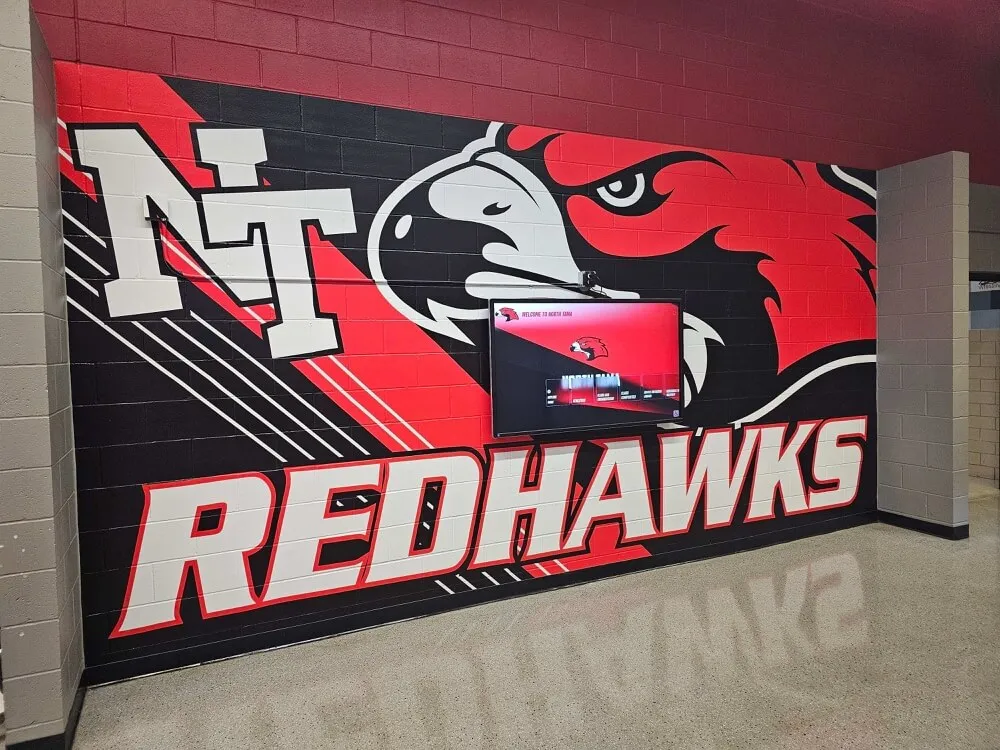
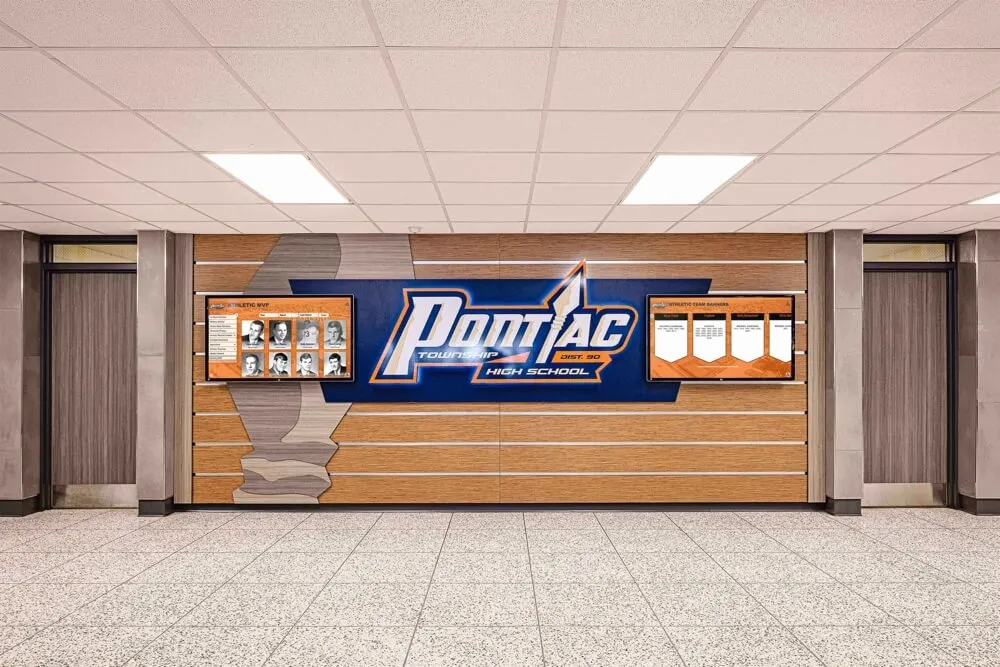
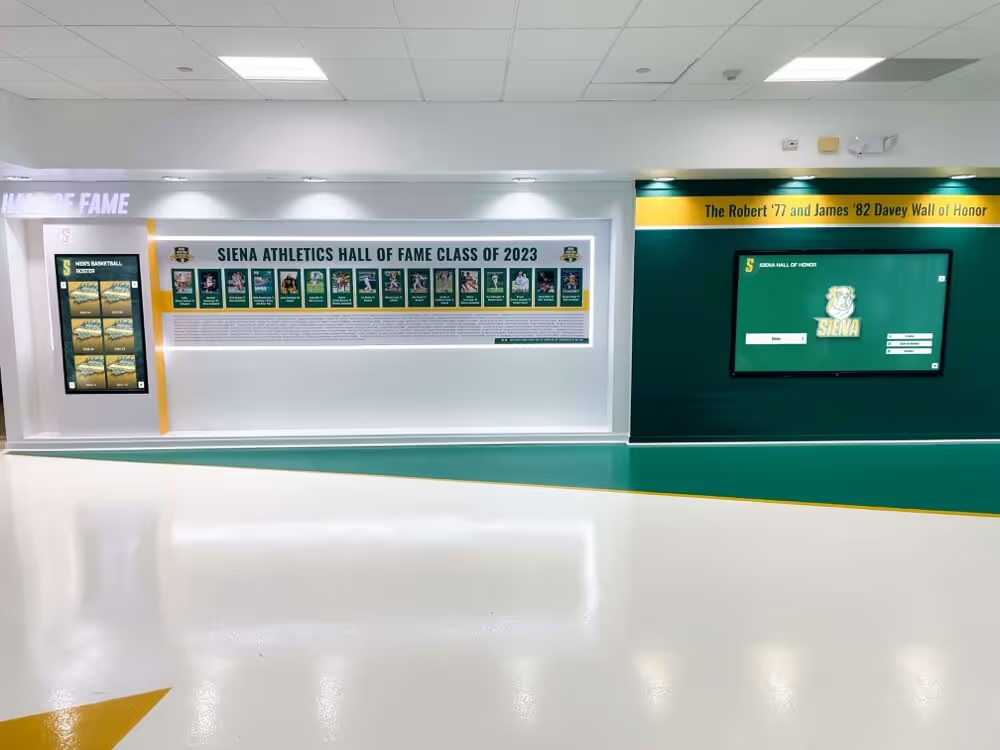
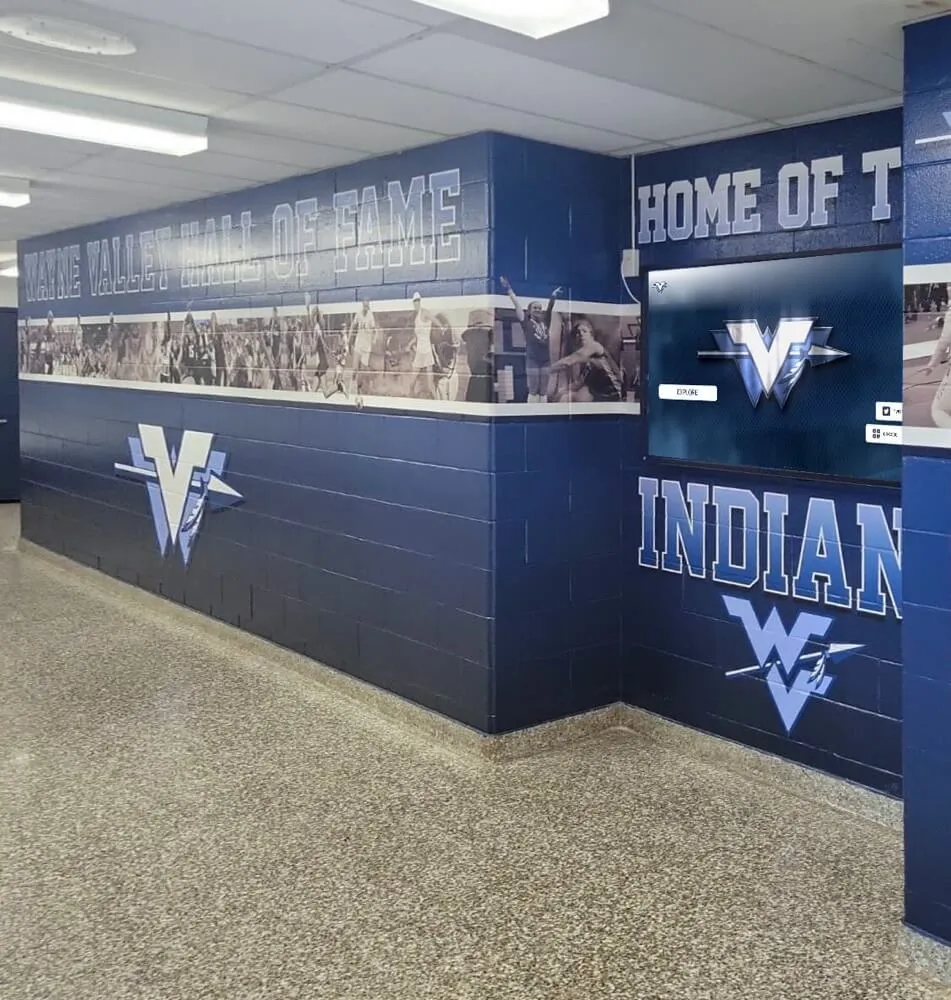
Brand-integrated displays incorporate institutional colors and logos creating recognition experiences that reinforce school identity
Developing Selection Criteria and Governance Structure
Fair, transparent selection systems maintain program credibility across constituencies.
Creating Objective Induction Standards
Written criteria establish minimum qualifications and evaluation frameworks:
Statistical Achievement Benchmarks
Quantifiable thresholds provide objective minimums for consideration. Common criteria include career statistical totals calibrated to program history and season length, statistical leadership positions in program record books, all-conference or all-state selection frequency, championship participation or individual tournament success, and minimum participation duration ensuring sustained contribution rather than brief excellence.
Administrators should establish sport-specific statistical standards reflecting different measurement conventions—scoring averages for basketball, batting averages for baseball, goals and assists for soccer—rather than attempting universal standards inadequately capturing diverse athletic contexts.
Qualitative Excellence Indicators
Beyond statistics, criteria should acknowledge contributions defying quantification: demonstrated leadership through captain roles and peer respect, competitive impact on opponents and conference reputation, clutch performance in critical competitive moments, sportsmanship reflecting institutional character standards, and memorable achievements defining program tradition and competitive identity.
Qualitative factors enable recognition of athletes whose statistical totals may fall below established thresholds but whose competitive significance and program impact clearly warrant induction consideration.
Waiting Period Requirements
Most programs establish minimum elapsed time between graduation and eligibility consideration. Common approaches include five-year minimums allowing post-playing careers to develop before evaluation, ten-year standards ensuring sustained program connection and community contribution, and graduated criteria with shorter waiting periods for truly exceptional achievement meeting unanimous selection standards.
Waiting periods prevent premature induction of athletes whose complete legacies remain uncertain while enabling committee assessment of post-playing career achievements, continued institutional engagement, and character development impossible to evaluate immediately following athletic eligibility conclusion.
Comprehensive frameworks for athletic recognition programs provide detailed criteria development approaches ensuring fair, defensible selection across diverse achievement categories.
Establishing Selection Committee Structure
Governance procedures ensure systematic, equitable evaluation:
Committee Composition
Diverse committees represent multiple perspectives and institutional knowledge. Recommended composition includes current athletic director or designee providing administrative oversight, head coaches contributing sport-specific expertise, former athletes and coaches offering historical institutional memory, alumni representatives ensuring graduated community voice, school administrators maintaining institutional values alignment, and optional community members providing external perspective on candidates’ broader impact beyond immediate program contexts.
Typical committees include 7-11 members—sufficient diversity without becoming unwieldy for deliberation and decision-making requiring consensus building across varied perspectives.
Term Structure and Rotation
Multi-year terms with staggered rotation ensure institutional continuity while incorporating fresh perspectives regularly. Common approaches include three-year terms with one-third of committee rotating annually, term limits preventing permanent committee membership and ensuring broad stakeholder participation over time, and emeritus positions for founding committee members providing historical continuity while making room for new voices.
Staggered rotation prevents complete committee turnover disrupting institutional knowledge transfer while ensuring no committee configuration remains static across decades as programs and constituencies evolve.
Nomination and Evaluation Procedures
Systematic processes ensure thorough, equitable candidate assessment:
- Open nomination periods with standard forms requesting complete candidate information
- Self-nomination options enabling candidates to submit their own candidacy
- Coach and staff nominations leveraging institutional knowledge
- Alumni and community nominations allowing broad stakeholder participation
- Committee review of complete nomination packages with supporting documentation
- Discussion sessions enabling deliberation and perspective sharing
- Multiple voting rounds systematically narrowing candidate pools
- Supermajority requirements (typically 60-75%) ensuring broad consensus rather than simple majority approval
- Annual induction limits maintaining recognition prestige through selectivity
The most credible programs document evaluation criteria and voting procedures in written policies preventing arbitrary decisions and ensuring consistent application across all candidates regardless of personal relationships or political considerations.
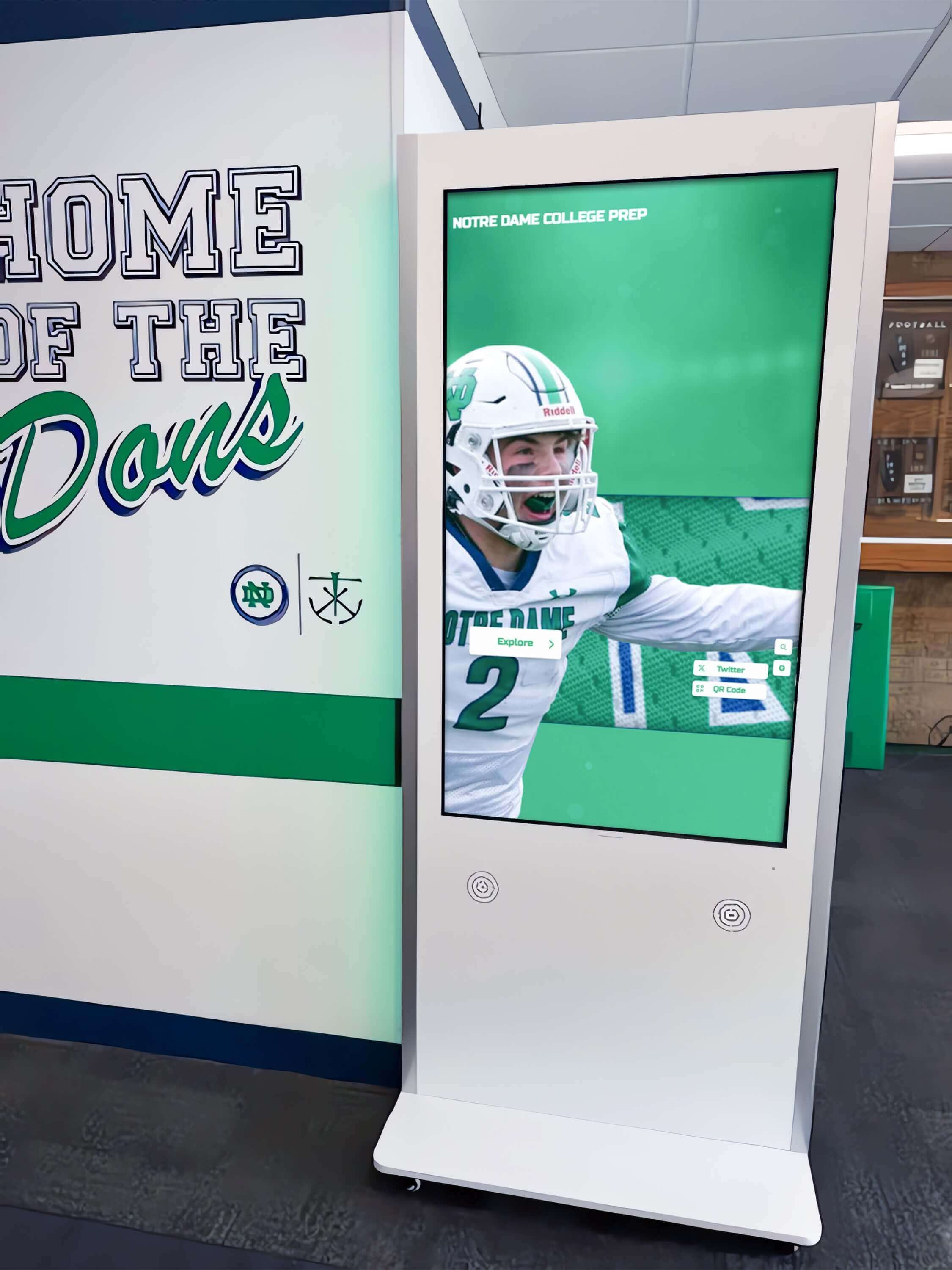
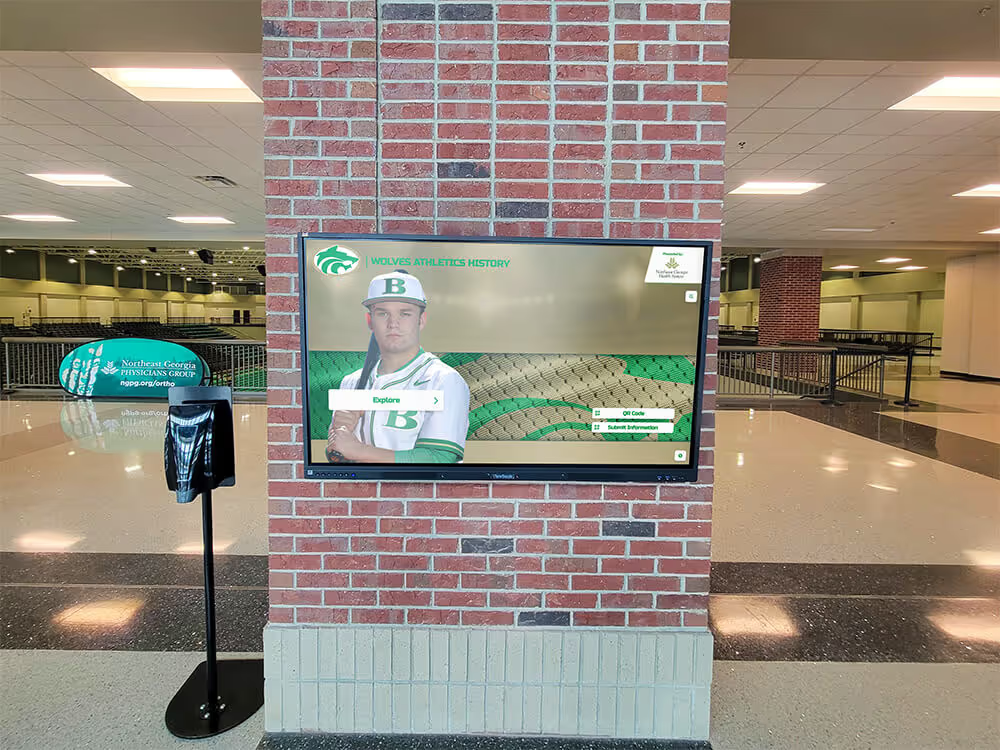
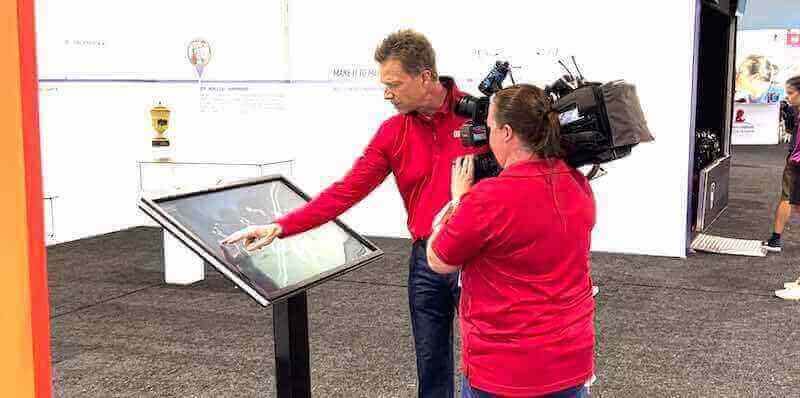
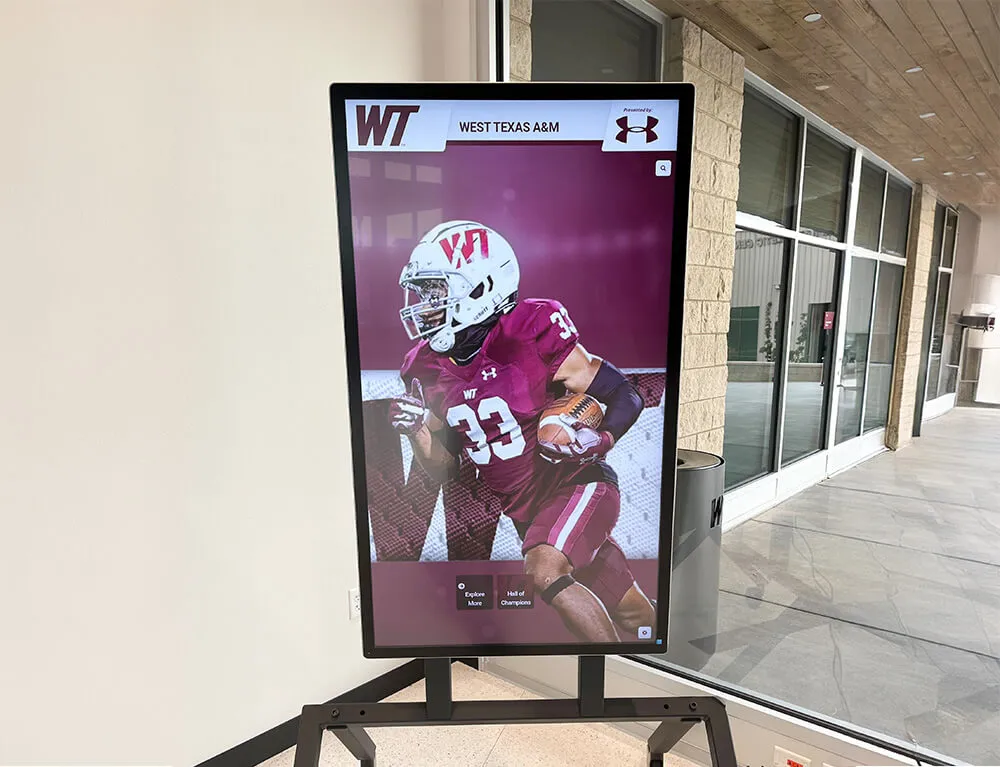
Free-standing kiosks provide flexible placement options enabling recognition throughout athletic and academic facilities without wall mounting requirements
Selecting Recognition Display Formats
Physical and digital options offer distinct advantages requiring careful evaluation.
Traditional Physical Recognition Approaches
Conventional formats provide tangible acknowledgment valued by inductees:
Individual Plaque Installations
Standard displays feature individual plaques with inductee photographs, career dates, achievement summaries, and organizational branding. Physical plaques offer ceremonial significance and permanent visibility families deeply value. However, space constraints eventually limit capacity as programs mature and inductee numbers grow across decades.
Budget considerations include initial plaque fabrication ($200-$500 per inductee), professional installation and mounting ($100-$300 per plaque), and periodic maintenance addressing damage or necessary corrections. Schools recognizing 3-5 inductees annually face ongoing costs of $1,000-$2,500 annually for physical recognition alone.
Composite Wall Displays
Rather than individual plaques, composite designs feature all inductees in unified presentations. These displays offer cohesive visual aesthetic, efficient space utilization, flexibility adding inductees within existing footprint through pre-planned expansion capacity, and prominent facility placement creating impressive recognition focal points.
Composite approaches work well for newer programs anticipating substantial future growth but uncertain about long-term inductee volumes requiring flexible accommodation.
Trophy Case Integration
Comprehensive programs complement hall of fame recognition with memorabilia displays featuring game-worn jerseys, championship trophies, historical photographs, equipment artifacts, and newspaper clippings documenting program evolution. Physical artifacts create emotional connections traditional plaques alone cannot provide.
Trophy case maintenance requires environmental control preventing deterioration, security measures protecting valuable items, periodic rotation maintaining fresh displays, and systematic cataloging documenting artifact provenance and significance for future reference.
Approaches to high school trophy case design demonstrate effective physical recognition strategies balancing aesthetic appeal with practical maintenance considerations.
Modern Digital Recognition Solutions
Interactive technology addresses traditional limitations while creating engaging experiences:
Overcoming Physical Space Constraints
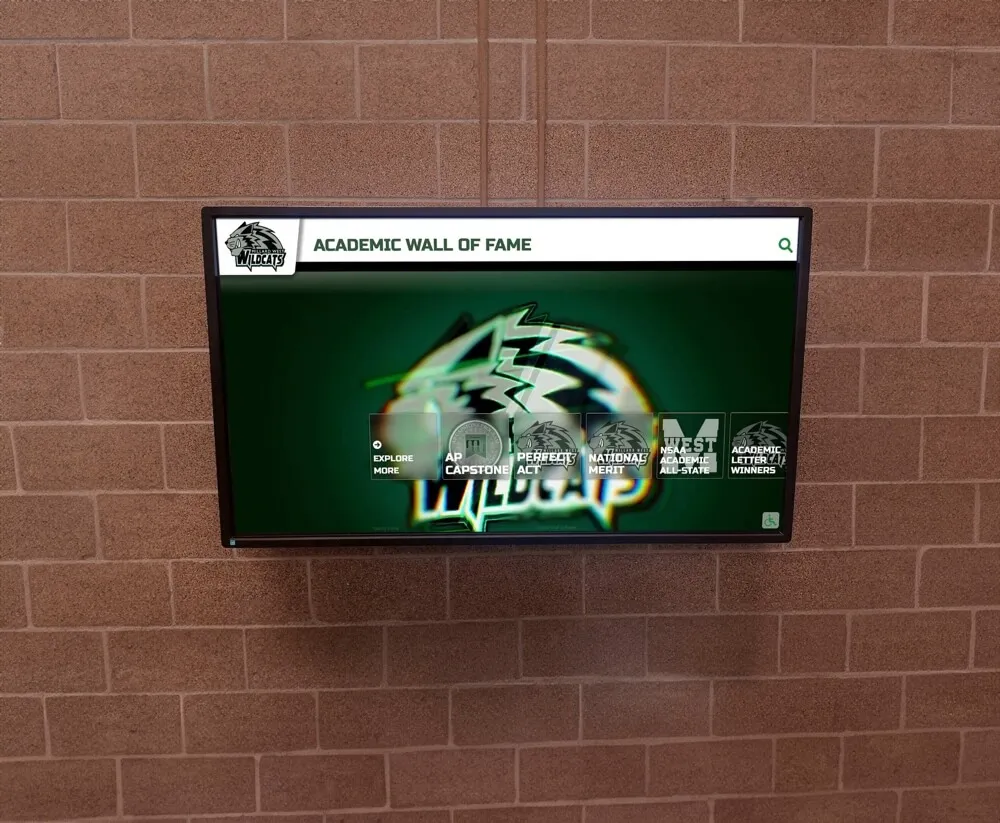
Digital platforms eliminate capacity limitations entirely. Single touchscreen displays accommodate unlimited inductees—hundreds or thousands of detailed profiles accessible through instant search and intuitive navigation. Schools never face removal decisions or expansion projects when recognition needs exceed available wall space.
This unlimited capacity proves particularly valuable for comprehensive programs recognizing athletes, coaches, and contributors across multiple sports spanning decades or centuries of institutional history.
Supporting Rich Multimedia Content
Interactive displays enable comprehensive inductee profiles including high-resolution photographs across career stages, complete career statistics with context and historical comparisons, video highlight compilations preserving signature performances, biographical narratives explaining backgrounds and achievement significance, post-playing career updates documenting continued success, and personal reflections through recorded interviews sharing perspectives and memories.
This multimedia depth transforms simple name acknowledgment into compelling storytelling creating emotional connections and appreciation for inductee contributions across multiple dimensions impossible with brief plaque text alone.
Enabling Immediate Content Updates
Cloud-based content management enables instant recognition updates without construction delays. When new inductees receive honor, administrators update digital displays within minutes through remote access—changes appearing immediately rather than requiring months-long physical modification processes.
Real-time capability ensures recognition remains perpetually current while eliminating ongoing costs associated with plaque fabrication, professional engraving, and installation coordination. Schools report 60-75% cost reduction managing digital recognition compared to traditional physical systems over 10-year program timelines.
Extending Recognition Through Web Access
Modern platforms provide responsive web portals accessible worldwide. Alumni living far from campus can explore hall of fame content remotely, families can share inductee profiles through social media, prospective athletes can research program tradition during recruitment, and media can access historical information for coverage—all extending recognition impact beyond those visiting physical facilities.
Solutions like Rocket Alumni Solutions provide purpose-built platforms specifically designed for athletic hall of fame recognition, combining commercial-grade hardware with intuitive content management and engaging interactive features administrators can maintain without specialized technical expertise.
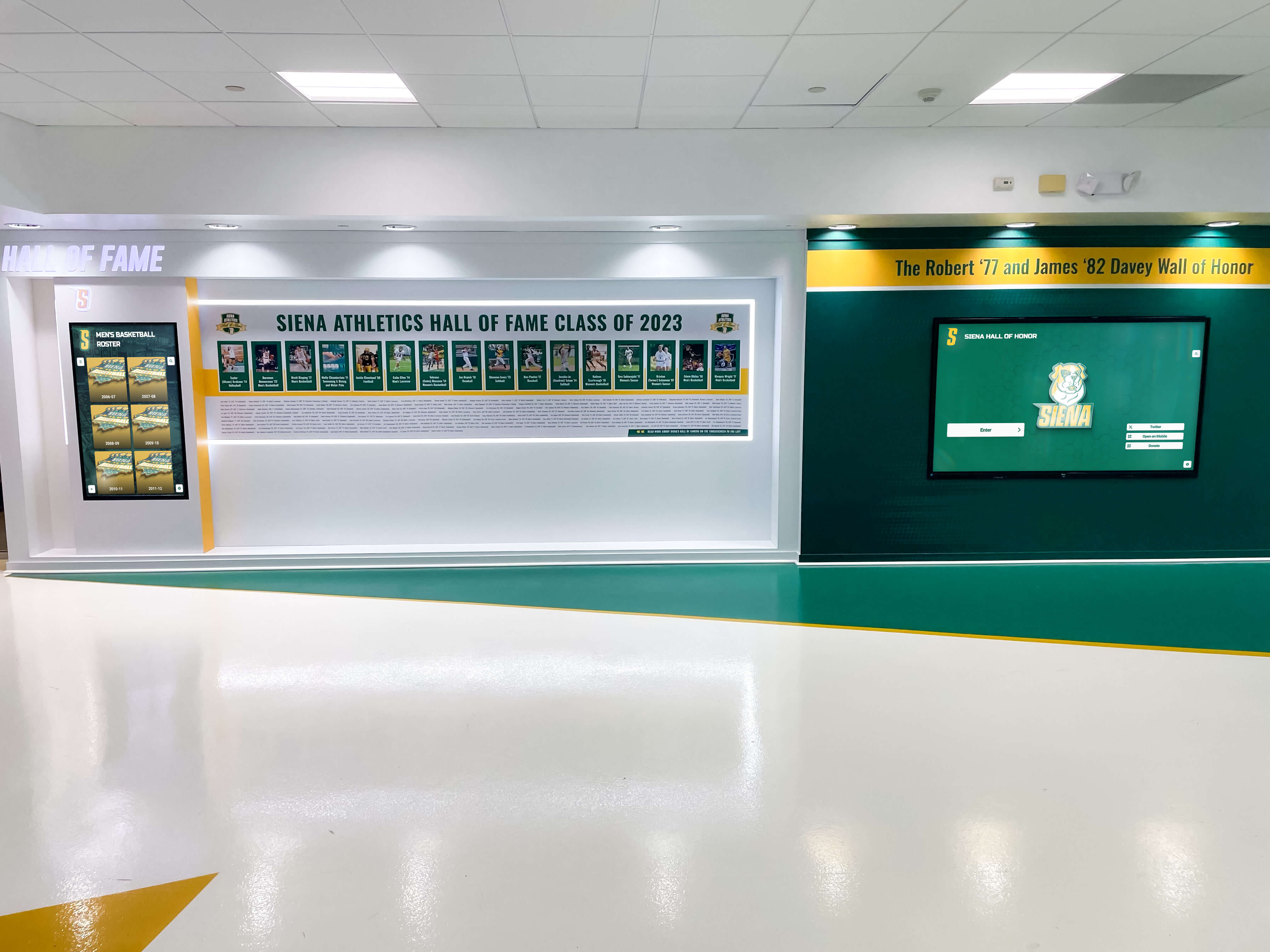
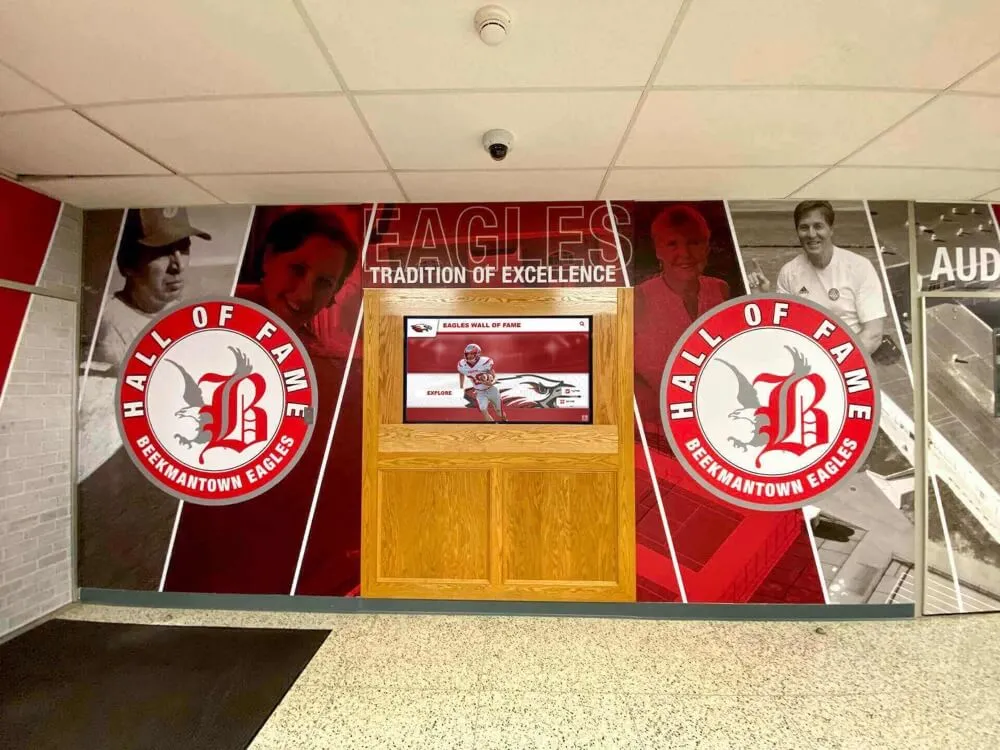
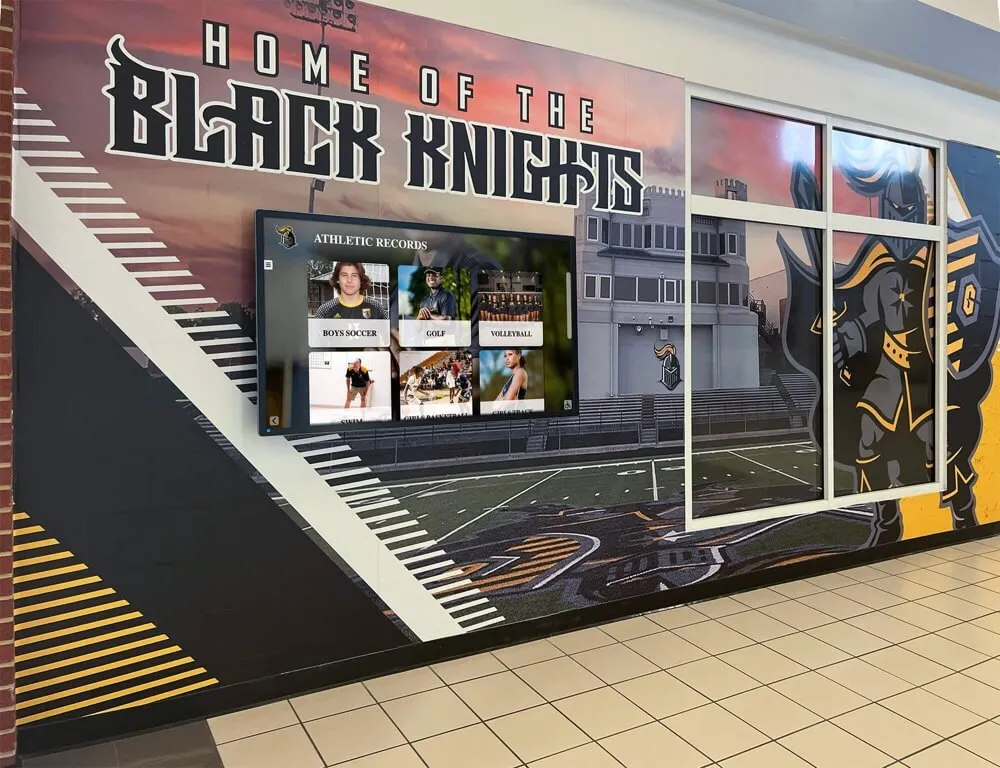
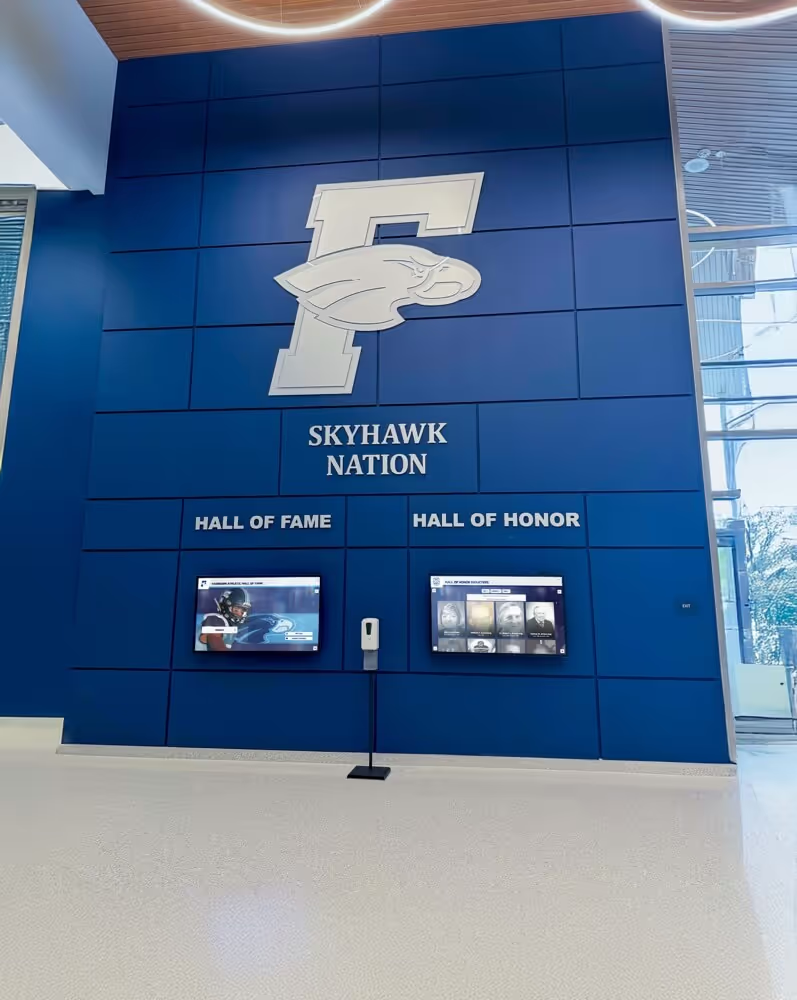
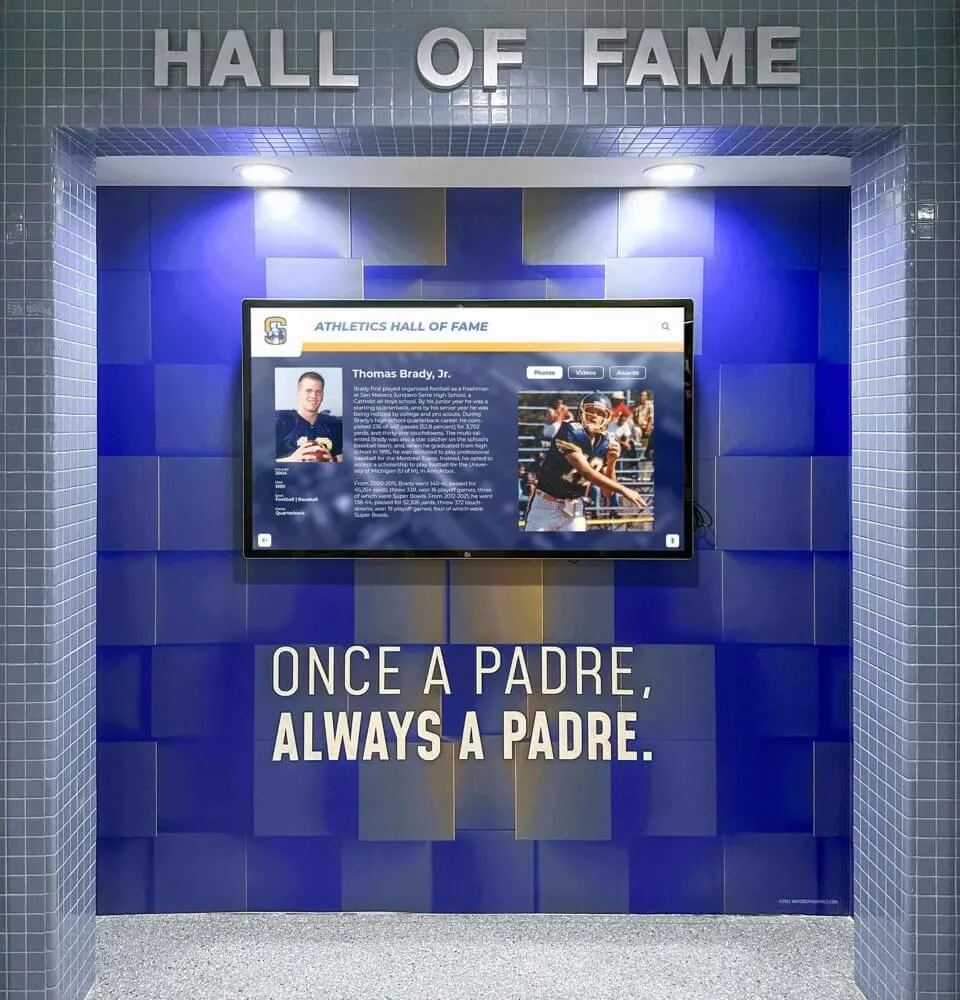
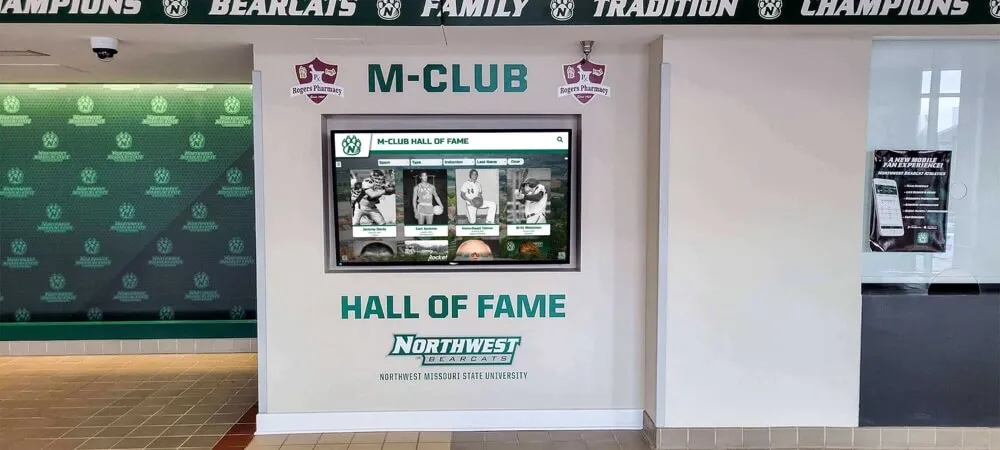
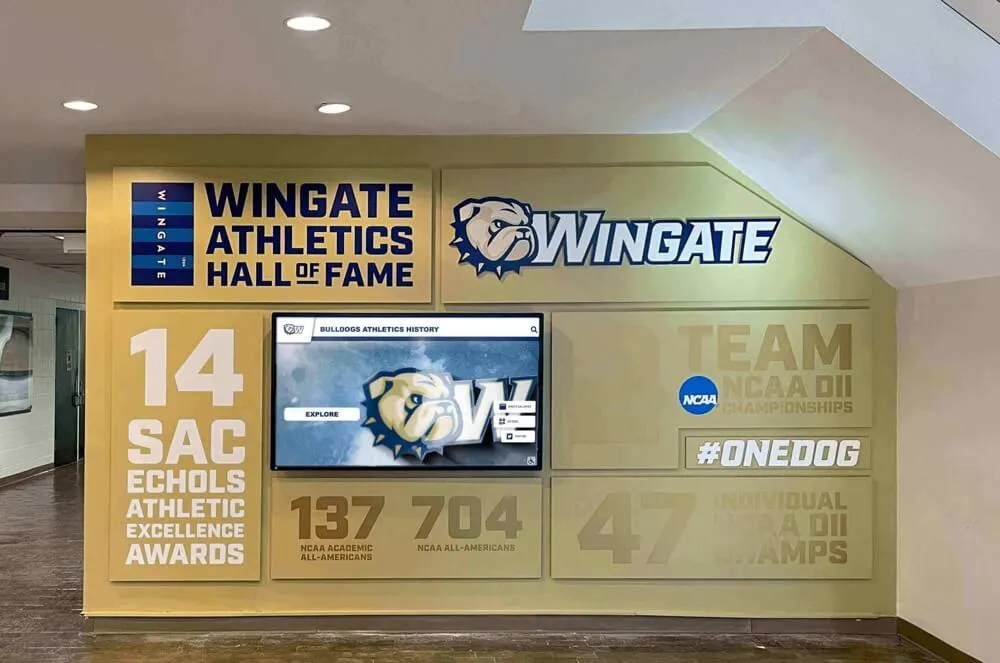
Large-format digital installations in prominent locations ensure hall of fame recognition receives appropriate visibility and prestige within athletic facilities
Managing Content Development and Historical Research
Comprehensive inductee profiles require systematic information gathering and narrative development.
Conducting Historical Research
Athletic achievement documentation varies dramatically across eras:
Accessing Institutional Archives
Schools with systematic athletic record-keeping provide relatively accessible documentation through official media guides and record books, yearbook archives containing photos and season summaries, newspaper clippings preserved in institutional collections, athletic program files documenting rosters and statistics, and digital archives when previously undertaken by institutional historians.
Administrators should begin with official sources before expanding to community resources requiring more extensive research and verification.
Engaging Alumni Networks
Alumni often possess unique information and materials unavailable through institutional channels. Effective engagement strategies include alumni association outreach requesting biographical information and photos, social media campaigns soliciting community memories and documentation, reunion event coordination gathering information during natural alumni gatherings, direct contact with inductees and families requesting personal materials, and volunteer recruitment identifying alumni passionate about heritage preservation willing to contribute research time.
Community engagement often uncovers forgotten achievements, rare photographs, and personal narratives substantially enriching recognition content beyond bare statistical documentation.
Verifying Information Accuracy
Historical records frequently contain errors, inconsistencies, or gaps requiring verification through multiple sources. Best practices include cross-referencing statistics across multiple documents, confirming dates and biographical details through official transcripts when available, fact-checking newspaper accounts against official records, interviewing multiple sources when relying on personal recollections, and documenting source materials enabling future verification if questions arise.
Accuracy standards protect program credibility while honoring inductees through recognition reflecting their actual achievements rather than perpetuating historical errors or exaggerations.
Comprehensive approaches to school history preservation provide detailed research methodologies applicable to athletic recognition programs requiring systematic historical documentation.
Developing Compelling Recognition Narratives
Effective profiles balance comprehensive information with accessible storytelling:
Biographical Structure
Standard profiles should include background context establishing inductee’s journey to athletic excellence, career highlights detailing specific accomplishments with supporting statistics, championship contributions describing roles in team success, individual honors documenting external recognition received, leadership impact beyond statistical achievement alone, memorable performances defining program tradition, post-playing career developments demonstrating continued success, and personal reflections adding authentic voice through quotes or recorded commentary.
Biographical templates ensure consistency across inductees while allowing customization for unique individual stories requiring different emphasis depending on contribution type and available documentation depth.
Writing for Multiple Audiences
Hall of fame content serves diverse constituencies—current students unfamiliar with program history, alumni remembering inductees personally, prospective athletes evaluating program tradition, families celebrating relatives’ recognition, and community members learning about institutional excellence. Effective writing provides sufficient context for complete newcomers while offering depth satisfying audiences with existing program knowledge.
Avoid jargon or assumed knowledge limiting accessibility for general audiences. Define terms, explain significance, and provide historical context enabling any reader to appreciate achievement scope and program importance regardless of prior athletic knowledge.
Multimedia Asset Development
Rich content requires diverse format creation:
- High-resolution photograph scanning from yearbooks and personal collections
- Professional photo restoration for historical images showing age damage
- Video digitization converting analog footage to modern formats accessible through digital platforms
- Highlight video editing creating compelling career compilations
- Interview recording preserving personal stories and reflections
- Document scanning capturing newspaper coverage and memorabilia
- Graphic design creating visual interest and professional polish
Quality multimedia development requires dedicated resources but dramatically enhances recognition impact compared to text-only approaches generating minimal visitor engagement or emotional connection.
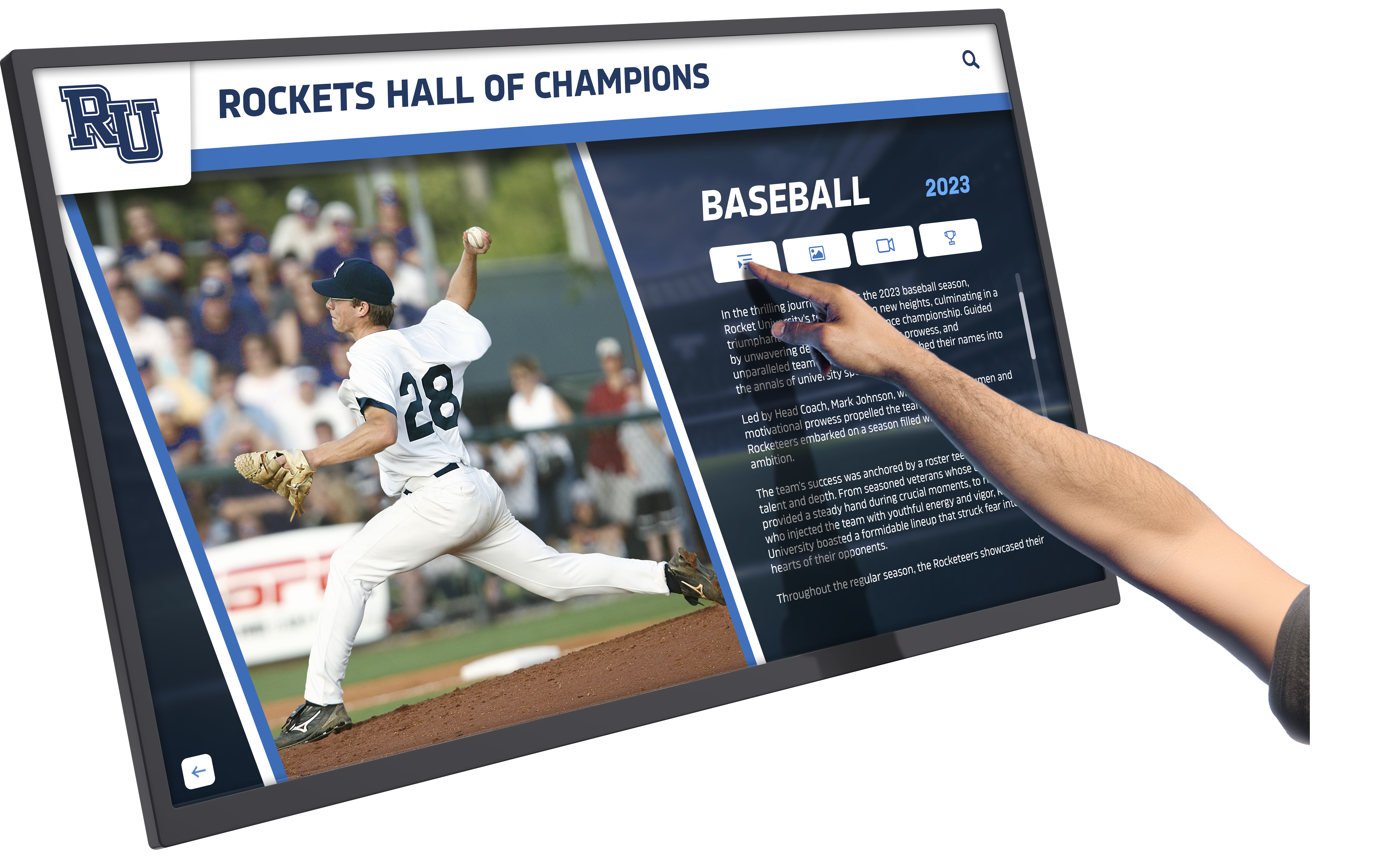
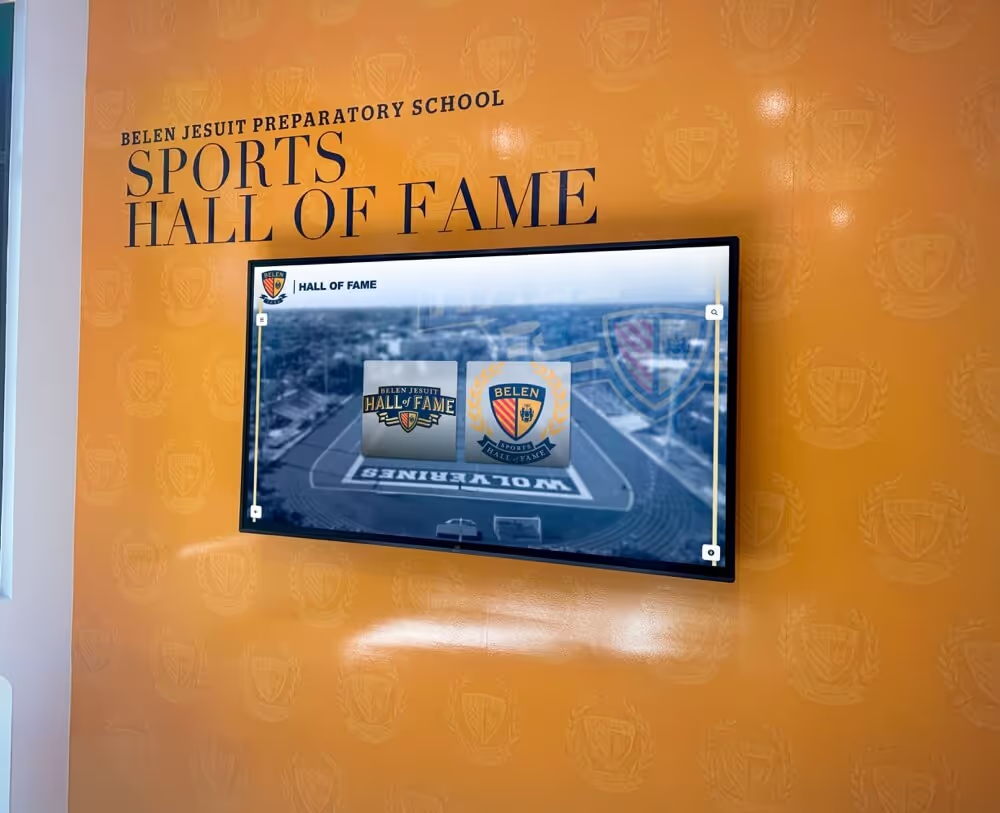
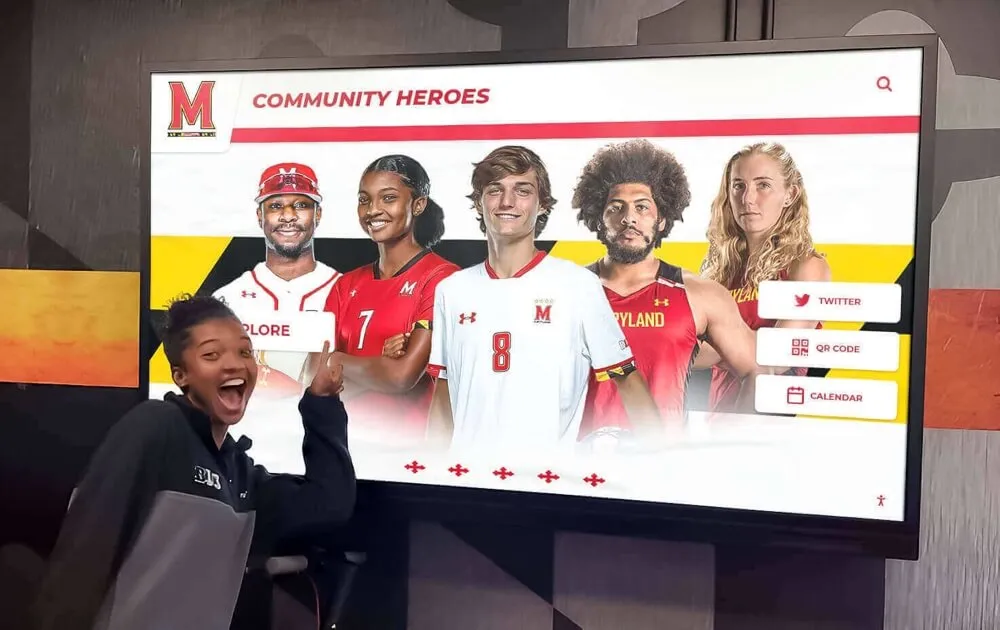
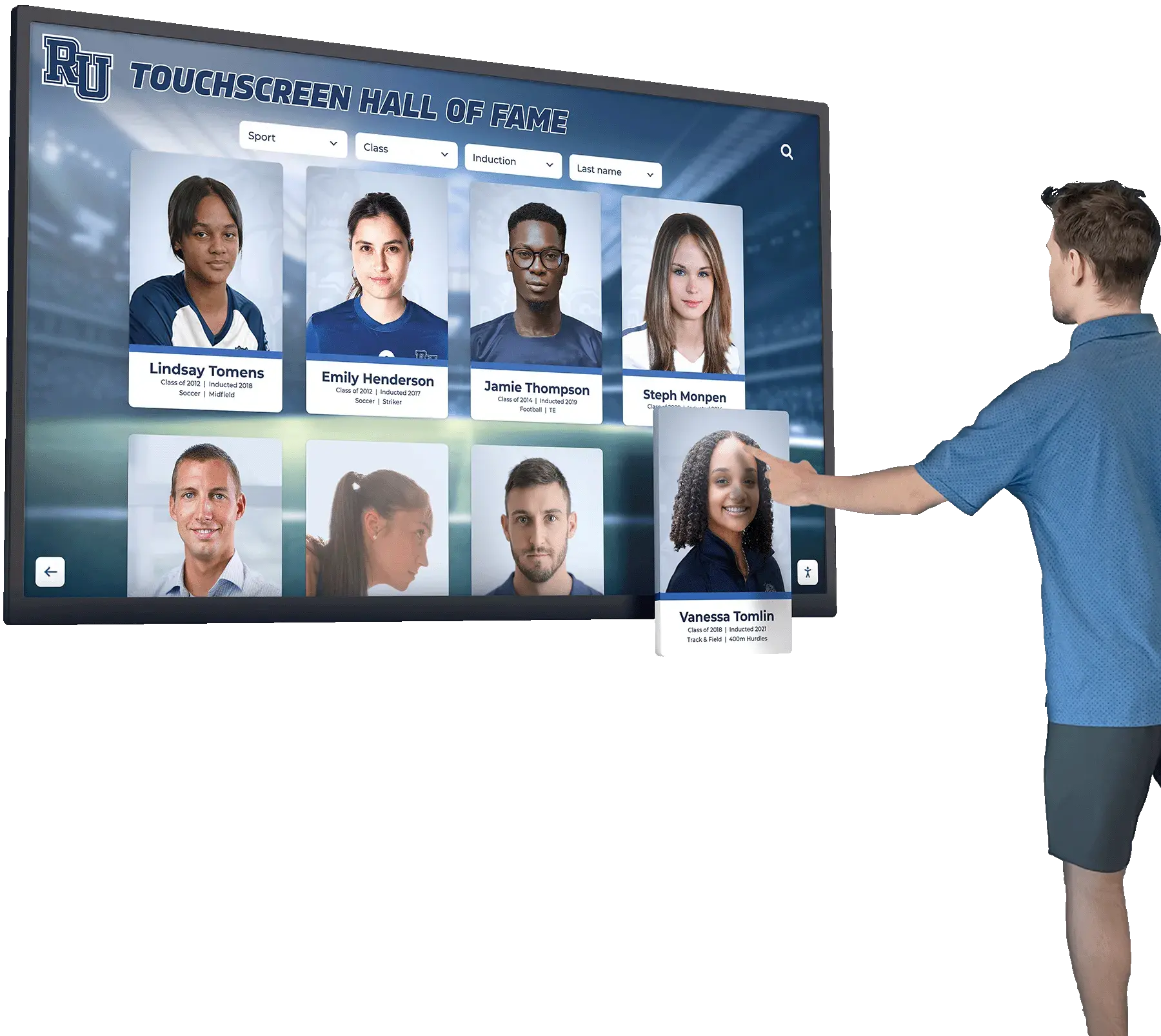
Intuitive card-based interfaces enable natural exploration with clear touch targets and immediate visual feedback creating engaging user experiences
Implementing Digital Hall of Fame Technology
Technology deployment requires systematic planning across hardware, software, and integration dimensions.
Evaluating Platform Requirements
Administrators should assess solutions against essential criteria:
Technical Specifications
Commercial-grade touchscreen displays rated for continuous operation in high-traffic facilities (not consumer TVs adapted for institutional use), screen sizes appropriate for viewing distances and content density (43-55 inches for close viewing, 65-75 inches for lobby installations), touch technology options (capacitive for responsive smartphone-like experience, infrared for larger sizes and durability), portrait or landscape orientation matching content type and facility architecture, and network connectivity options (hardwired Ethernet preferred over WiFi for reliability).
Hardware specifications significantly impact user experience quality and long-term operational reliability—areas where budget constraints tempting consumer-grade equipment purchases create ongoing problems requiring eventual replacement with appropriate commercial solutions.
Software Platform Features
Purpose-built recognition software specifically designed for celebrating achievement rather than generic digital signage adapted for recognition purposes, intuitive content management requiring minimal technical expertise enabling staff updates without IT dependency, athletic organization templates and layouts optimized for sports recognition, comprehensive multimedia support including photos, videos, and statistics, robust search and filtering enabling efficient content navigation as inductee totals grow, cloud-based architecture eliminating local server maintenance and enabling remote access, mobile and web extensions reaching audiences beyond physical locations, and proven implementation track record with educational institutions showing platform maturity and vendor viability.
Generic digital signage platforms adapted for recognition typically lack sport-specific functionality, intuitive content workflows, and specialized features purpose-built athletic recognition software provides natively without extensive customization investment.
Vendor Assessment
Evaluate providers across multiple dimensions: demonstrated experience with educational athletic recognition programs, quality of reference installations and client testimonials, technical support availability and documented response commitments, training resources and onboarding assistance, customization capabilities matching institutional branding requirements, pricing transparency including all ongoing costs, and total cost of ownership across typical 5-7 year hardware lifecycle.
Request live demonstrations with actual recognition content rather than generic presentations, speak directly with reference clients about implementation experiences and ongoing satisfaction, and verify accessibility compliance before committing to platforms requiring future modification addressing regulatory requirements.
Comprehensive digital recognition buyer guides provide detailed vendor evaluation frameworks ensuring successful platform selection aligned with institutional needs and constraints.
Planning Installation and Facility Integration
Display placement significantly impacts engagement and operational success:
Strategic Location Selection
Optimal installation locations include main gymnasium entrance lobbies where all visitors naturally pass, athletic department corridors and administrative areas ensuring daily visibility for athletes and staff, training facility entrances viewed by current athletes during regular practice attendance, cafeteria and common areas where students gather socially, school main entrance lobbies ensuring whole-community visibility beyond just athletic program participants, and alumni center locations dedicated to graduate engagement and fundraising cultivation.
Consider both traffic volume and audience composition—locations with modest total visitors but high alumni and athlete concentration often outperform higher-traffic areas where few viewers have athletic program connections justifying extended engagement with recognition content.
Physical Installation Requirements
Professional implementation ensures reliable operation through secure mounting at appropriate viewing heights (48-60 inches to screen center for standing adults), dedicated electrical circuits with surge protection preventing damage from power fluctuations, hardwired network connectivity preferred over WiFi for reliability and security, professional cable management maintaining clean aesthetic without exposed wiring, screen protection and anti-glare treatments optimizing visibility in various lighting conditions, and comprehensive testing verifying all functionality before launch and staff training.
Work with experienced installers familiar with commercial-grade display systems and educational facility environments—ensuring installations withstand demanding conditions while maintaining professional appearance and reliable operation across years without constant technical intervention.
Accessibility Compliance
ADA requirements extend to interactive recognition displays. Ensure mounting height places primary controls within reach range (15-48 inches above floor for wheelchair access), forward reach depth does not exceed 25 inches for compliance, sufficient knee and toe clearance for wheelchair approach when using free-standing kiosks, touch target size minimums (44x44 pixels) with adequate spacing, text contrast ratios meeting WCAG 2.1 AA standards (minimum 4.5:1 for normal text), and volume controls for audio content respecting quiet environments while supporting visitors with visual impairments.
Accessibility verification through diverse user testing including wheelchair users, older adults, and people with visual impairments prevents future remediation requirements while ensuring recognition programs genuinely serve all constituencies equitably.
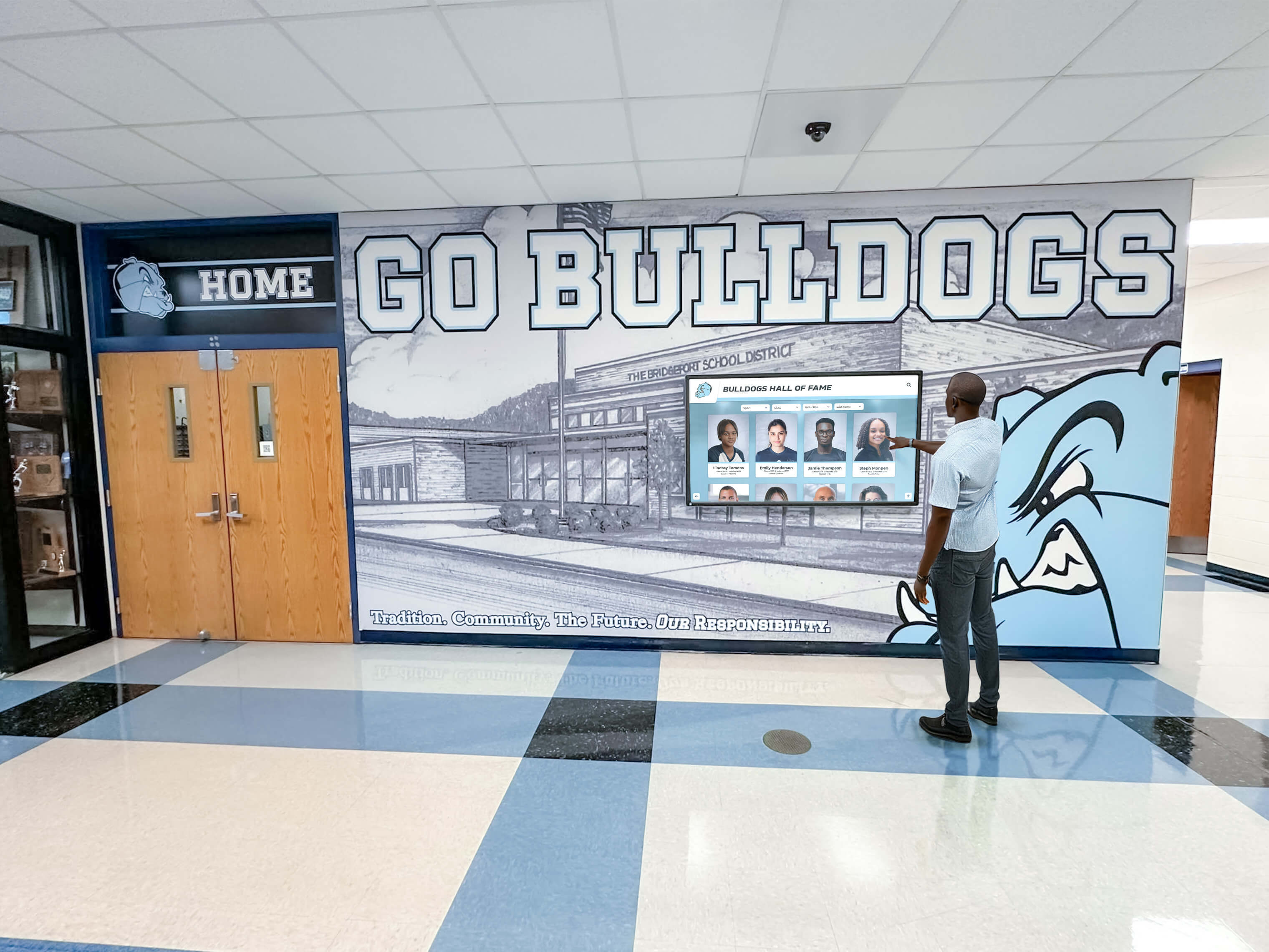
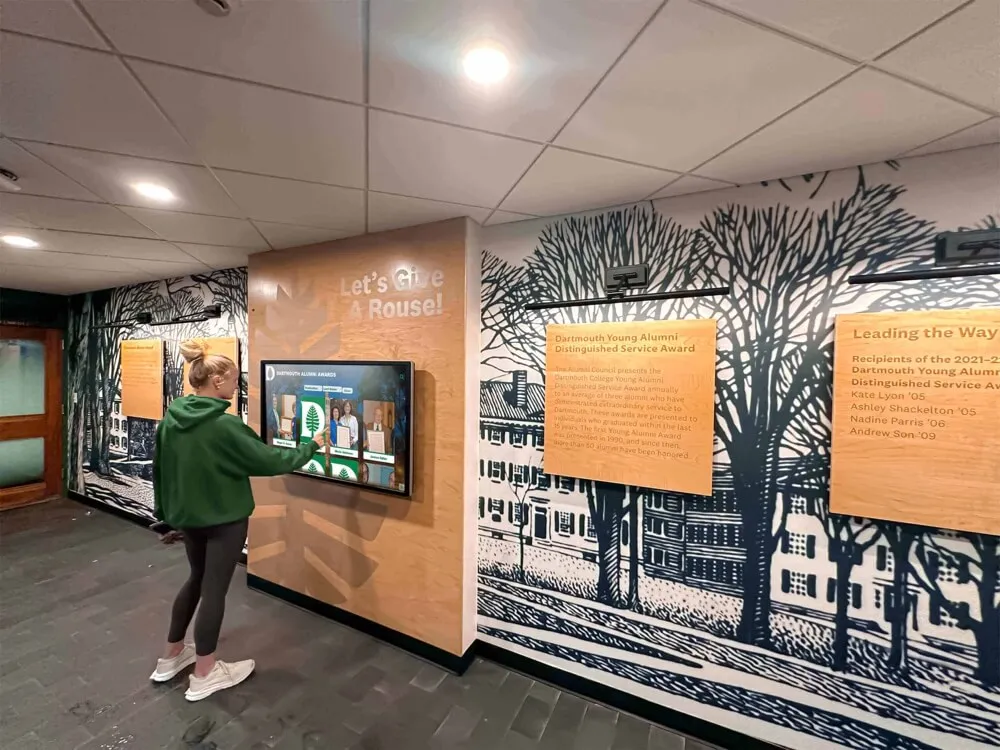
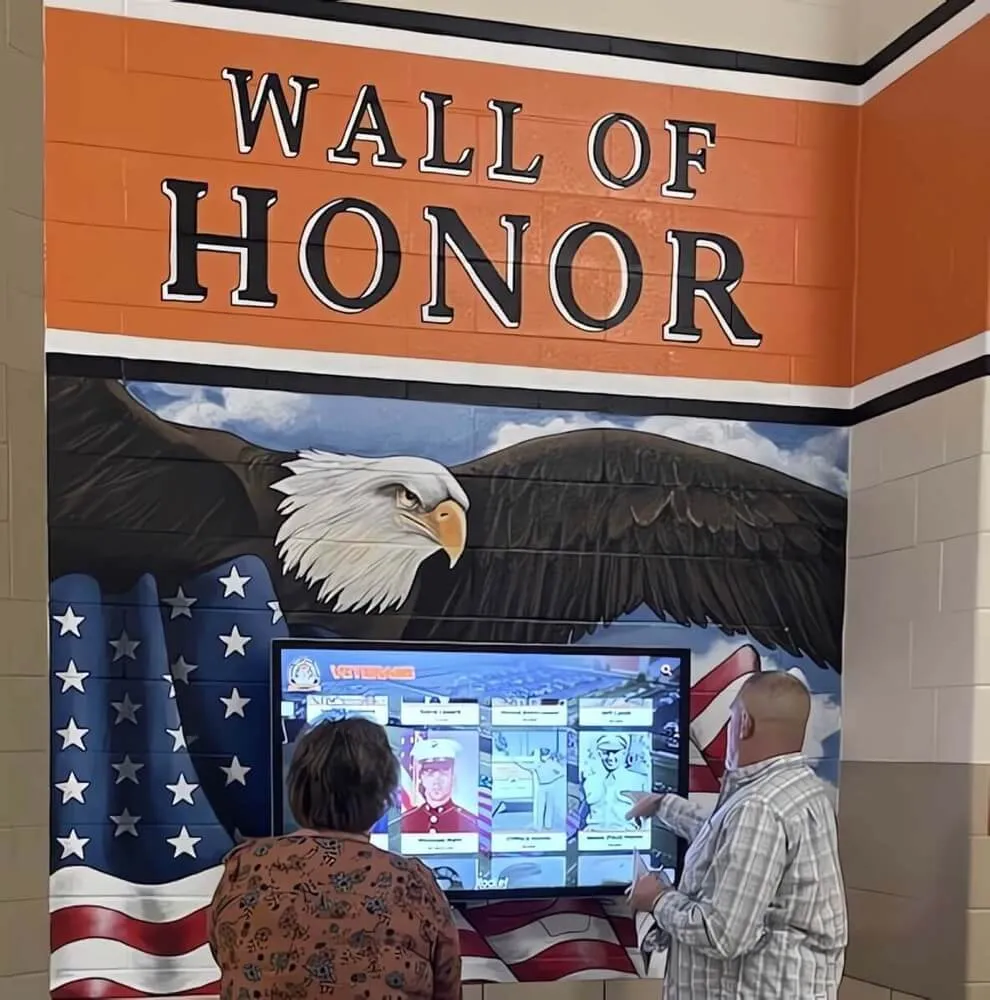
Natural interaction with recognition content demonstrates successful implementation creating genuine visitor engagement rather than passive viewing
Managing Ceremonies and Community Engagement
Public recognition events celebrate inductees while reinforcing program prestige.
Planning Induction Ceremonies
Annual ceremonies create traditions communities anticipate:
Event Format Considerations
Schools typically choose between formal banquet dinners providing elevated ceremonial atmosphere with meal service, ticketed admission, and structured program timing, or game-day recognition ceremonies during athletic competitions enabling broader community attendance, natural athletic context, and current athlete exposure to tradition.
Banquet formats enable extended programming with video tributes, multiple speakers, and table fellowship but limit attendance through cost barriers and venue capacity. Game-day recognition provides mass community visibility but constrains programming within halftime or pre-game time windows requiring concise presentations.
Many programs combine approaches—formal banquet dinners for inductees, families, and program stakeholders followed by public game-day recognition ensuring broader community awareness and current athlete inspiration through visible connection between past excellence and contemporary competition.
Program Components
Effective ceremonies balance achievement celebration with community engagement: opening remarks contextualizing hall of fame program mission and significance, inductee introduction speeches highlighting careers and contributions, video tributes documenting achievements through multimedia presentations, acceptance speeches enabling inductees to share reflections and gratitude, recognition gift presentations (plaques, rings, certificates, or commemorative items), photo opportunities creating memories and media coverage content, and community reception enabling networking and informal celebration.
Ceremony duration should respect audience attention spans—typically 90-120 minutes for banquet programs, 15-20 minutes for halftime recognition. Longer programming risks losing audience engagement while failing to appropriately honor inductees whose recognition becomes rushed or truncated.
Family Involvement
Inductee families should receive special consideration: reserved seating in prominent locations, advanced program information enabling attendance planning, complimentary or discounted tickets acknowledging family financial constraints, photo opportunities with inductees and institutional leadership, and recognition in program materials acknowledging family support enabling athletic achievement.
Family inclusion shows institutional appreciation for support systems enabling athletic excellence while creating memorable shared experiences strengthening ongoing institutional connections and potential future philanthropic engagement.
Resources on athletic recognition event planning provide comprehensive ceremony development frameworks ensuring successful community celebration of achievement.
Building Ongoing Program Awareness
Recognition impact depends on community understanding and engagement:
Communications Strategies
Systematic promotion ensures program visibility: induction announcement press releases to local media, social media campaigns highlighting new inductees with photos and career highlights, school newsletter and website features profiling honorees, facility tours during prospective student visits emphasizing tradition and excellence, alumni magazine coverage connecting graduates to program developments, and annual reports documenting hall of fame program growth and community impact.
Consistent communication prevents hall of fame programs from becoming invisible infrastructure only noticed during induction years—maintaining year-round awareness generating ongoing community pride and institutional reputation enhancement.
Alumni Engagement Integration
Hall of fame programs provide natural alumni engagement vehicles: reunion event programming incorporating facility tours and recognition updates, fundraising appeals connecting philanthropic support to recognition program sustainability, volunteer recruitment identifying alumni passionate about heritage preservation, networking opportunities connecting inductees with current program needs, and mentorship programs leveraging honored alumni as role models and advisors for current athletes.
Alumni engagement transforms recognition from simple historical acknowledgment into active community asset generating tangible value through sustained graduate connection supporting institutional mission and priorities.
Current Athlete Inspiration
Recognition visibility should surround developing athletes: team meeting discussions of hall of fame inductees and achievement standards, facility tours for new athletes emphasizing tradition and expectations, goal-setting sessions referencing specific benchmarks recognized through hall of fame inclusion, inductee guest appearances sharing experiences and advice, and social media content connecting current competitions to historical context and program tradition.
Maximum motivational impact occurs when athletes view hall of fame recognition as achievable aspiration rather than distant impossible honor—requiring visible examples at various achievement levels demonstrating multiple pathways to recognition beyond only generational superstars.
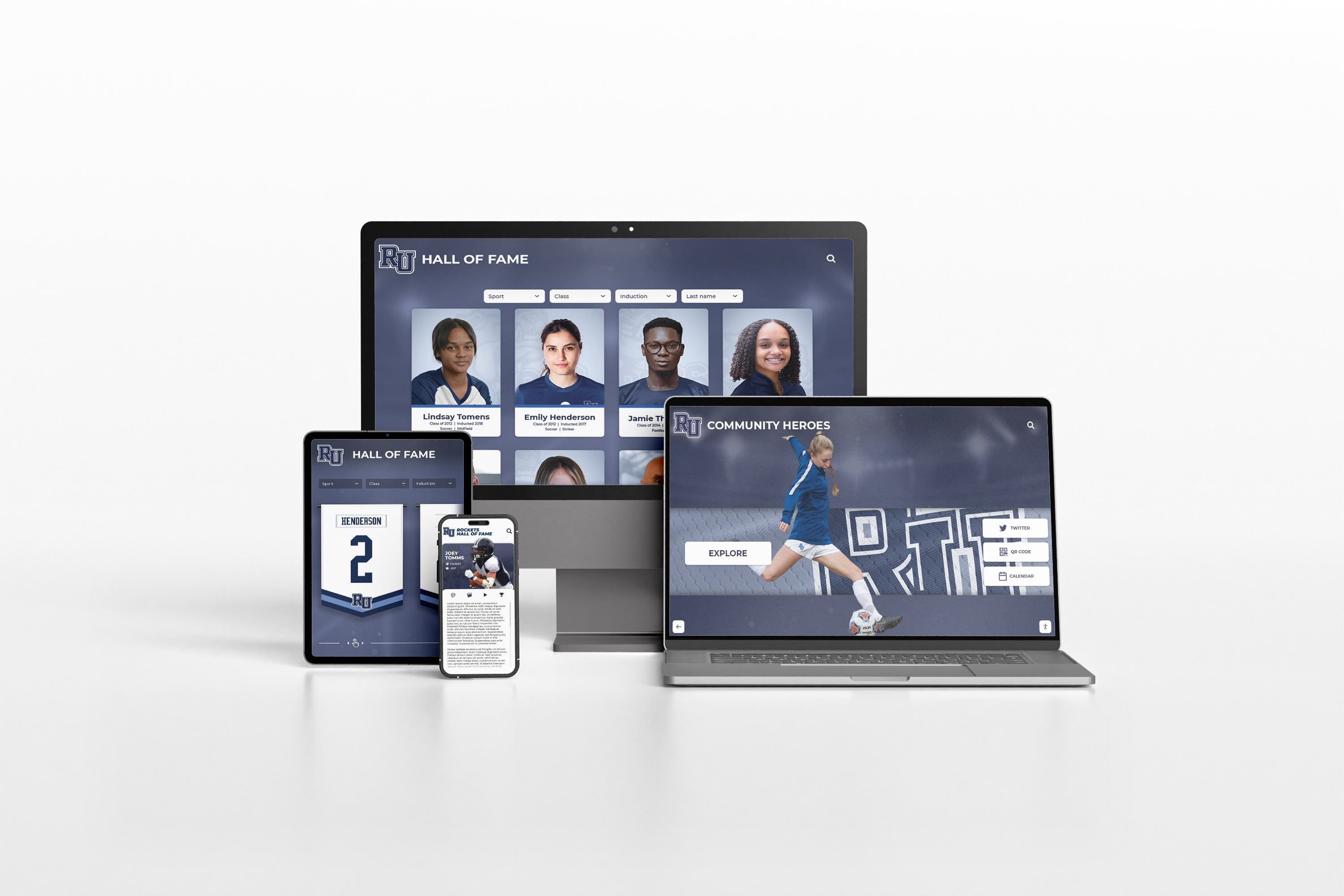
Responsive web access extends recognition beyond physical locations enabling alumni, recruits, and families to explore hall of fame content from anywhere
Ensuring Long-Term Program Sustainability
Successful recognition requires sustained commitment beyond initial launch:
Establishing Operational Workflows
Systematic procedures ensure consistent program management:
Annual Induction Cycle
Standardized timelines create predictability: nomination period opening and candidate submission deadlines, selection committee meetings and deliberation scheduling, induction announcement timing coordinating with ceremony planning, content development windows ensuring profile completion before ceremony dates, ceremony execution and public recognition events, and display updates implementing new inductee recognition immediately following induction.
Documented procedures with assigned responsibilities prevent confusion, missed deadlines, and inconsistent execution across different staff members or committee leadership changes. Calendar templates ensure annual cycles repeat reliably without requiring complete planning from scratch each year.
Content Maintenance Responsibilities
Ongoing updates maintain current, accurate recognition: adding new inductees immediately following induction ceremonies, enhancing existing profiles as new information becomes available, updating biographical details reflecting post-playing career developments, correcting errors or outdated information identified through review, refreshing design elements maintaining contemporary appearance, and archiving source materials supporting future updates and historical verification.
Assign clear ownership for different maintenance categories—preventing ambiguous responsibility where no one maintains content because everyone assumes someone else handles updates.
Budget Planning
Recognition programs require sustained financial commitment: hardware replacement planning across typical 5-7 year display lifecycle, software licensing and support costs for cloud-based platforms, content development resources for annual inductee profile creation, ceremony expenses including venue, food service, awards, and program materials, marketing and communications budget supporting community awareness, and reserve funding addressing unexpected repair or replacement needs.
Multi-year budget projections demonstrate total cost of ownership informing administrative decision-making and preventing programs from launching with unsustainable financial models requiring future cutbacks or elimination damaging institutional credibility.
Planning Technology Refresh Cycles
Hardware and software evolve requiring periodic updates:
Display Lifecycle Management
Commercial touchscreen displays typically operate reliably for 5-7 years with 50,000+ hour ratings at continuous operation. Administrators should establish replacement schedules preventing catastrophic failures disrupting recognition visibility while displays remain functional but approach end-of-life thresholds.
Budget reserve accounts funded annually enable replacement purchasing without emergency capital requests when aging displays fail. Phased replacement approaches prevent simultaneous multi-display failures by staggering purchase timing across installation networks.
Software Platform Evolution
Cloud-based software platforms receive ongoing feature updates and security patches requiring no local administration. However, administrators should maintain vendor relationships ensuring advance notification of major updates, participation in user advisory groups influencing product direction, and understanding vendor technology roadmaps informing long-term planning decisions.
Evaluate competing platforms every 3-5 years ensuring selected solutions remain market-competitive as recognition technology evolves. Vendor lock-in through proprietary content formats creates future migration challenges—preferring platforms supporting standard export formats enabling eventual vendor changes without losing accumulated content investment.
Content Format Updates
Recognition content formats evolve with technology—static photos giving way to photo galleries, simple text expanding to video profiles, and basic biographical information enriching through interactive timeline presentations and social media integrations. Periodic content enhancement maintains contemporary appearance rather than allowing displays to appear dated despite ongoing technical operation.
Budget modest annual content enhancement funding enabling systematic profile improvement rather than treating recognition as one-time project frozen at launch while visual presentation standards evolve across broader digital media environments.
Frameworks for maintaining digital recognition systems provide detailed operational guidelines ensuring long-term program sustainability beyond initial implementation enthusiasm.
Addressing Common Administrative Challenges
Anticipate typical obstacles enabling proactive solutions:
Managing Limited Budgets
Recognition programs compete with numerous institutional priorities:
Phased Implementation Approaches
Launch with minimal viable recognition demonstrating value before requesting expansion funding. Begin with single display in highest-visibility location, focus initial content on recent decades with simpler research requirements, utilize basic recognition features before adding advanced capabilities, and demonstrate engagement metrics justifying expansion investment.
Phased approaches prove program value while distributing costs across multiple budget cycles rather than requiring large single-year capital commitments.
Alternative Funding Sources
Consider funding beyond general operating budgets: athletic booster club fundraising appeals, alumni campaigns targeting graduated athletes and families, memorial giving opportunities honoring deceased program legends, corporate sponsorships from local businesses receiving recognition visibility, capital campaign integration within broader facility improvement projects, and grant opportunities through foundations supporting educational technology or alumni engagement.
Alternative funding relieves pressure on operating budgets while building stakeholder investment in recognition program success through direct financial participation.
Balancing Recognition Equity
Avoid political complications through systematic fairness:
Sport-Specific Standards
Different sports require different achievement thresholds reflecting competitive context. Basketball scoring totals differ from soccer goals; football statistics don’t compare to swimming times. Establish sport-specific criteria calibrated to each program’s competitive context and statistical norms rather than attempting universal standards inadequately capturing diverse athletic dimensions.
Sport-specific standards prevent unintentional bias toward major revenue sports with extensive statistical documentation while inadvertently excluding athletes from smaller programs with limited historical records despite comparable achievement levels within their competitive contexts.
Gender Representation
Monitor induction demographics ensuring equitable recognition across male and female athletes. Historical imbalances reflecting pre-Title IX eras require intentional correction preventing perpetuation of past inequities. Consider temporary criteria adjustments or supplemental recognition categories accelerating female athlete recognition until gender balance reflects contemporary program participation rather than historical contexts where female opportunities were limited.
Document equity analyses showing systematic consideration protecting programs from potential discrimination claims while ensuring recognition genuinely honors excellence across all constituencies equally.
Community Sensitivity
Selection controversies occasionally emerge when candidates with community support fail to meet criteria or when inductees face later controversies raising character concerns. Transparent criteria and documented deliberations demonstrate systematic rather than arbitrary decisions. Character provisions addressing post-playing conduct enable removal or induction postponement when warranted by serious issues.
Advanced stakeholder communication explaining selection rationale prevents surprise and manages community expectations regarding recognition standards and committee independence from political pressure attempting to influence selections.
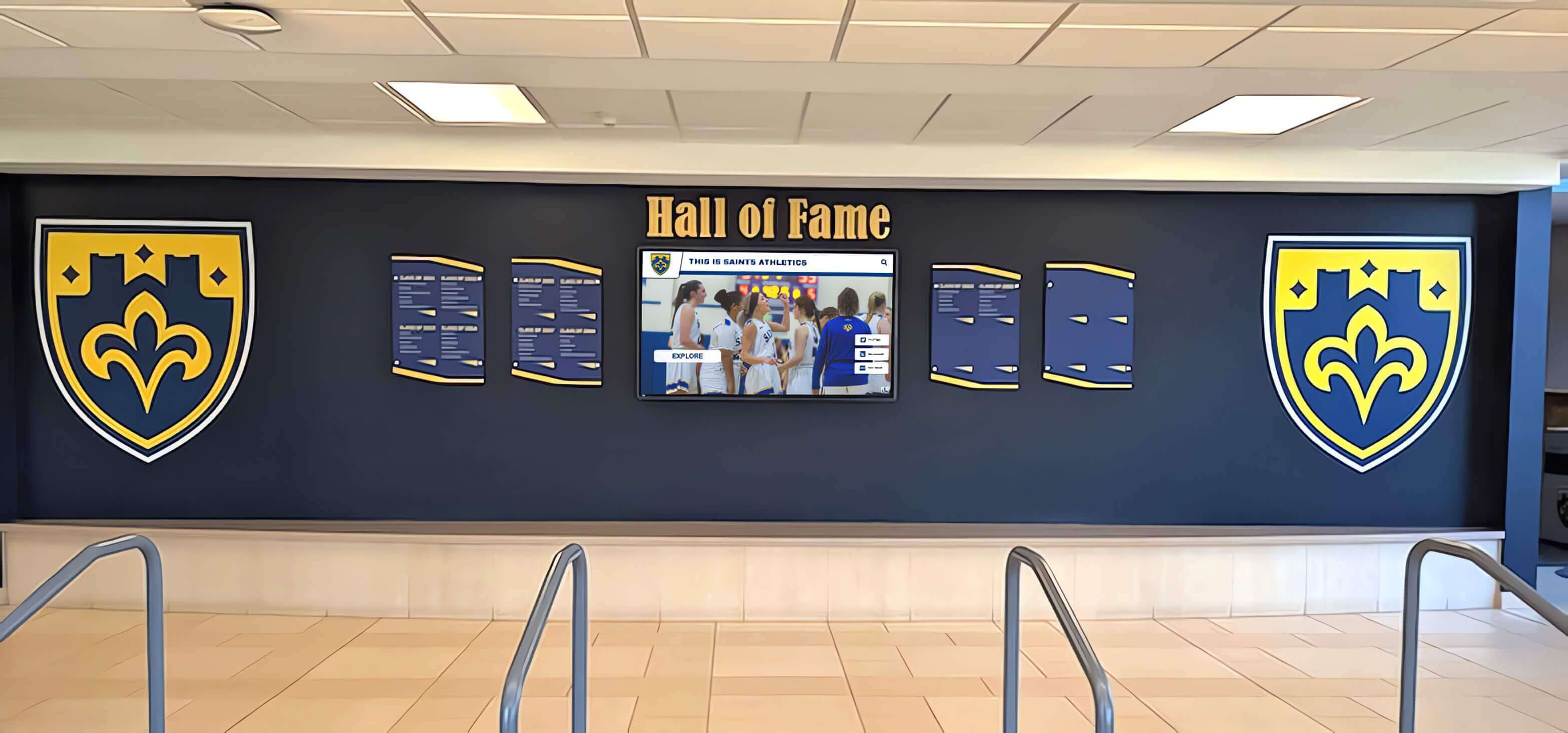
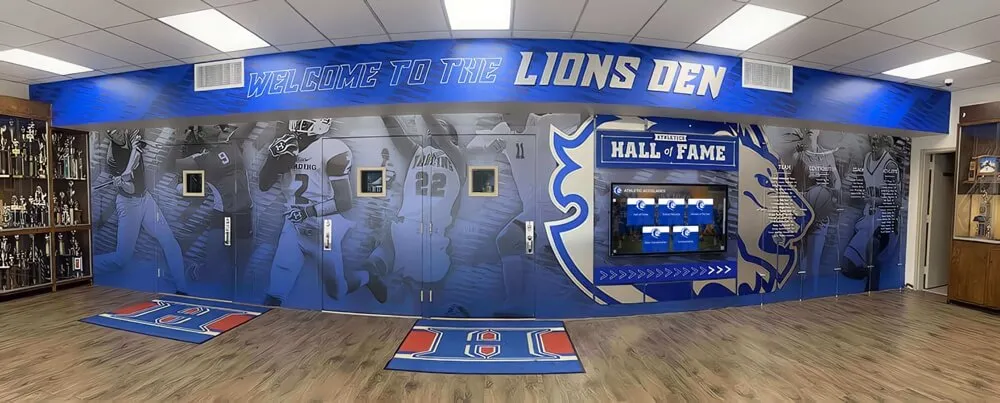
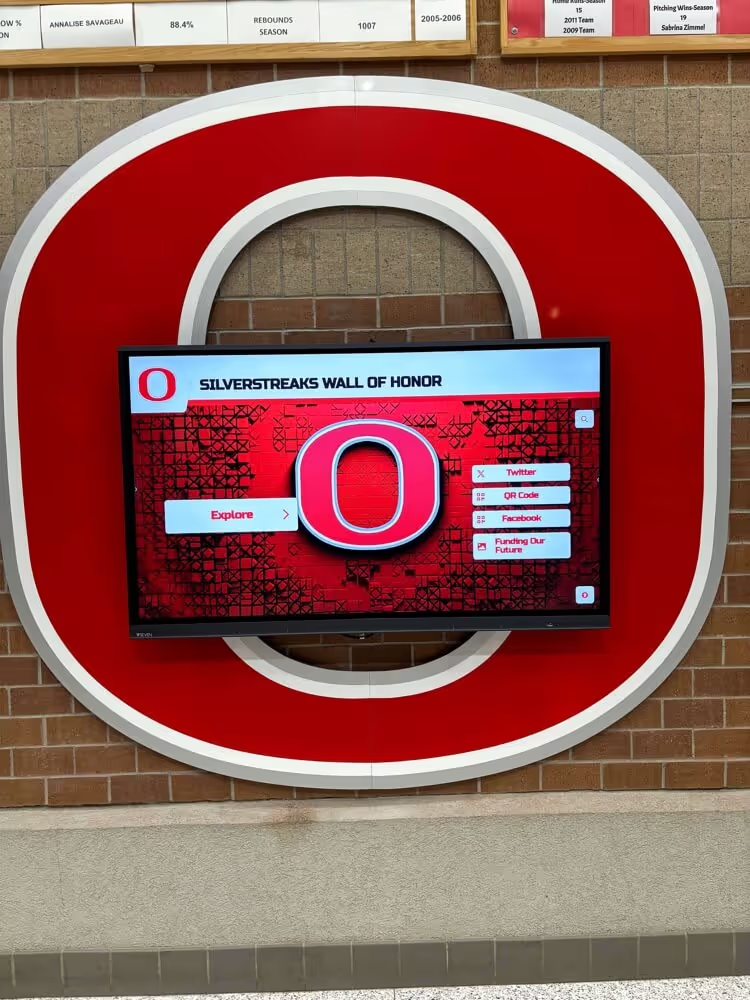
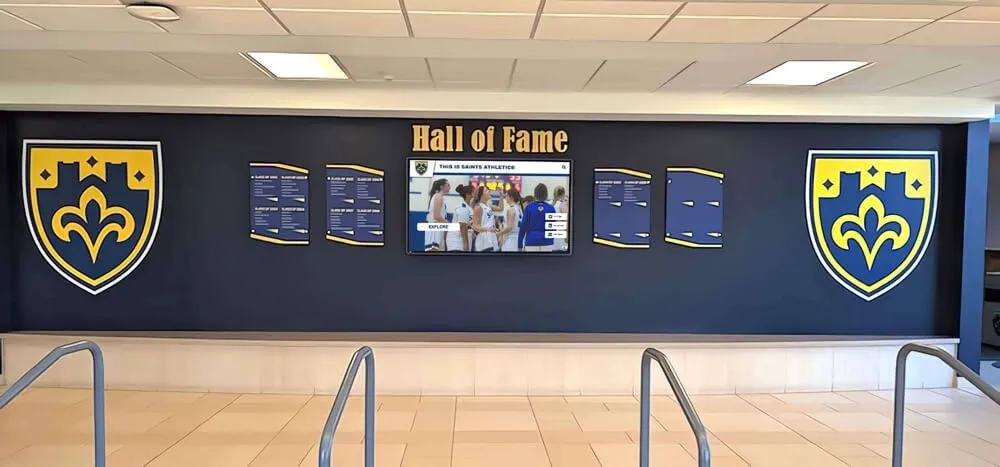
Hybrid installations preserve traditional design elements while adding modern interactive capacity satisfying constituencies valuing both heritage and innovation
Measuring Recognition Program Impact
Data-driven assessment demonstrates value while identifying improvement opportunities:
Tracking Engagement Metrics
Digital platforms provide objective usage measurement:
Visitor Interaction Data
Analytics reveal recognition system utilization: total sessions and unique visitors establishing baseline engagement, average session duration indicating content interest depth (targeting 6-12 minutes for athletic recognition), interactions per session showing exploration breadth across inductee profiles, peak usage times correlating with events and facility traffic, and repeat visitor rates demonstrating sustained interest.
Low engagement metrics indicate placement problems, interface usability issues, or content gaps requiring attention. High engagement shows value justifying continued investment and potential expansion.
Content Performance Analysis
Identify which content resonates most powerfully: most-viewed inductee profiles revealing community interests, popular search terms showing what visitors seek, navigation patterns indicating content discovery pathways, video completion rates determining multimedia effectiveness, and feature utilization showing which capabilities users value most.
Performance data guides enhancement priorities—identifying inductees deserving enriched profiles, popular content types warranting expansion, and underutilized features requiring redesign or better promotion.
Assessing Community Impact
Beyond usage metrics, evaluate broader outcomes:
Alumni Engagement Indicators
Measure recognition influence on graduate connection: alumni attendance at induction ceremonies and athletic events, social media engagement with hall of fame content, alumni giving participation and donation levels, volunteer involvement in program activities, and inductee participation in mentorship and program support.
Recognition programs strengthening alumni engagement generate value extending beyond simple acknowledgment—creating active community assets supporting recruitment, fundraising, and institutional reputation.
Recruiting and Reputation Benefits
Athletic recognition influences prospective athlete decisions: recruit awareness of program tradition during campus visits, commitment decisions citing recognition programs and competitive heritage, facility tour feedback from visiting families and coaches, and comparative perception versus peer institutions and competitors.
Strong recognition programs signal institutional commitment to honoring achievement—differentiating programs from competitors lacking similar infrastructure and demonstrating sustained excellence across generations rather than recent isolated success.
Current Athlete Motivation
Assess recognition influence on developing athletes: athlete awareness of hall of fame standards and achievement benchmarks, goal-setting incorporating recognition-worthy targets, performance trends in recognized achievement categories, athlete testimonials about motivation sources, and program culture reflecting recognition values.
Successful programs report athletes actively pursuing hall of fame-worthy careers because visible recognition makes aspirational goals tangible and achievable rather than abstract distant possibilities.
Comprehensive assessment approaches demonstrate recognition value to skeptical stakeholders while identifying continuous improvement opportunities ensuring programs deliver maximum institutional benefit relative to ongoing investment requirements.
Conclusion: Building Athletic Recognition Infrastructure That Endures
Athletic hall of fame programs represent permanent institutional infrastructure—not temporary initiatives but foundational systems preserving heritage, honoring achievement, and inspiring excellence across generations. Successful programs require systematic administrative planning addressing selection criteria, governance structures, display formats, content development, community engagement, and long-term sustainability beyond initial launch enthusiasm.
The administrative frameworks explored throughout this guide provide roadmaps for school leaders creating recognition programs that serve multiple constituencies: inductees receiving honor matching their contributions’ significance, current athletes gaining inspiration and aspirational goals through visible excellence examples, alumni maintaining lifelong program connections through celebration of shared tradition, communities building pride around institutional athletic heritage, and schools documenting memory preserving tradition across leadership transitions and demographic change.
Ready to Launch Your Athletic Hall of Fame Program?
Discover how purpose-built digital recognition platforms enable comprehensive athletic hall of fame programs with unlimited capacity, engaging multimedia content, and sustainable management fitting realistic administrative resources.
Book a DemoModern technology has fundamentally expanded what’s possible in athletic recognition. Administrators no longer face impossible choices between comprehensive recognition and limited physical space, expensive ongoing plaque fabrication and sustainable operating budgets, or rich multimedia storytelling and minimal technical expertise. Interactive platforms provide solutions addressing each constraint while creating superior recognition experiences compared to traditional static approaches.
Whether launching new athletic hall of fame programs, revitalizing existing systems outgrown traditional formats, or exploring how modern technology enhances celebration of program legends, the administrative principles and implementation strategies outlined here provide proven frameworks creating recognition infrastructure serving institutional missions across decades of sustained operation.
Your athletic legends—athletes who achieved extraordinary excellence, coaches who built championship cultures, administrators who established competitive infrastructure, and contributors who enabled program sustainability—deserve recognition matching their contributions’ significance. With clear mission statements, fair selection criteria, thoughtful display formats, comprehensive content, systematic ceremonies, and sustainable operational structures, you can build athletic hall of fame programs that preserve the past, celebrate the present, and inspire future excellence defining your program’s continuing tradition.
Ready to explore athletic hall of fame solutions for your school? Learn about digital hall of fame implementation strategies applicable across educational levels. Discover athletics wall of honor approaches combining traditional and digital elements. Explore best displays for state championship recognition celebrating team excellence. And understand content planning strategies ensuring rich biographical development honoring inductees comprehensively through modern recognition technology purpose-built for celebrating athletic excellence.