




A three-ring binder with handwritten entries and a painted gymnasium board share one critical flaw: neither has policies. When two coaches disagree about whether a record set during a scrimmage counts, or when a former athlete calls to dispute a time she says was recorded wrong in 1998, programs without written standards have no defensible answer. The athletic record book stops being a source of pride and becomes a source of conflict—not because the records are wrong, but because nobody defined what “right” looks like.
Building a high school athletic record book that lasts across coaching changes, administrative transitions, and competitive generations requires more than a database. It requires documented policies covering what gets counted, how records are verified, how disputes are resolved, and how information gets organized across every sport in the program. This guide walks through those policies sport by sport, so athletic directors can build a record system that is credible, consistent, and sustainable.
Sound policies transform record books from informal collections of numbers into institutional documents with real authority. When an athlete’s family asks why their son isn’t listed as the school’s all-time scoring leader, a policy document provides a clear, neutral answer. When a new coach inherits a program and discovers conflicting records from three different sources, the policy defines which source wins. The work of building those policies pays dividends that outlast any specific administration.

Schools with consistent record-keeping policies can display athletic history with confidence, knowing every entry meets the same documented standard
Foundational Policies Every Athletic Record Book Needs
Before any sport-specific categories are defined, athletic directors should establish baseline policies that apply universally across all sports. These foundations determine the record book’s credibility.
Defining What Counts as an Official Performance
Not every athletic performance qualifies for the record book. Clear policy should specify:
Competition Level Requirements Most programs limit records to varsity competition only. Junior varsity records, if tracked, should live in a separate section with clear labeling. A JV athlete who performs better than the current varsity record should not displace that record in the primary record book — but recording the performance separately motivates younger athletes and provides historical context for development programs.
Meet and Event Eligibility Records set at unaffiliated invitationals, out-of-state competitions, or scrimmage events require explicit policy guidance. Most state athletic associations provide official timing and scoring at sanctioned events, making those the natural standard for record certification. Performances at events lacking official timing or scoring should be excluded by policy regardless of their apparent significance. For reference on how end-of-season competitions are typically structured, the complete guide to sport end-of-year awards outlines how competitive seasons conclude and what documentation typically exists.
Performance Documentation Requirements Define what documentation certifies a new record before it is entered. Acceptable documentation typically includes official meet results published by the meet host, state association databases, and official score sheets signed by a game official. Newspaper reports and coach recollections are not sufficient as primary documentation, though they may serve as supporting evidence when primary documentation has been lost.
Number of Records Tracked Per Category
Policy should specify whether the record book tracks only the all-time best, the top three, the top ten, or the all-time top twenty-five for each category. Different schools make different choices here, but consistency across sports matters more than which number is chosen. Tracking the top ten in track and field while tracking only the all-time best in swimming creates an appearance of inequity even if the decision was practical rather than intentional.
Handling Ties
Ties occur more often than athletic directors expect, particularly in swimming and track events where performances are measured to the hundredth of a second and two athletes achieve identical times. Policy should define whether ties are listed jointly (both athletes sharing a rank), separately (both listed under the same position), or broken by date (the earlier record retaining priority).
Records from Discontinued Sports
Schools that have discontinued sports — whether due to budget constraints, changing enrollment, or elimination of a specific program — should establish policy on whether those records remain in the primary record book or move to a historical archive. Removing them entirely erases program history; keeping them in the main record book alongside active sports requires clear labeling about the sport’s status.
Universal Policy Checklist
- Competition level eligibility defined (varsity vs. JV)
- Acceptable documentation standards specified
- Number of records per category (top 3, top 10, all-time list)
- Tie-breaking methodology documented
- Discontinued sport policy established
- How to handle records set by ineligible athletes
- Retroactive disqualification procedures
- Annual review and update calendar

Trophy walls and record books work together to tell a program's competitive history when both are maintained with consistent, documented standards
Track and Field: The Most Category-Intensive Sport
Track and field generates more distinct record categories than any other high school sport — a reality that many first-time record book builders underestimate. Failing to plan for this complexity from the start leads to incomplete records that are difficult to correct retroactively.
Mandatory Category Structure for Track and Field
Each of the following represents a distinct record that should be tracked separately for both men and women:
Running Events 100m, 200m, 400m, 800m, 1600m, 3200m, 100m/110m hurdles, 300m hurdles, 400m relay, 1600m relay, 3200m relay, sprint medley relay, distance medley relay. Schools that also compete in cross country should maintain a separate cross country record section covering 5,000m (varsity standard distance) and any distance variants used in the program’s history.
Field Events High jump, long jump, triple jump, pole vault, shot put, discus, javelin (where offered), and hammer (at programs that compete in non-NFHS events). Each requires separate records for men and women.
Combined Events Decathlon (men) and heptathlon (women) records should be tracked both as composite scores and, ideally, with point breakdowns by individual event so athletes can identify where their strongest opportunities for improvement lie.
Conversion and Equipment Policy
Shot put weight standards differ between men’s and women’s competition and may have changed over the decades at your school. If boys’ shot put records were set in an era using a 12-pound implement rather than the current 12-pound standard for high school competition — or if records predate any standardization — those records need annotation explaining the conditions, not deletion. Equipment changes should be documented as footnotes rather than used as justification for erasing historical marks.
Time Standards vs. Distance/Height Standards
Running records should always express time in the standard format for the event (minutes:seconds.hundredths for events where timing precision allows; hours:minutes:seconds for distance events). Field event records should express measurement in the standard unit your program uses — feet and inches for American programs — with metric equivalents noted for events that may eventually align with international competition standards.
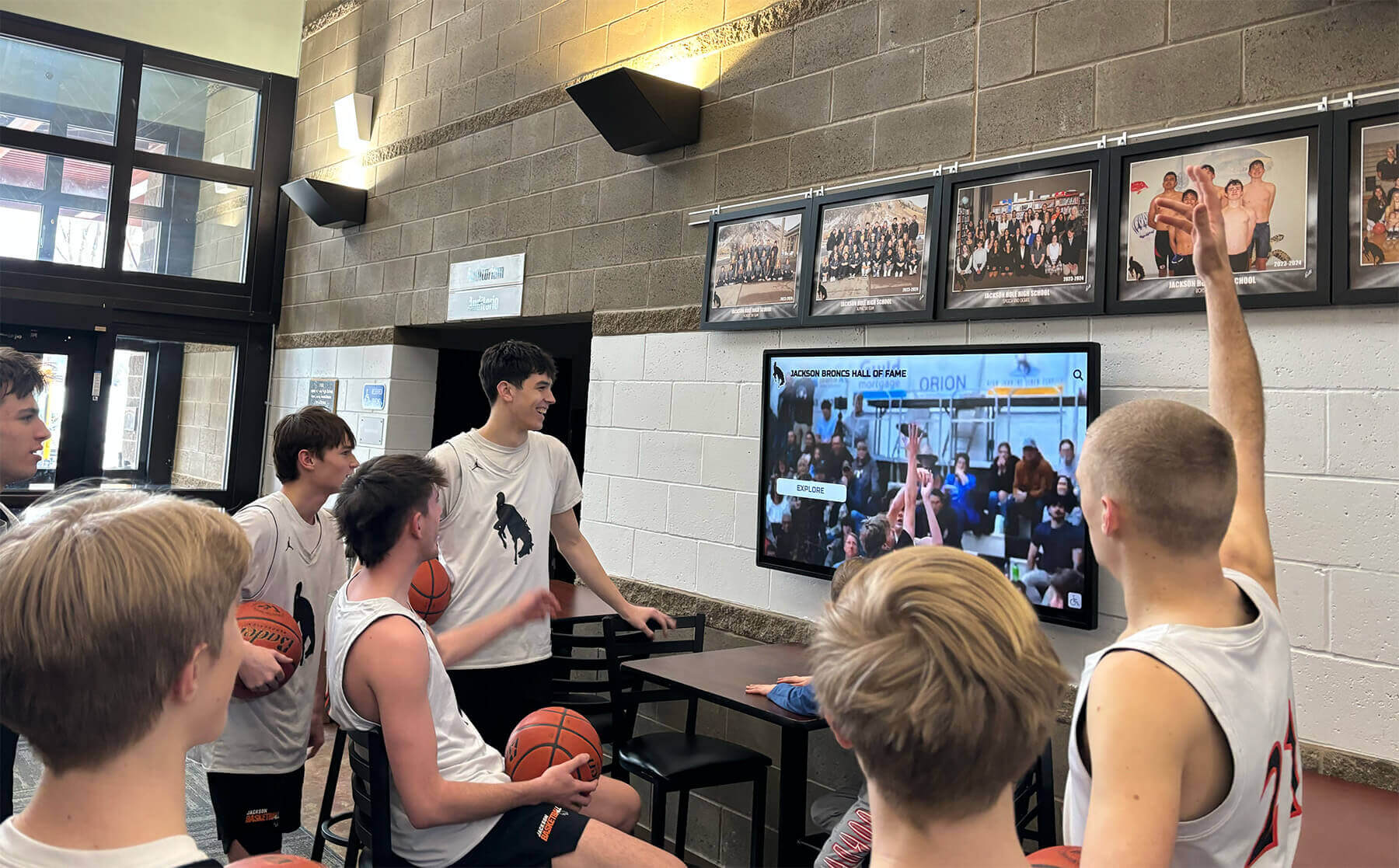
Making athletic records visually accessible in common areas turns historical achievements into daily motivation for current athletes
Swimming and Diving: Pool Records vs. School Records
Swimming creates a specific challenge that most sports don’t face: athletes may compete in multiple pool facilities with different course lengths, water temperatures, and starting block equipment. This generates a distinction between school records (the best performance in program history regardless of venue) and pool records (the best performance in a specific facility).
Defining the Record Hierarchy
Policy should specify whether the official record book tracks school records only, or maintains separate pool records alongside school records. If your program competes primarily in one home pool, the distinction may be minor. If athletes compete in facilities with meaningfully different conditions — a short-course pool for most of the season and a long-course pool for invitational events — the distinction becomes significant.
Short-Course vs. Long-Course Records Short-course (25-yard or 25-meter) and long-course (50-meter) performances are not directly comparable. Policy should maintain separate record sections for each course length if the program competes in both. The fundamentals of backstroke technique and competitive swimming illustrate how technical variables affect measurable performance — the same principle applies to how course configuration affects recorded times.
Diving Records
Diving requires a separate record framework because scoring is judged rather than measured. Record the highest single-meet score achieved in both one-meter and three-meter events, with documentation of the number of dives required and the scoring system in effect at the time of the record. If your state association has changed the required number of dives or the scoring methodology over the years, annotation is essential for historical records to remain meaningful.
Basketball, Soccer, and Counting-Stat Sports
Sports where cumulative statistics define achievement — basketball, soccer, lacrosse, volleyball, wrestling — require records in multiple categories that interact in ways that demand clear policy.
Career vs. Season vs. Single-Game Records
For any counting-stat sport, policy should address three levels:
Career Records aggregate performance across all competitive seasons. This requires the record book system to be capable of pulling data across multiple seasons — a technical requirement that eliminates simple spreadsheets as a long-term solution when multiple athletes are competing in the record book simultaneously.
Season Records capture the best single-season performance. A player who averaged 28 points per game in one season and 22 points per game in another holds two distinct seasonal marks; only the higher belongs in the season record section.
Single-Game Records document peak individual performances. These are particularly meaningful to current athletes who can chase them in a specific game context, rather than the sustained effort required for career or season records.
Position-Specific Records in Team Sports
Basketball programs should consider whether records track all players regardless of position, or whether position-specific records (point guard assists, center rebounds) are maintained separately. Position-specific records are more motivationally relevant for position players but create significant administrative complexity. Programs with dedicated coaching staff per position may find the investment worthwhile; programs with smaller staffs typically don’t.
For programs researching how athletic records connect to college recruiting visibility, resources covering how student athletes get recruited for college sports demonstrate why program-level record books increasingly influence evaluation by college coaches and scouts.
Sportsmanship and Leadership Records
Some programs track non-statistical achievements alongside performance records: team captains by year, athletes who received sportsmanship awards from the conference or state association, and four-year lettermen. These sections require their own policy framework defining what qualifies and how selections are documented. Programs that formalize recognition for leadership and character alongside athletic achievement create record books that reflect program values, not just performance metrics. The complete guide to high school sportsmanship award recognition provides frameworks for documenting character-based recognition alongside performance records.

Interactive touchscreen record displays let athletes and visitors explore historical records with the depth and context that static boards cannot provide
Baseball, Softball, and Pitching-Intensive Sports
Pitching statistics in baseball and softball create record-keeping challenges unique to those sports. Earned run average, strikeouts, and innings pitched are simultaneously individual records and team-context-dependent numbers — a pitcher’s ERA reflects both their performance and the quality of the defense behind them.
Minimum Qualifying Thresholds
Policy should establish minimum qualifying thresholds before a statistical record becomes eligible for the record book. Season ERA leaders require a minimum number of innings pitched to be eligible (a common standard is one inning pitched per game the team played). Career batting average leaders typically require a minimum number of at-bats across their career. These thresholds prevent small-sample statistical anomalies from displacing genuine all-time performances.
Pitcher Win-Loss Records
Win-loss records are among the most debated pitching statistics in high school baseball because they depend significantly on run support. Policy should determine whether wins and losses are tracked in the record book at all, or whether strikeouts, ERA, and innings pitched — statistics that more directly reflect pitcher performance independent of team context — serve as the primary pitching record categories.
Wrestling and Weight-Class Sports
Wrestling records require weight-class specificity that no other sport matches. A 145-pound career win record cannot be compared to a 215-pound career win record because they represent different competitive populations entirely.
Weight Class Record Structure
Policy must specify whether records are maintained at current NFHS weight classes (which have changed over the decades) or at the weight classes in effect at the time each record was set. When weight classes change — as they have several times in the history of high school wrestling — records from previous weight class structures should be preserved in an archived section with a notation explaining the historical weight class system, rather than being retroactively assigned to the nearest current weight class.
Dual Meet Records vs. Tournament Records
Program win totals can be documented in two ways: dual meet win totals by season and career, or tournament placement records. Both serve different purposes in communicating program strength. Dual meet records demonstrate consistency; tournament records demonstrate peak performance. Programs with strong tournament histories often find that tournament-based records generate more recognition at banquets and award events than dual meet statistics alone. Digital trophy case implementations that integrate both dual meet and tournament records side by side help athletes and alumni understand the full competitive picture a program has built.
Record Verification and Dispute Resolution
Every record book that has existed long enough will generate a disputed entry. The athlete who believes the scorer recorded her point total incorrectly. The coach who insists that the meet results don’t reflect what actually happened. The alumni who are certain the school record in their event was higher than what the book shows.
Standard Verification Process
Define a hierarchy of acceptable documentation for verifying records:
- Official meet results published and maintained by the meet host or state athletic association
- Official scorebooks maintained by the school’s athletic department
- Game films from the season in question, where available
- Contemporaneous newspaper reporting from local coverage of the event
- Yearbook documentation with statistical summaries
- Coach records from the relevant season
When multiple sources conflict, policy should define which source takes precedence. Official association results should generally supersede all other sources; contemporaneous newspaper reports may supersede later recollections but not official documentation.
Dispute Submission Requirements
Require any dispute to be submitted in writing — even informally — within a defined window. Disputes of records from the current or immediately prior season might have a 30-day post-season window. Historical records might allow disputes to be submitted at any time but require documentary evidence from the verification hierarchy above.
Disputes based solely on personal recollection without documentary support should be declined on policy grounds, not because the recollection is necessarily wrong, but because the record book cannot be built on unverifiable memory. The academic history archiving guide for schools applies similar verification standards to non-athletic historical records — the same framework translates directly to athletic record disputes.

When record book entries are verifiable and documented, athletes and alumni can engage with the record book with confidence rather than suspicion
Handling Records Set by Athletes Later Ruled Ineligible
This is among the most politically sensitive record book decisions. If a state athletic association retroactively rules an athlete ineligible for academic or eligibility violations, policy should specify whether records set during the ineligible period are removed or annotated. Most programs choose annotation over removal — the competitive performance occurred regardless of the eligibility ruling, and complete removal creates confusion about apparent gaps in the record book. Annotation maintains historical completeness while documenting the context.
Display Standards: Public vs. Internal Record Sections
Not every record category belongs on a public-facing display. Policy should define which record sections are appropriate for lobby displays and which remain internal administrative documents.
Public Display Categories
Records appropriate for public lobby displays include:
- Individual career records by sport
- Season records by sport
- Championship history by team and year
- All-state and all-conference honorees by year
- College signing records (with athlete permission)
These categories tell the school’s competitive story in a way that engages current athletes, alumni, and visitors without raising the policy sensitivities that attend some internal categories.
Internal Administrative Records
Records appropriate for internal administrative use only include:
- Unverified records flagged during data audits
- Records currently under dispute
- Records from discontinued sports that haven’t been fully verified
- Ineligibility-annotated records
Maintaining internal records separately from display records ensures the public-facing record book maintains its credibility while the administrative team still has complete institutional memory.
Touchscreen Display Architecture for Record Books
When athletic records are displayed on touchscreen kiosks — the standard for programs investing in physical recognition infrastructure — the display architecture should reflect these policy distinctions. A top-level navigation showing verified, public categories ensures every visitor interaction reinforces program credibility. Kiosk software complete guide resources outline how navigation structure affects user engagement with displayed content — the same principles that govern museum exhibit design apply to athletic record book kiosks.
Print vs. Digital Display Policy
Programs should define the relationship between print and digital record book versions clearly. When records are updated in the digital system, does the print version (if maintained) automatically fall out of date? Most programs that maintain both formats end up with discrepancies — which version is authoritative when they conflict?
Policy should declare a single authoritative version. For programs using a purpose-built digital platform, the digital system should be declared authoritative, with print versions representing snapshots of the record book at a specific point in time rather than the living record.

Well-maintained display standards ensure that recognition hallways communicate a consistent, credible history rather than a patchwork of different eras and formats
Building Historical Records from Existing Archives
Most high schools have decades of athletic history that predates any systematic record-keeping. Building a complete record book requires actively reconstructing that history from available sources.
Archive Sources to Search
Yearbooks are the single most valuable source for historical athletic records at most high schools. Athletic sections in yearbooks typically list team rosters, coaching staff, seasonal records, and individual statistical leaders for each year. Many school libraries maintain complete yearbook archives going back to the school’s founding.
Local Newspapers published game summaries and seasonal recaps that contain performance data unavailable in formal athletic records. Local libraries and newspaper archives often have historical editions that predate digital archives by decades. Digital yearbook systems that have integrated yearbook digitization services demonstrate how schools have successfully converted historical print records into searchable, accessible databases.
State Athletic Association Archives may maintain historical meet results, state tournament brackets, and all-state selections going back many decades. These official sources provide the highest-quality historical documentation for records set at state-level competition.
Retired Coaches and Alumni can provide valuable context for historical records, though their recollections function as supporting documentation rather than primary verification. Oral history interviews with coaches who built programs in the 1970s and 1980s often surface records that no other source documents — but those records should be entered with annotation noting the source and its limitations.
Prioritizing Historical Research
Complete historical reconstruction from the school’s founding is a multi-year project. Prioritize the reconstruction in this order:
- Current and recent seasons (last 10 years) — highest relevance, best documentation
- Championship eras — seasons when teams achieved conference titles, state appearances, or other notable accomplishments
- Athlete-specific records where specific athletes are known to have set marks worth preserving
- Decade-by-decade reconstruction working backward from the present
This priority order ensures the record book is credible and current for the athletes and families it most immediately serves, even if historical reconstruction is incomplete.
Record Update Workflows That Actually Work
The most thoroughly documented policies mean nothing if the workflow for updating records isn’t followed during competitive seasons. Programs fail to maintain accurate record books because the update process is too burdensome for coaches managing full competitive schedules.
Coach Submission Model
Build a workflow where coaches are responsible for notifying the athletic department when a record is broken, not for updating the record book themselves. A simple notification system — an email or text message to the athletic director or designated record keeper immediately after the competitive performance — creates an audit trail while keeping the verification and entry responsibility with administrative staff who have access to official documentation.
National Letter of Intent tracking follows a similar notification model in well-run programs — coaches notify athletic directors promptly, administrators confirm and document formally. The same structure works for record book maintenance.
Seasonal Review Calendar
Establish a mandatory post-season review for each sport immediately following the conclusion of their competitive season. This review compares the season’s results against the existing record book and updates all qualifying categories before the next sport’s season creates a competing workload. A structured seasonal review is more reliable than expecting real-time updates during the competitive season.
Annual Comprehensive Audit
Once per year — typically in late July or early August before the fall sports season begins — conduct a comprehensive audit of the entire record book. Compare entries against available documentation, update any categories that weren’t caught during seasonal reviews, and flag any entries that require verification before they can be confirmed.
School history touchscreen full-service vs. DIY comparisons consistently identify content update workflows as the deciding factor between successful and unsuccessful implementations — not hardware or software selection. A system that’s easy to update gets updated; one that isn’t, doesn’t.
Technology That Enforces Policy Consistency
Paper-based record books cannot enforce policies — they’re only as consistent as the person maintaining them. Digital record management systems with purpose-built athletic structures enforce consistency through their architecture.
Required Fields and Validation
A well-designed digital record system requires that every record entry include the athlete name, class year, performance date, competitive venue, and documentation source before the entry can be saved. This eliminates the casual entries that plague paper systems — the record that got entered without a date because the coach remembered it happened “somewhere in the spring of 2003.”
Role-Based Permissions
Role-based permission systems allow coaches to propose record entries, but require athletic department administrator review before entries are published to the public-facing display. This two-step workflow applies policy verification at the point of entry without requiring IT involvement.
Automated Update Notifications
Purpose-built platforms that integrate with school websites and social media can notify alumni when records they hold are challenged or broken — generating genuine engagement that general digital signage platforms cannot replicate. A swimmer who set the school’s 200 butterfly record in 2009 and receives a notification when a current athlete ties that mark has a reason to reconnect with the school that standard alumni outreach cannot create.
Athletic record management platforms from providers like Rocket Alumni Solutions are built specifically for this combination of policy enforcement, multi-sport record organization, and physical display integration — enabling athletic directors to manage a consistent record book without relying on the institutional memory of any single staff member.

Programs that integrate record book data with physical display environments create recognition systems that serve athletes, alumni, and visitors simultaneously
Connecting the Record Book to College Recruiting and Alumni Engagement
An athletic record book is most powerful when it connects athletes to outcomes beyond the high school program. Two specific connections deserve explicit attention in record book policy.
College Signing Records
Maintaining annual records of athletes who signed National Letters of Intent or made verbal commitments to college programs documents the program’s recruiting pipeline in a way that recruits and their families actively search for. This section benefits from its own verification policy: entries should be confirmed through official NLI signing documentation, not verbal reporting, to ensure accuracy.
The record of athletes who have received athletic scholarships serves a dual purpose — it honors those individuals and simultaneously communicates the program’s track record in athlete development to the families evaluating it.
Alumni Record Acknowledgment
When alumni records are broken, the moment creates a natural opportunity for outreach. Policy should define how and when former record-holders are notified, and whether the record book maintains a “former record-holders” section alongside the current records. Some programs keep previous record holders visible alongside the current standard — showing that the record stood for 12 years before being broken creates context that celebrating the new record alone cannot.
A formal alumni outreach policy for record-breaking moments, combined with digital record book access, turns the record book into an ongoing alumni engagement tool rather than a one-time recognition document. Homecoming and event planning contexts demonstrate how record-based recognition consistently generates higher alumni event attendance than generic invitation campaigns.
Making the Record Book Policy Document Official
A policy document that exists in draft form on an administrator’s desktop is not a policy. Making the record book framework official requires several concrete steps.
Formal Adoption
Present the record book policy to the athletic director, principal, and — depending on your school’s governance structure — the school board’s athletic committee for formal adoption. Official adoption transforms the policy from an administrative preference into a school document with institutional authority.
Coach Orientation
Review the policy annually with all coaching staff during pre-season orientation. Coaches who understand the verification requirements and update notification procedures are far more likely to follow them consistently than coaches who learn about the record book only when they have a new record to report.
Public Availability
Make the record book policy available to athletes, families, and alumni. Transparency about how records are verified and maintained builds trust in the record book’s accuracy. When athletes and families know the standards, disputes are less likely to become contentious because everyone understands the framework that governs decisions.
A comprehensive, publicly available policy paired with a well-maintained digital record book — one that meets the standards described throughout this guide — positions your program as one that takes athletic history as seriously as athletic performance.
Conclusion
The athletic record book is only as trustworthy as the policies behind it. Sport-specific categories, clear verification standards, consistent dispute resolution procedures, and documented update workflows are what separate a record book that communities trust from one that generates ongoing controversy. Building those policies takes time, but the investment protects everything that makes the record book worth maintaining in the first place.
Programs that establish these standards and implement them through purpose-built digital platforms create record systems that outlast any individual administrator, coach, or athlete — carrying competitive history forward across decades with the accuracy and consistency that institutional legacy deserves.
Build a Record Book That Lasts
Rocket Alumni Solutions helps high schools create digital athletic record systems with the structure, update workflows, and display infrastructure to maintain accurate, credible records across every sport — permanently.
Explore Digital Record Book Platforms






























