



Intent: Demonstrate how to design, implement, and optimize digital hall of fame touchscreen experiences that inspire, engage, and celebrate achievement through interactive storytelling.
A digital hall of fame transforms traditional recognition from static plaques into dynamic, multimedia experiences that honor achievement while engaging modern audiences through interactive touchscreen displays. Unlike conventional trophy cases limited by physical space and minimal storytelling capacity, digital recognition platforms provide unlimited recognition potential, rich multimedia profiles, and accessible experiences that reach communities far beyond physical locations.
The challenge facing institutions with growing recognition needs involves managing expanding honoree collections within constrained physical spaces while maintaining engaging, current displays that truly celebrate excellence. Traditional halls of fame built on wall-mounted plaques exhaust available space, require weeks or months for updates, and reduce meaningful achievements to names and dates alone—failing to capture the complete stories that make recognition inspiring and impactful.
This comprehensive guide explores digital hall of fame design, implementation, and optimization—covering interactive experience layouts, content strategies, accessibility considerations, brand integration, and best practices for creating recognition displays that engage visitors while honoring the excellence these platforms celebrate. Whether planning your first digital recognition installation or enhancing existing programs, you’ll discover actionable frameworks for leveraging touchscreen technology to transform institutional recognition.
Organizations implementing well-designed digital hall of fame experiences report dramatic engagement improvements, with visitors spending three to five times longer exploring interactive recognition compared to traditional static displays. This increased engagement translates to stronger community connections, enhanced institutional pride, and more effective recognition that genuinely honors achievement rather than simply documenting it.

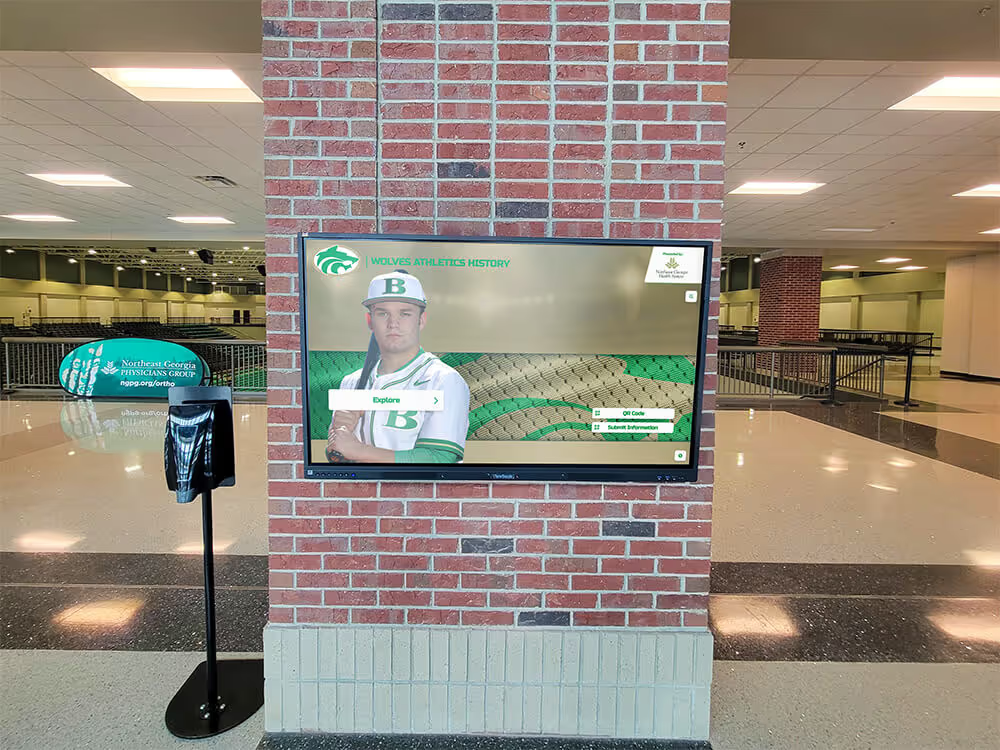
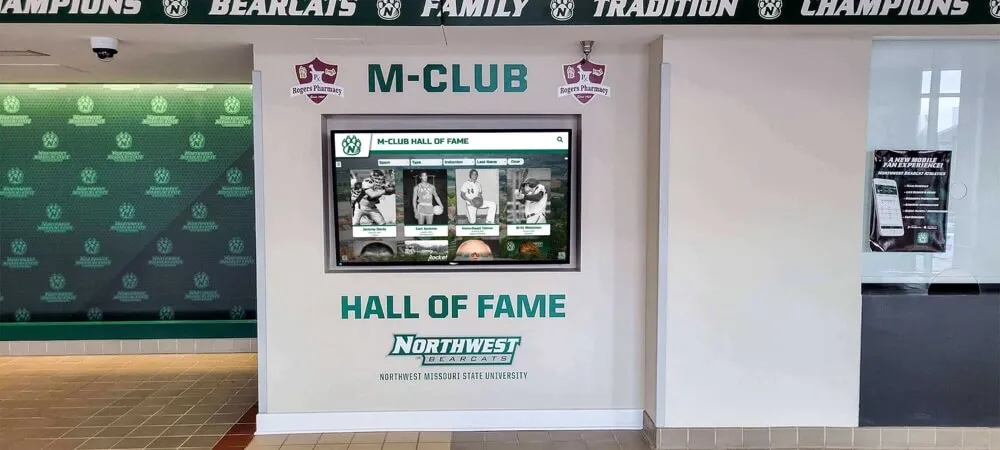
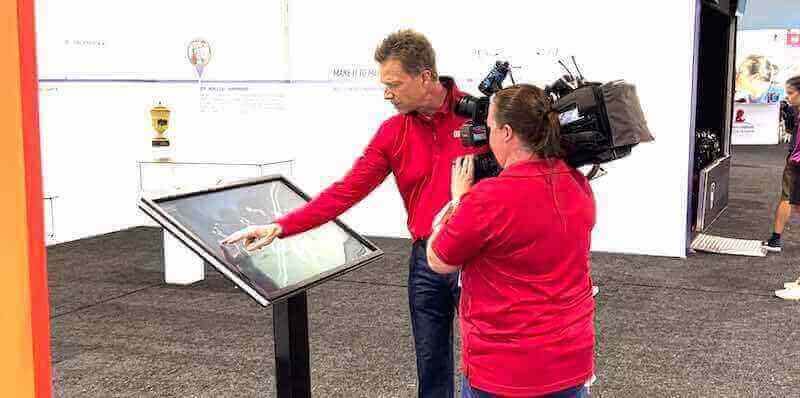
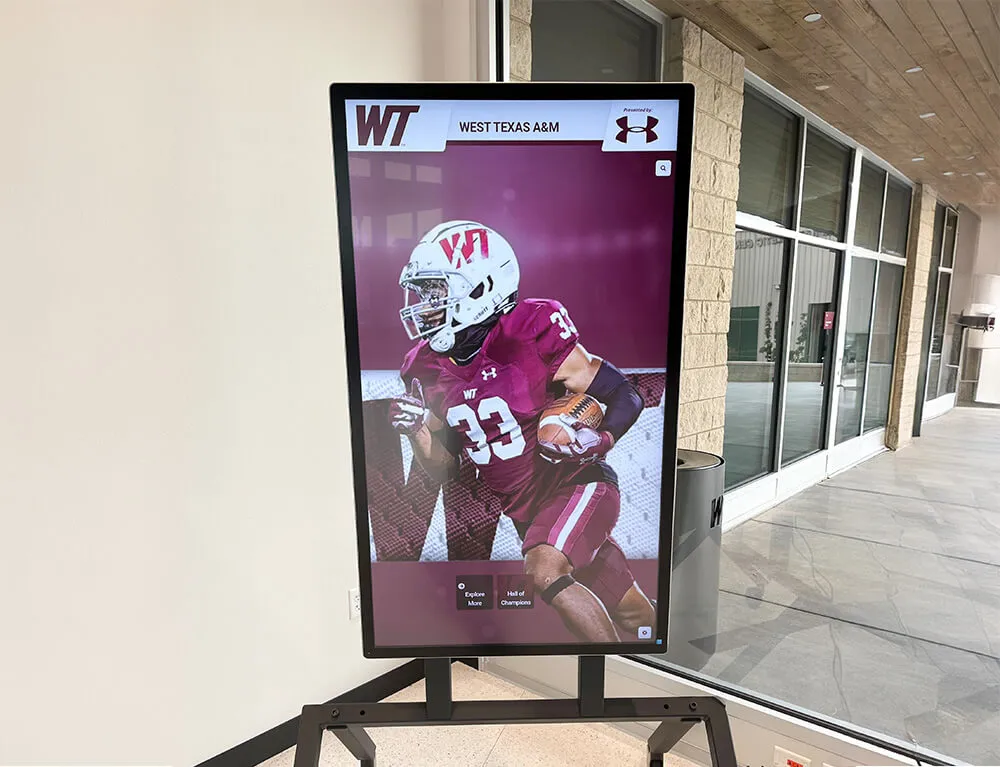
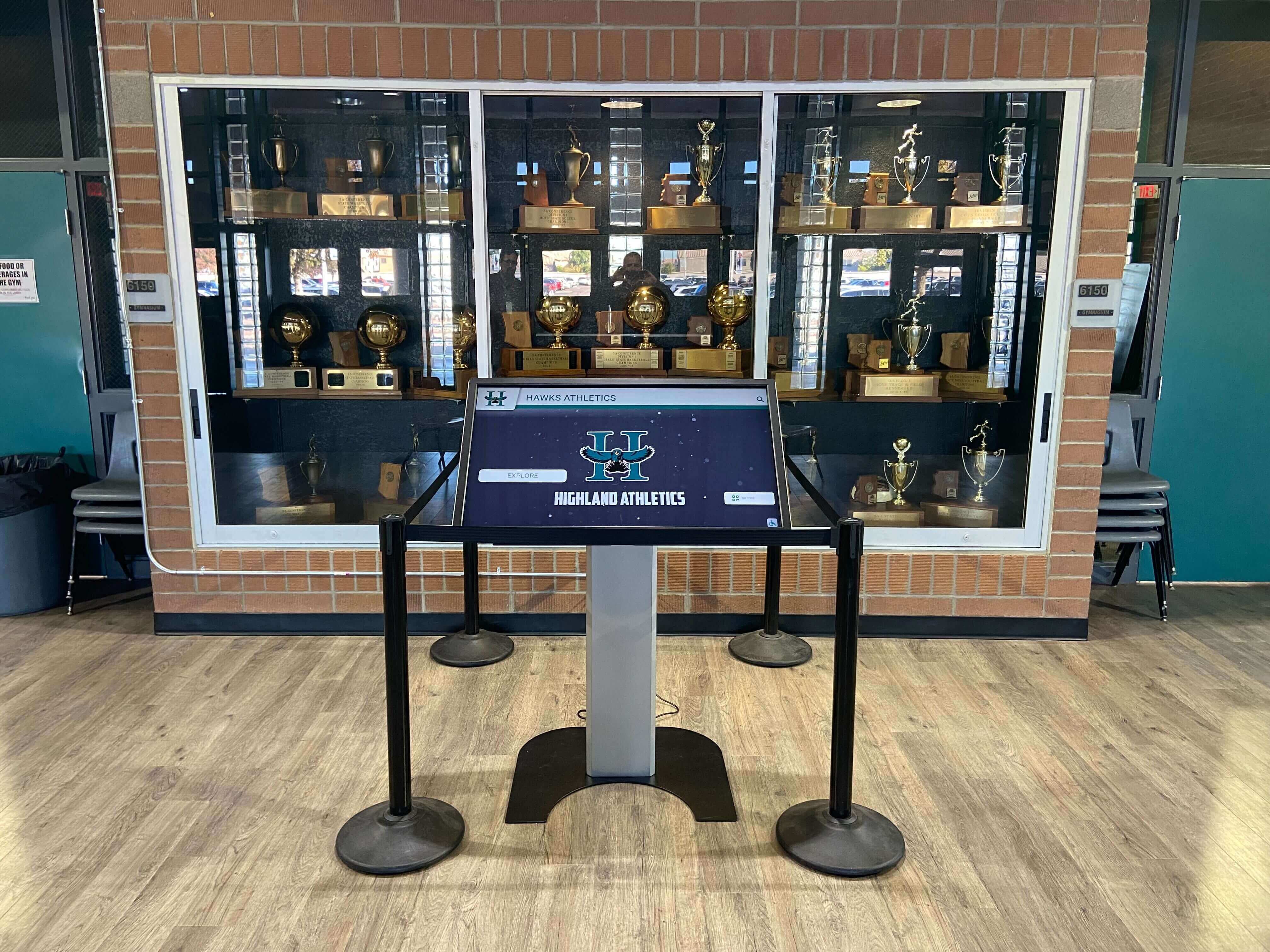
Freestanding touchscreen kiosks complement traditional recognition while providing unlimited digital capacity and interactive exploration capabilities
Understanding Digital Hall of Fame Recognition Systems
Before designing specific experiences, understanding what digital halls of fame are and how they function provides essential context for creating effective recognition programs.
What Makes Digital Halls of Fame Different
A digital hall of fame consists of large-format touchscreen displays—typically 43 to 75 inches—running specialized recognition software that enables interactive exploration where visitors control content discovery. Unlike generic digital signage displaying rotating announcements, purpose-built recognition platforms organize content around individual honoree profiles, enabling deep engagement through multimedia storytelling, searchable databases, and intuitive navigation patterns.
The technology combines integrated components creating complete recognition solutions: commercial-grade touchscreens rated for continuous operation, cloud-based content management systems enabling updates from any device, specialized recognition software designed specifically for celebrating people and achievements, and web-based portals extending recognition accessibility beyond physical displays to worldwide audiences.
Key Components of Effective Digital Recognition Displays
Modern digital hall of fame installations integrate hardware, software, content, and design elements working together seamlessly:
Hardware Foundation
Commercial touchscreen displays provide public-facing interfaces where visitors interact through touch navigation mirroring smartphone experiences. Critical hardware considerations include screen size appropriate for viewing distances and content density, touch technology (capacitive vs. infrared) affecting responsiveness and durability, brightness levels ensuring visibility in various lighting conditions, portrait or landscape orientation matching content and space, and mounting approaches including wall-mount, floor-standing kiosks, or custom installations.
Software Platform
Recognition software specifically designed for celebrating achievement provides search functionality enabling instant individual discovery, filtering options organizing content by year, category, or achievement type, multimedia support incorporating photos, videos, and audio, social sharing features allowing profile distribution, and analytics tracking engagement patterns demonstrating program value.
Solutions like Rocket Alumni Solutions provide purpose-built platforms understanding unique recognition requirements including privacy controls, giving level differentiation for donor recognition applications, and development office workflows that generic digital signage cannot accommodate effectively.
Content Architecture
Content organization significantly impacts visitor experience and engagement. Effective structures include chronological organization by induction year or achievement date, categorical classification by achievement type or program area, featured collections highlighting specific themes or milestones, and alphabetical directories enabling direct name-based discovery.
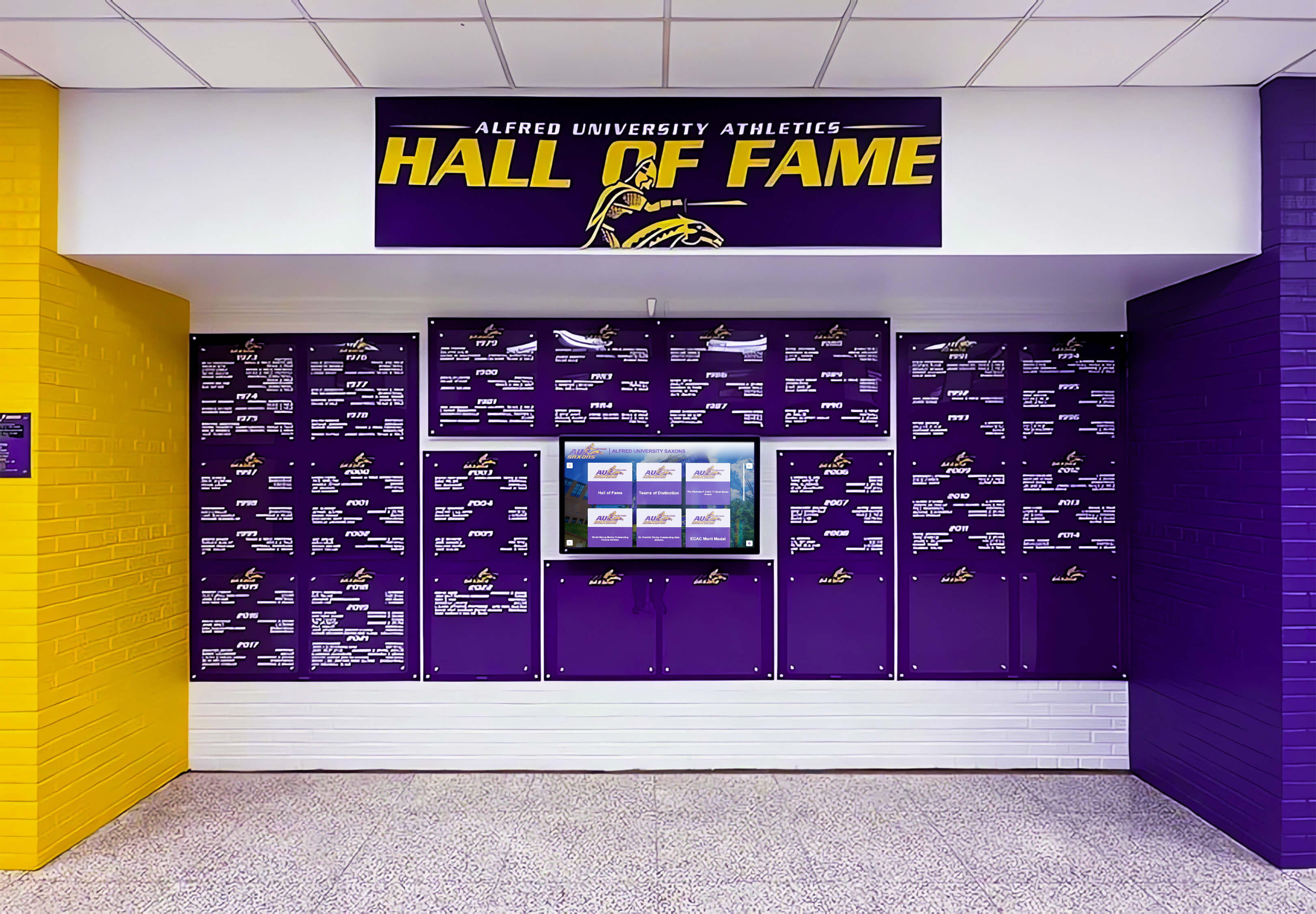
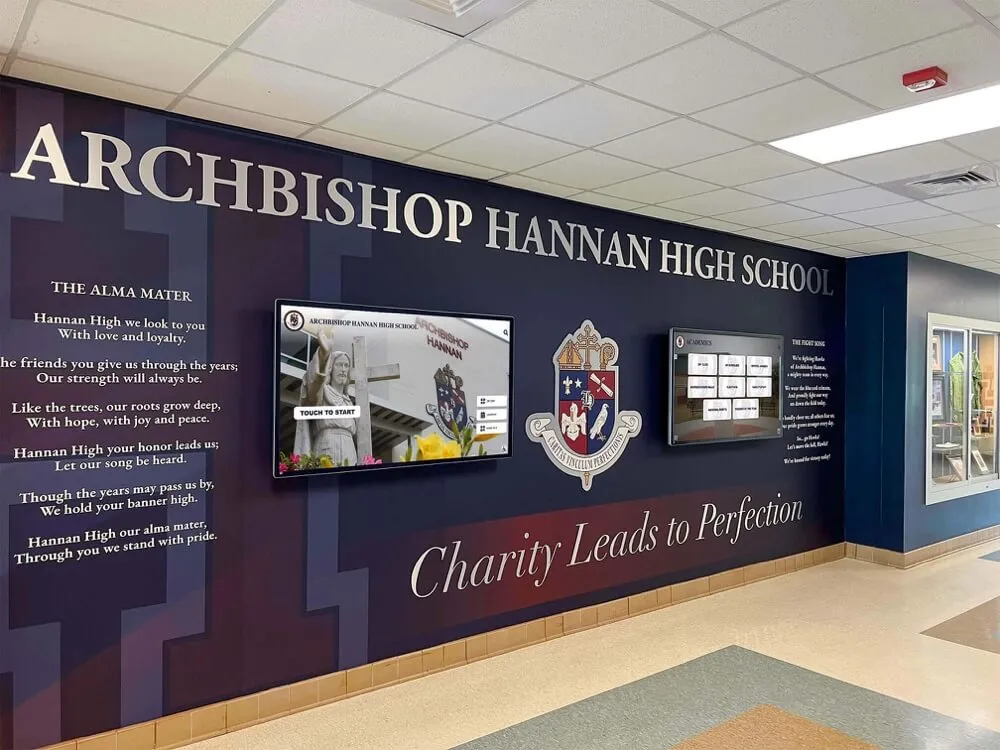
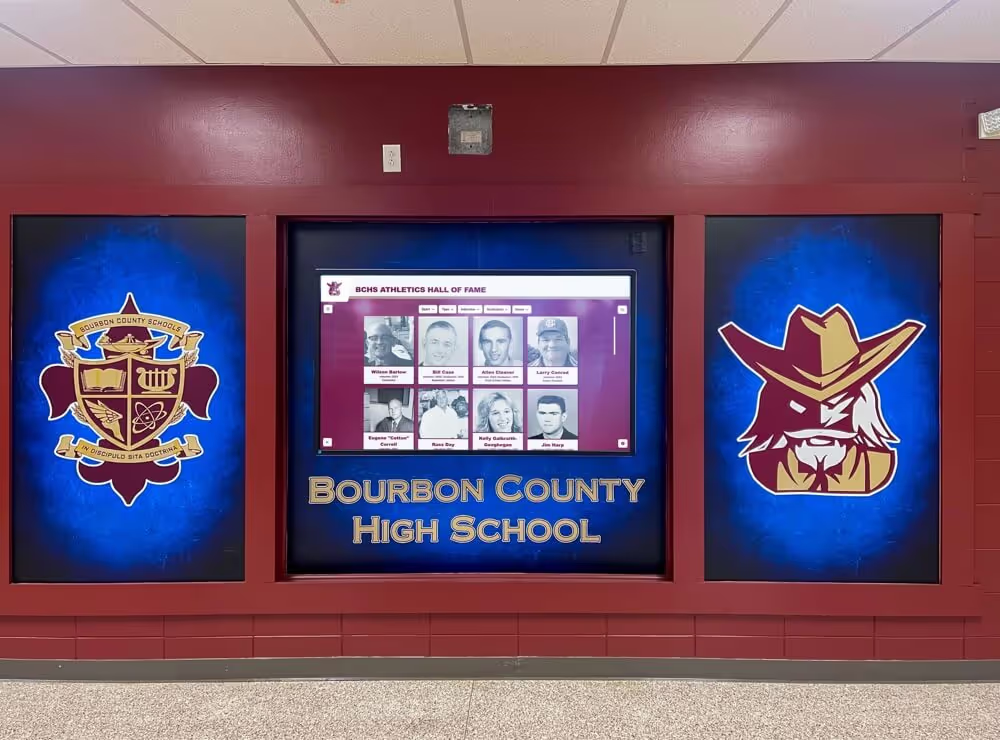
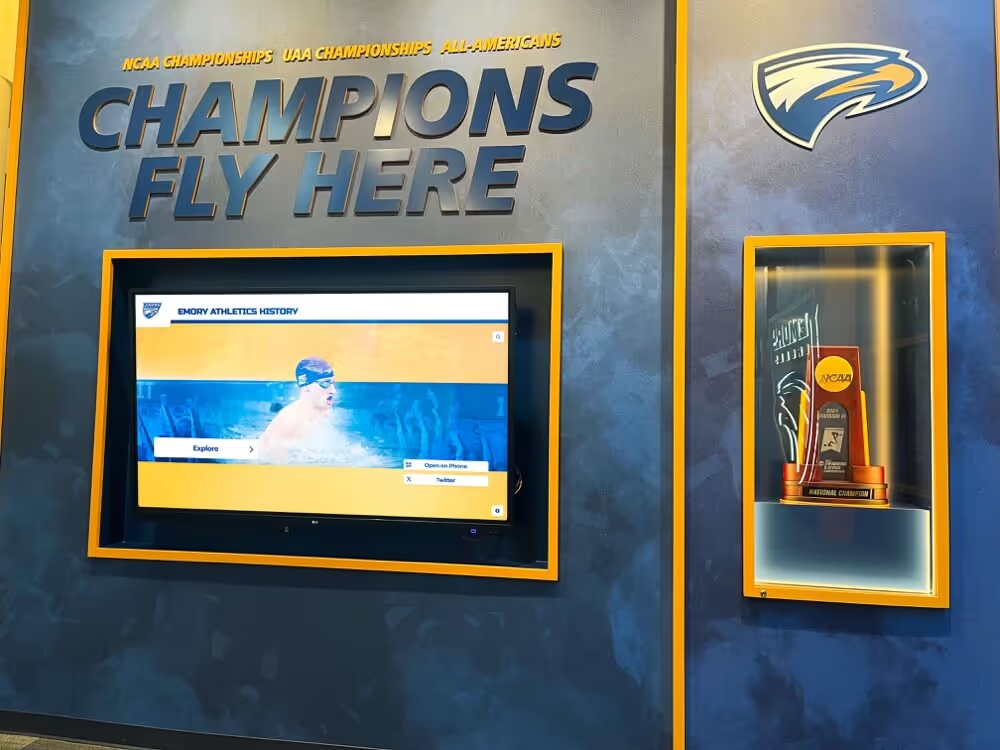
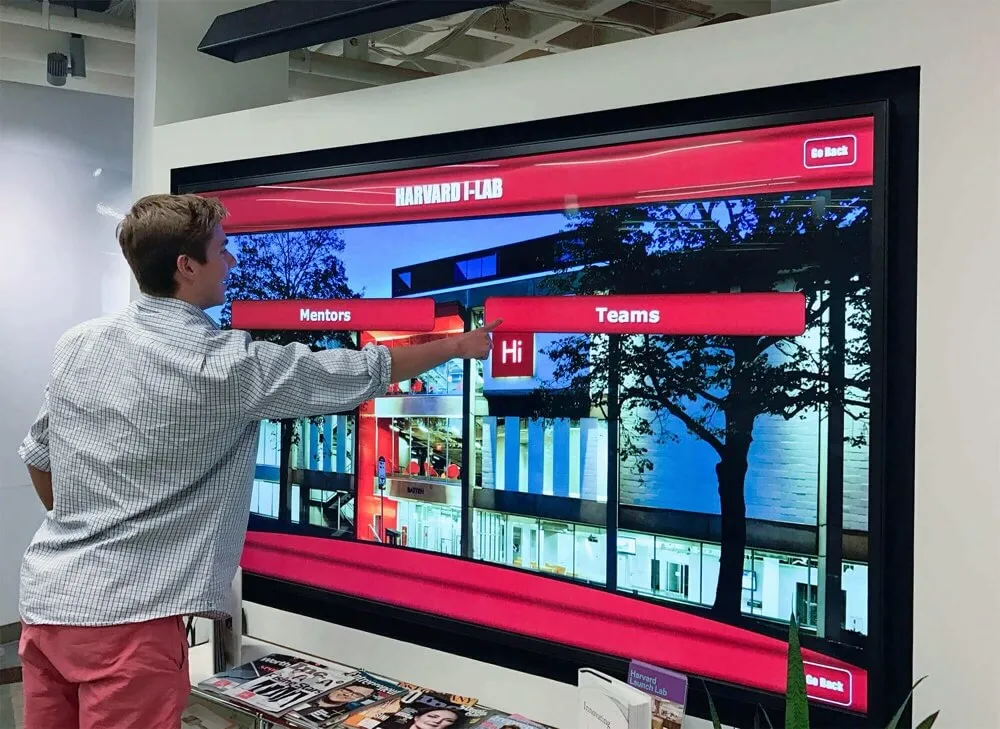
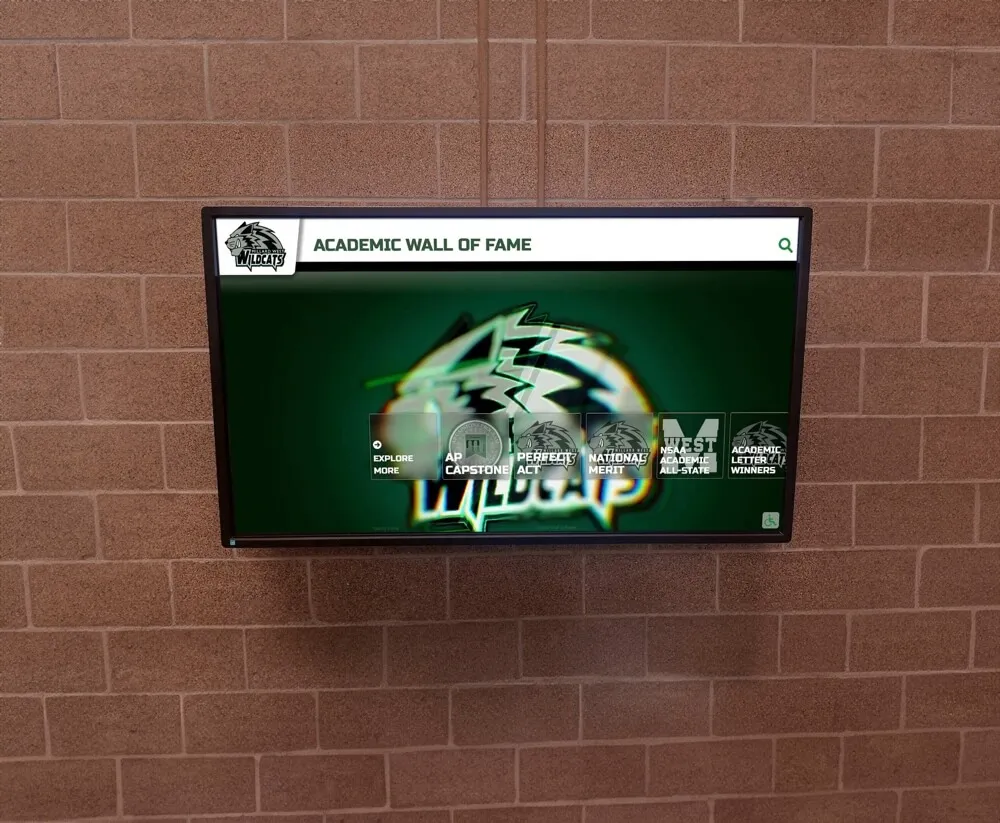
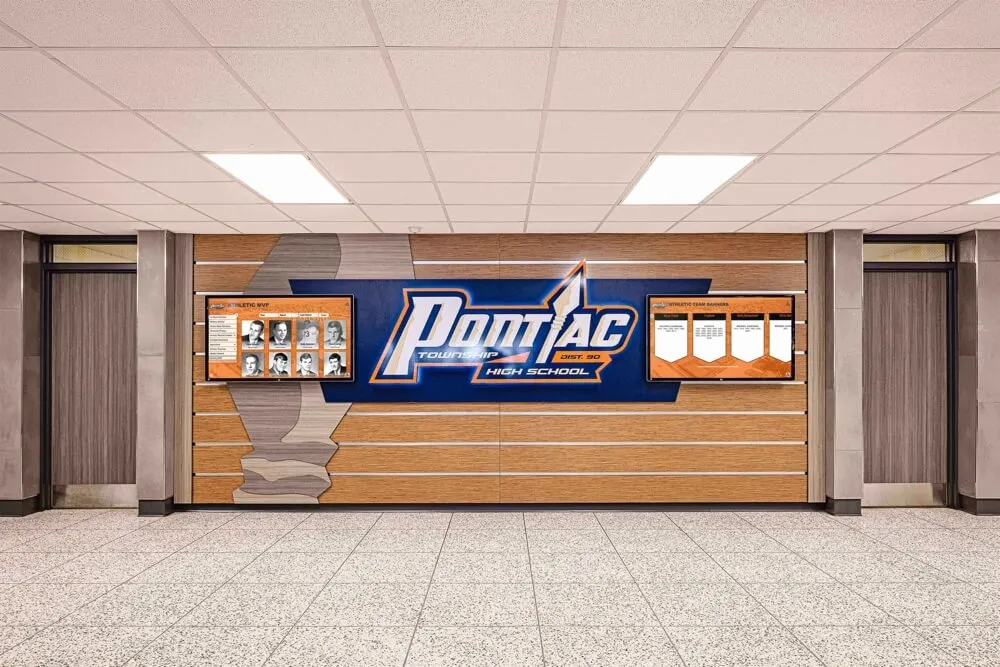
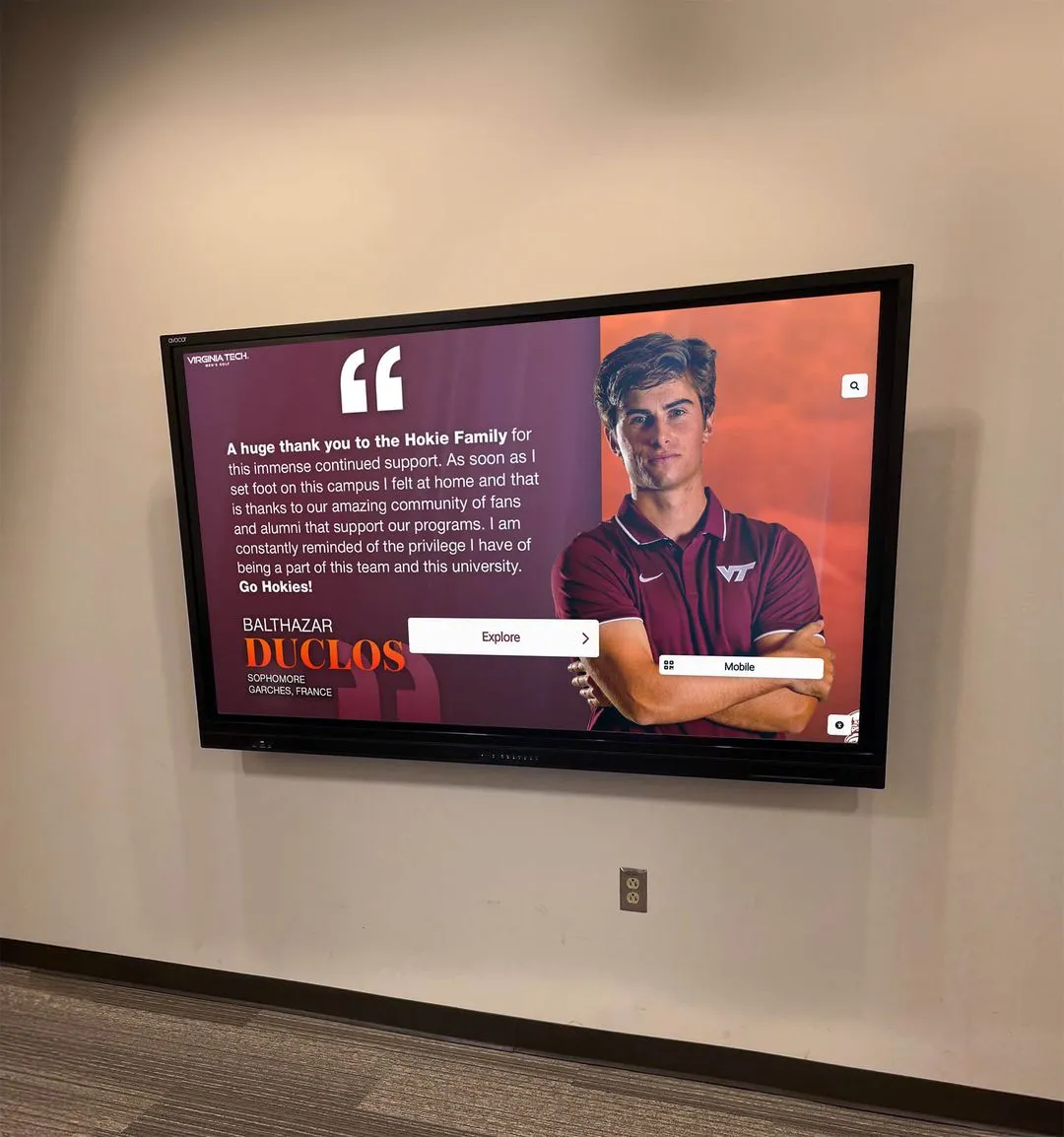
Brand-integrated displays incorporate institutional colors, logos, and design elements creating cohesive recognition experiences
The Evolution from Traditional to Digital Recognition
Traditional halls of fame have served institutions for generations through wall-mounted plaques and trophy cases. While these approaches maintain ceremonial significance, they face inherent limitations:
Traditional Recognition Constraints
Physical space capacity limits recognition to 20-50 honorees before exhausting wall space. Update processes require plaque manufacturing, shipping, and installation taking weeks or months. Information density remains minimal with small engravings providing only names, years, and basic achievements. Accessibility restricts recognition to those physically present during facility hours. And maintenance requires ongoing coordination with vendors, installers, and designers for each recognition cycle.
Digital Recognition Advantages
Digital platforms eliminate space constraints, accommodating unlimited honorees without physical expansion. Updates happen instantly through content management systems accessible from anywhere. Rich multimedia profiles include photos, videos, biographical narratives, and achievement documentation creating emotional connections impossible with engraved text. Powerful search and filtering enable instant location of specific individuals. Analytics demonstrate engagement levels informing continuous improvement. And web accessibility extends recognition to worldwide audiences rather than limiting visibility to physical location visitors.
Experience Layout: Designing Intuitive Recognition Interfaces
Effective digital hall of fame design requires systematic approaches balancing aesthetic appeal with functional usability across diverse user groups.
Layout Blueprint and Zone Architecture
Well-designed recognition experiences organize screen real estate into functional zones serving specific purposes:
Zone 1: Hero/Masthead Area (Top 15-20%)
The hero zone provides immediate context and brand presence. Essential elements include institutional branding with logos and colors, experience title clearly identifying the display purpose, current date/time orienting visitors temporally, and optional featured inductee or rotating highlights drawing attention to compelling content.
Zone 2: Navigation Bar (Below Hero, 10-15%)
Primary navigation enables content discovery through category browsing. Common navigation patterns include browse by year, browse by category/sport, search by name, view featured collections, and access to additional recognition (championships, records, special honors). Navigation should use large, touch-friendly buttons with clear labels and intuitive iconography.
Zone 3: Content Display Area (Center, 50-60%)
The main content zone presents honoree profiles, lists, or galleries. Effective layouts include grid-based card views showing multiple honorees simultaneously with photos and key information, list views providing scrollable directories with sorting options, detail views displaying complete individual profiles with full multimedia content, and gallery views showcasing images and videos with minimal text overlay.
Zone 4: Footer/Action Area (Bottom 10-15%)
Footer zones provide secondary actions and information including social media sharing options, QR codes linking to mobile experiences, sponsor acknowledgment when appropriate, navigation breadcrumbs showing current location, and home/back buttons enabling easy navigation return.
Zone 5: Side Panels (Optional, 15-20% vertical space)
Some layouts incorporate side panels for persistent navigation, filtering controls, featured content callouts, or sponsor content separate from primary display areas.
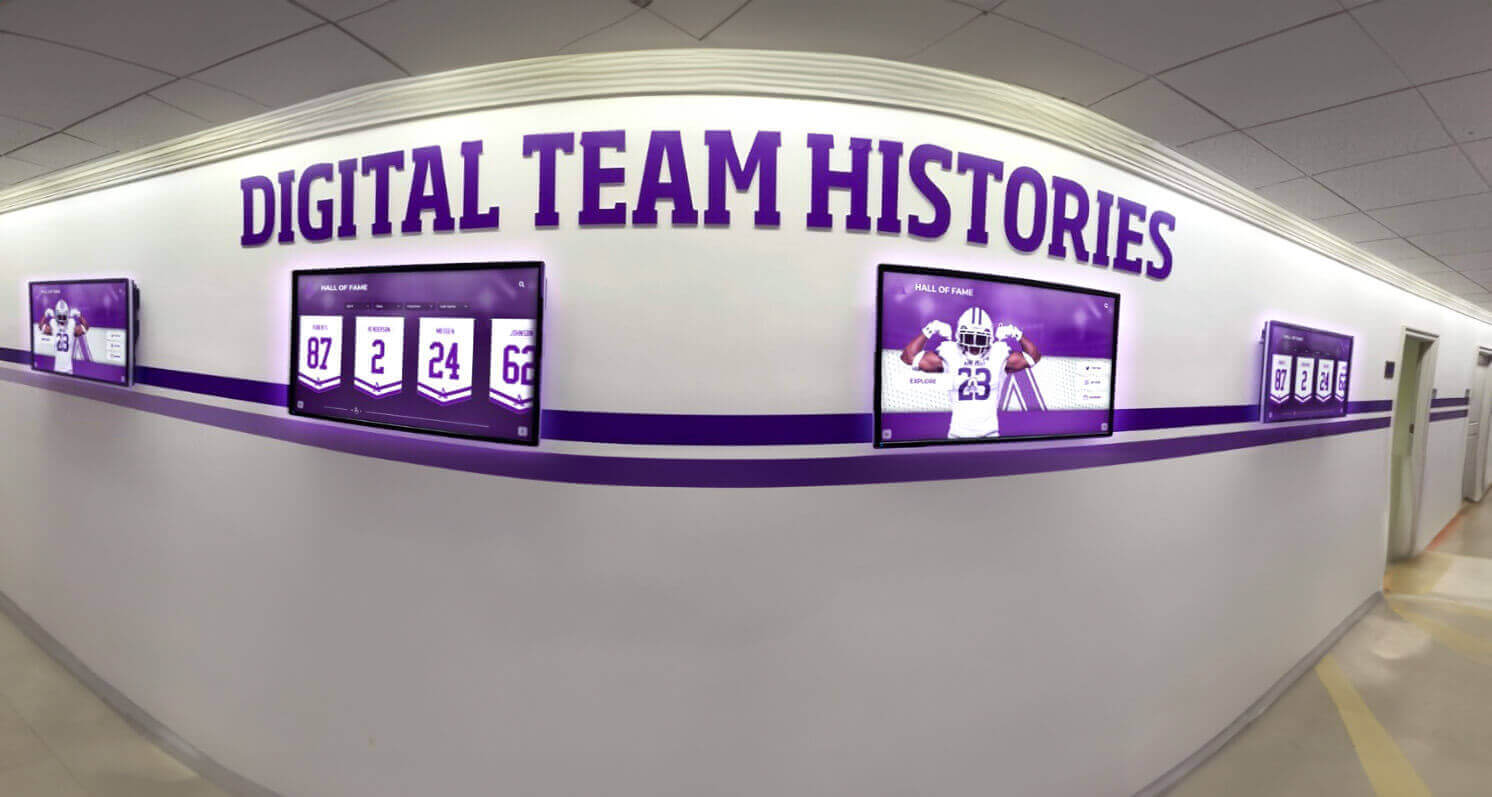
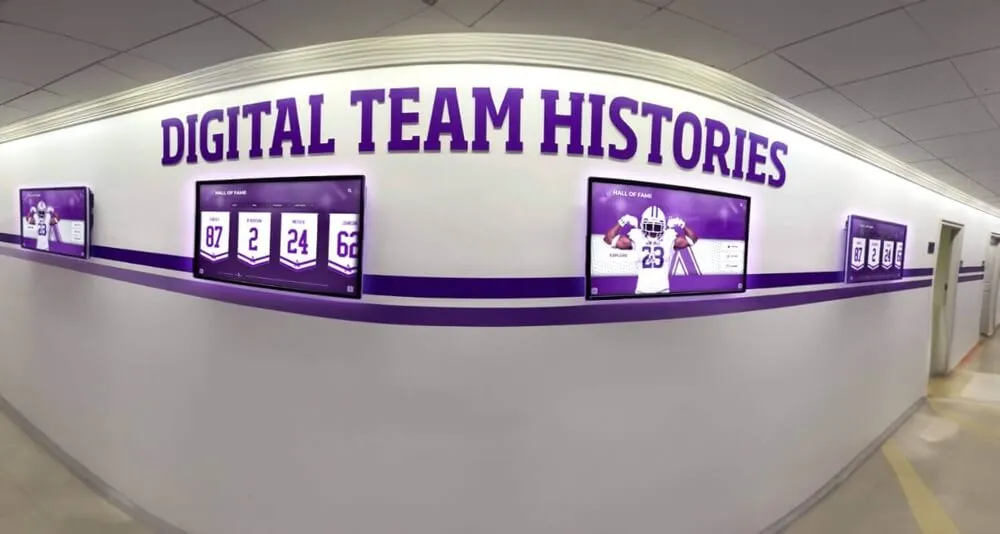
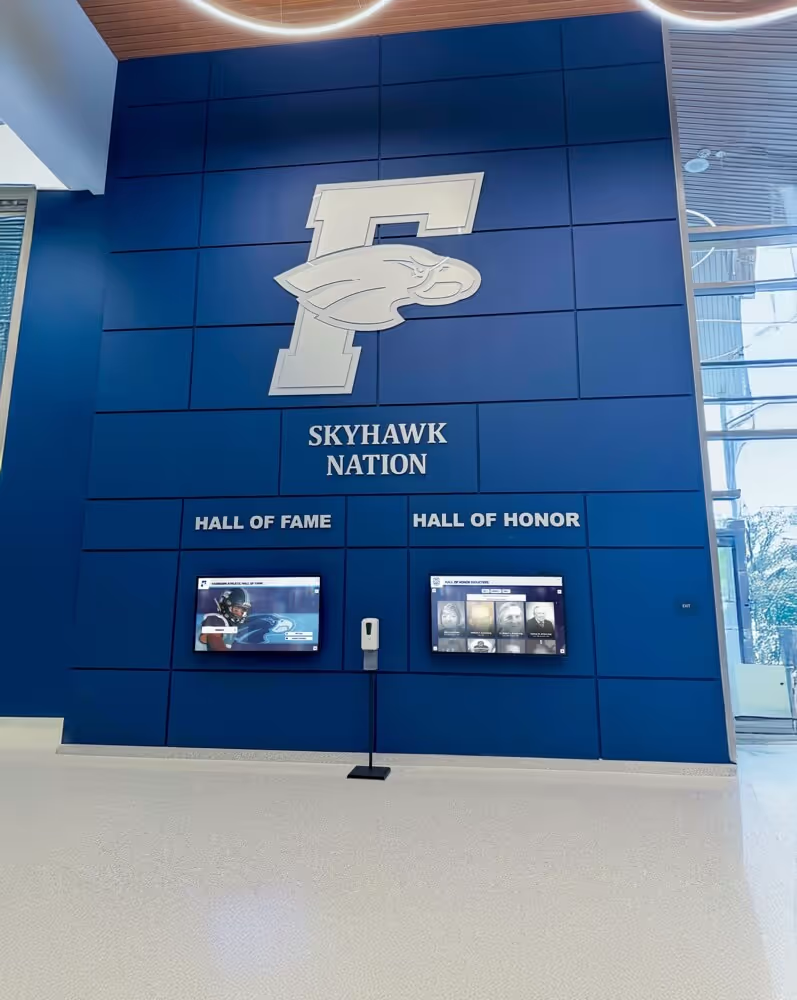
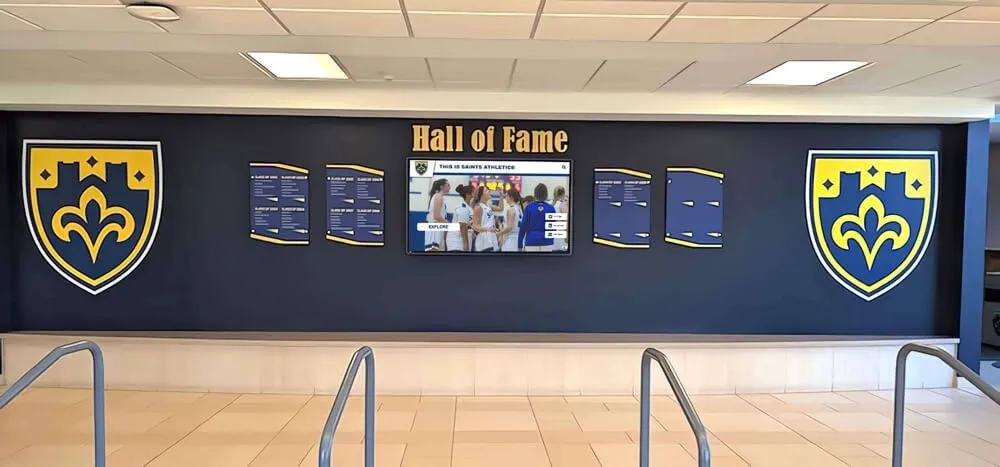
Multiple coordinated displays create comprehensive recognition networks serving different content categories while maintaining visual consistency
Content Blocks and Motion Design
Beyond static layout, animation and motion enhance usability and engagement:
Attraction Loop (Idle State)
When not actively used, displays should run attraction loops drawing attention and demonstrating interactivity. Effective attraction content includes highlight reels showing compelling honoree photos and videos, featured inductee spotlights rotating through recent additions, achievement statistics demonstrating program excellence, and clear touch prompts inviting interaction.
Transition Animations
Smooth transitions between screens enhance perceived quality and guide user attention. Use fade transitions for content swaps within same layout, slide animations indicating directional navigation (left/right for categories, up/down for chronology), and zoom effects when moving between list and detail views.
Interactive Feedback
Visual feedback confirms touch interactions: button press states show clear visual response, loading indicators appear when content loads, and success confirmations acknowledge actions like social shares.
Content Reveal Patterns
Progressive disclosure manages information density: summary cards show essential information at glance, expansion reveals additional detail on touch, and full profiles display comprehensive content in dedicated views.
Accessibility and UX Checklist
Creating inclusive recognition experiences requires deliberate accessibility consideration:
ADA WCAG 2.1 AA Compliance
- Text contrast ratios minimum 4.5:1 for normal text, 3:1 for large text
- Touch targets minimum 44x44 pixels with adequate spacing
- Text scaling supporting enlargement without horizontal scrolling
- Alternative text for images supporting screen readers when accessible modes enabled
- Captions for video content
Physical Accessibility
- Mounting height placing primary controls 15-48 inches above floor for wheelchair access
- Forward reach depth not exceeding 25 inches for reach range compliance
- Kiosk approaches providing knee and toe clearance when applicable
- Volume controls for audio content respecting quiet environments
Cognitive Accessibility
- Clear, simple language avoiding jargon
- Consistent navigation patterns throughout experience
- Minimal required steps to accomplish common tasks
- Obvious home/back options enabling recovery from navigation errors
- Optional high-contrast modes for visibility impairment
Organizations should verify accessibility with diverse user testing including wheelchair users, older adults, and people with visual impairments before finalizing designs. Resources on technical considerations for digital recognition provide detailed accessibility implementation guidance.
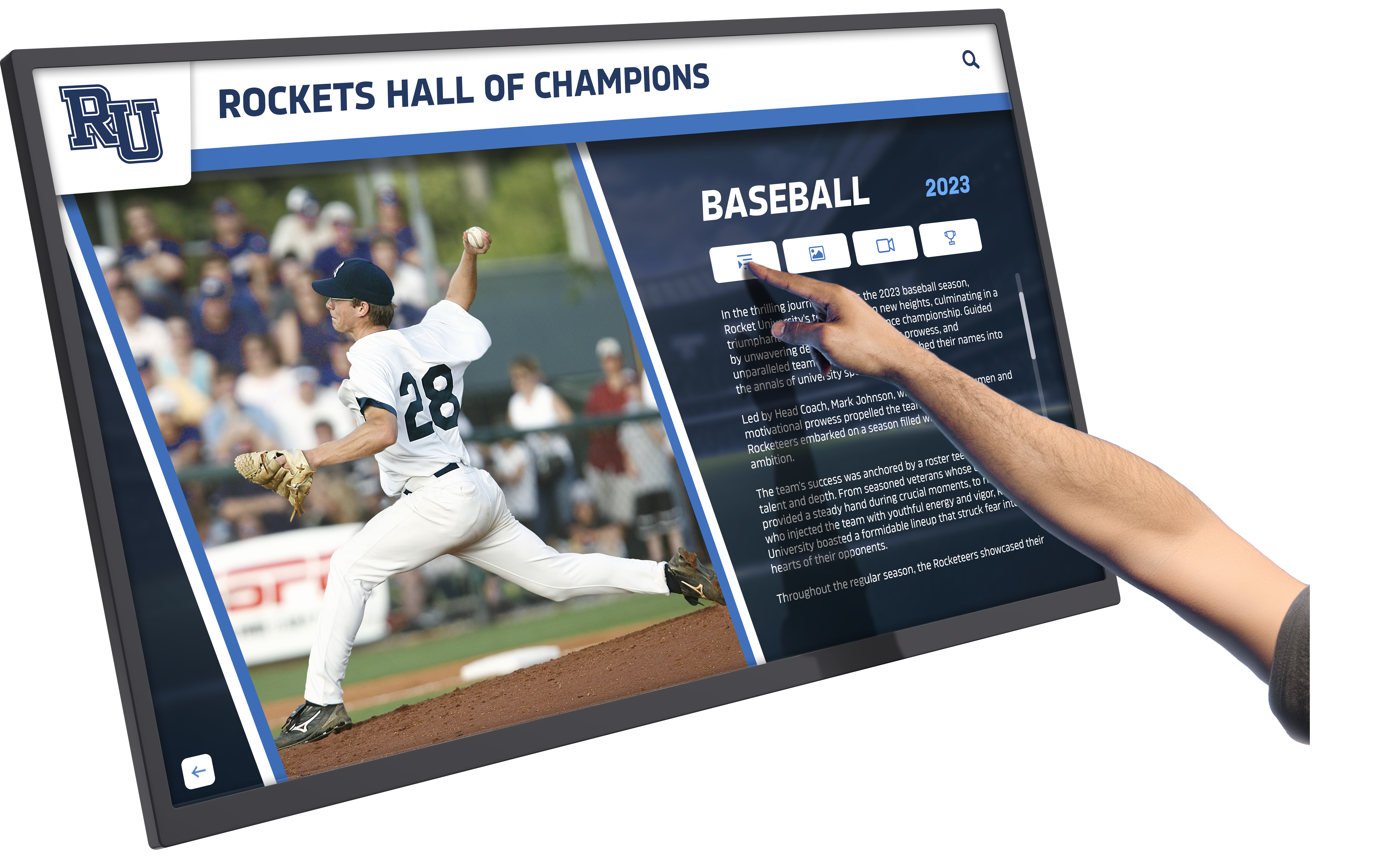
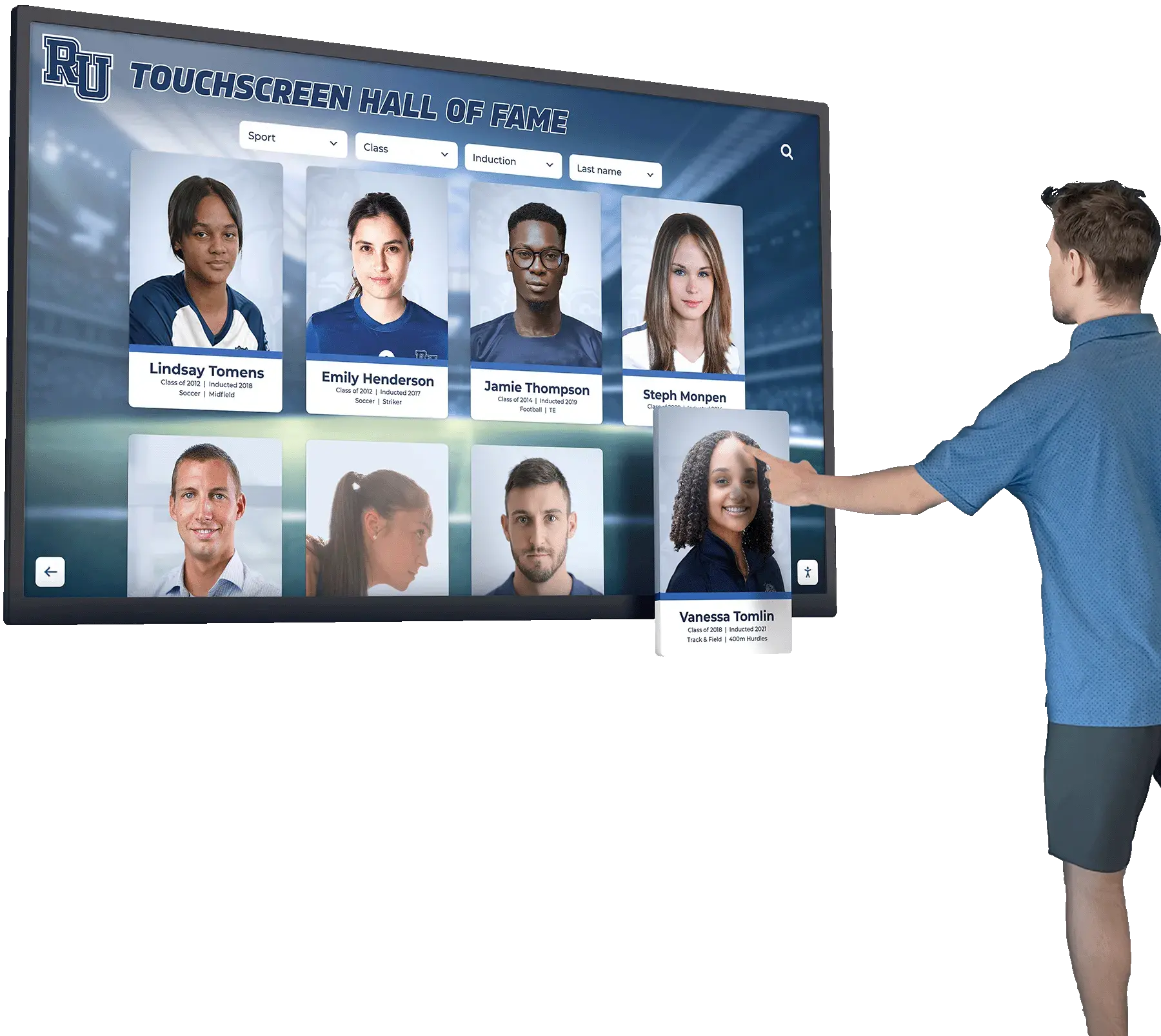
Intuitive card-based interfaces enable natural exploration with clear touch targets and immediate visual feedback
Brand Integration Checklist
Digital halls of fame should reflect institutional identity while providing professional, engaging experiences.
Visual Identity Implementation
Color Systems
Apply institutional colors systematically throughout experiences:
- Primary brand colors for hero areas, navigation elements, and key UI components
- Secondary colors for backgrounds, dividers, and supporting elements
- Accent colors for interactive elements, highlights, and calls-to-action
- Neutral colors for text and content areas ensuring readability
Typography Hierarchy
Establish clear type systems supporting both brand and readability:
- Headline fonts reflecting brand personality for titles and featured text
- Body fonts optimizing legibility for biographical content and descriptions
- Size scales creating clear information hierarchy from titles through captions
- Weight variations emphasizing key information without excessive styling
Logo and Marks
Integrate institutional marks appropriately:
- Primary logos in hero areas maintaining required clear space
- Secondary marks as watermarks or footer elements
- Mascot integration when appropriate for athletic recognition
- Sponsor logos when funding partnerships justify inclusion
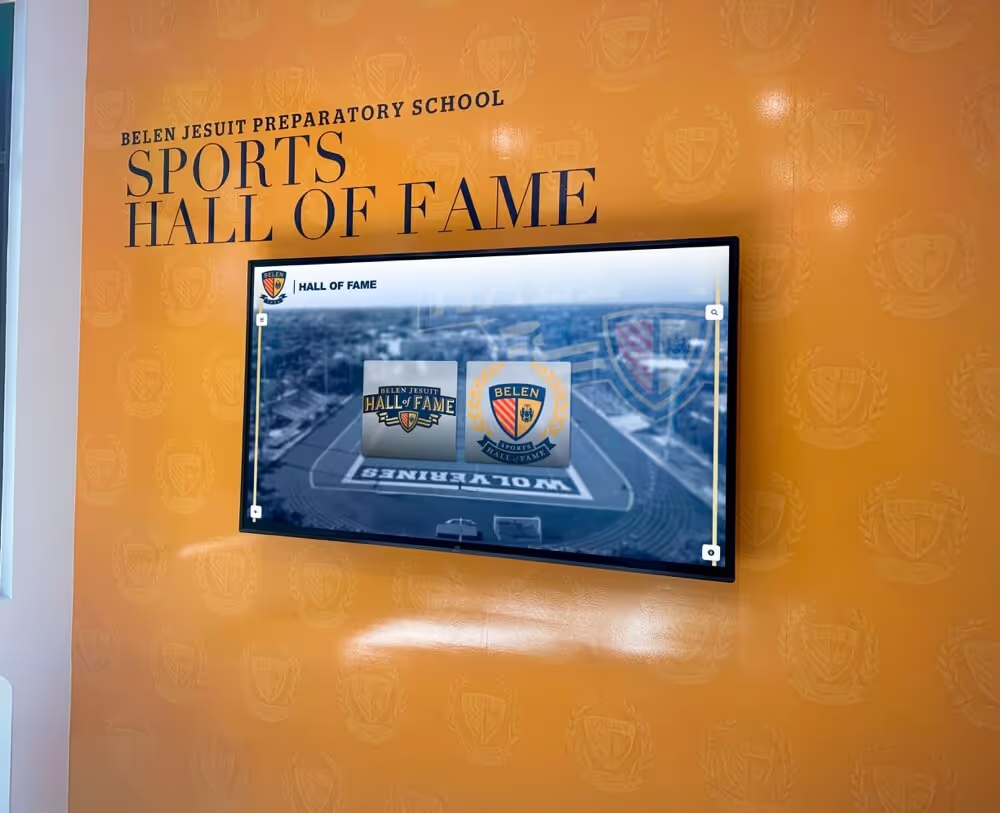
Custom Backgrounds and Imagery
Environmental Photography
Incorporate location-specific imagery creating connection to place:
- Campus or facility exteriors establishing institutional context
- Interior architectural details (hallways, gyms, stadiums) providing familiarity
- Landscape or cityscape imagery connecting to geography
- Historical photos blending heritage with modern presentation
Pattern and Texture Libraries
Subtle background treatments add visual interest without competing with content:
- Geometric patterns derived from architectural elements or logos
- Texture overlays suggesting materials (brick, wood, metal) connecting to physical spaces
- Gradient treatments creating depth and dimensionality
- Motion graphics providing subtle movement in attraction loops
Video Backgrounds
Looping video backgrounds create dynamic, engaging experiences:
- Campus life footage showing students, activities, and community
- Athletic action highlighting sports excellence
- Time-lapse sequences demonstrating facility evolution
- Abstract motion graphics supporting brand without distraction
Considerations for implementing digital storytelling in athletic programs provide frameworks for effective multimedia integration.
Sponsorship Zones and Donor Recognition
Many institutions fund digital recognition through sponsorships requiring tasteful integration:
Sponsor Placement Strategies
- Dedicated sponsor logos in footer areas with rotation for multiple supporters
- Splash screens acknowledging major funders before experience begins
- Named displays crediting donors funding specific installations
- Sponsor mentions in featured content when appropriate
Balancing Recognition and Experience
Avoid excessive commercialization degrading user experience:
- Limit sponsor content to 10-15% of screen real estate maximum
- Maintain clear visual separation between sponsor and honoree content
- Ensure sponsor materials match overall design quality
- Update sponsor content regularly maintaining current relationships
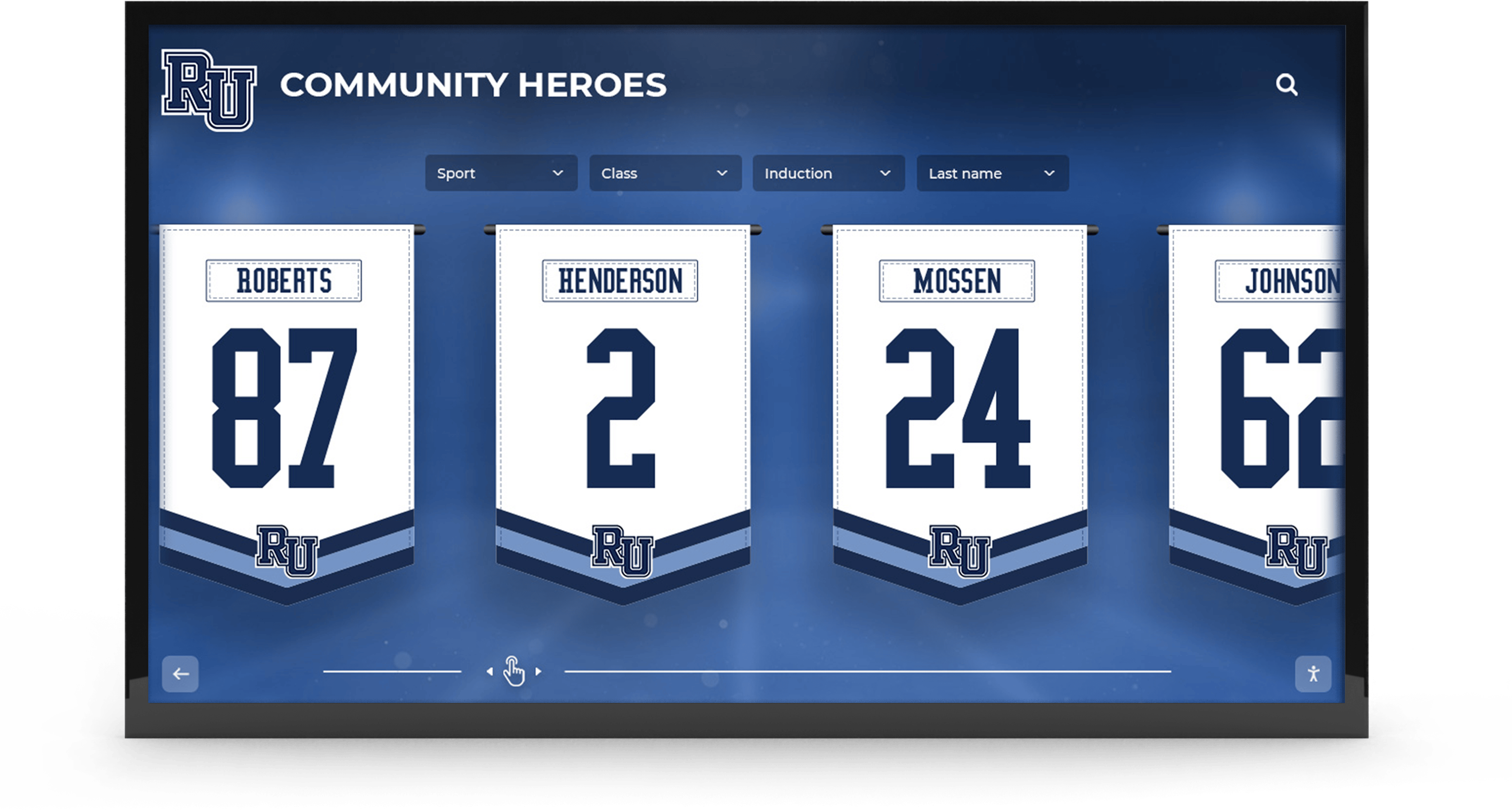
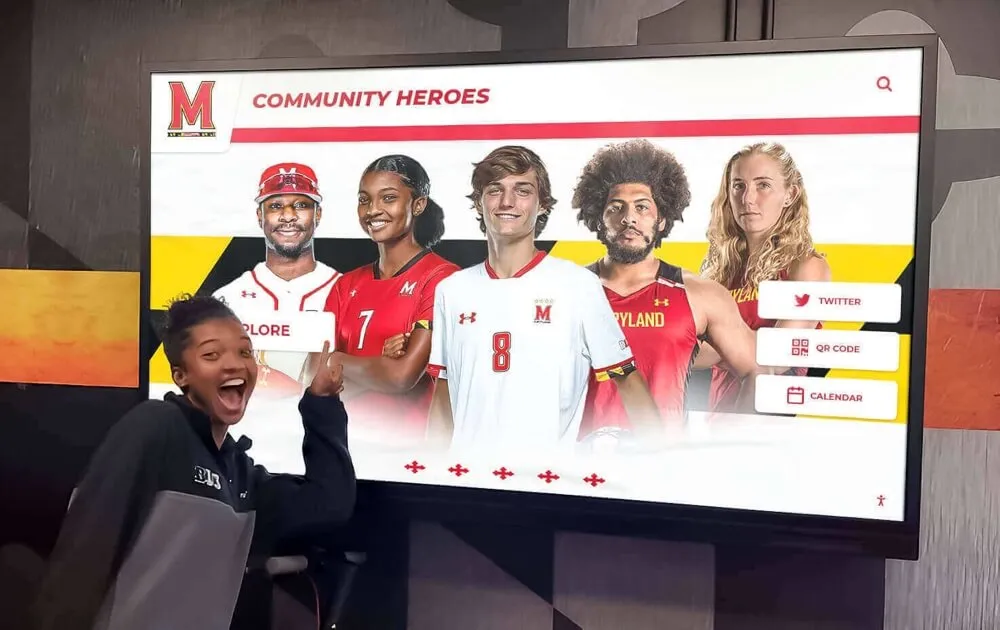
Dynamic banner displays highlight multiple honorees simultaneously through compelling visual arrangements
Content Development Strategy
Digital hall of fame value depends entirely on quality content celebrating achievements comprehensively.
Gathering Recognition Content
Systematic content collection ensures comprehensive, accurate recognition:
Source Identification
Compile content from diverse institutional sources:
- Athletic record books and archives documenting achievement statistics
- Yearbooks providing photos and historical context across decades
- School newspapers and media coverage capturing contemporaneous accounts
- Personal collections from families, alumni, and honorees
- Digital archives and databases when previously digitized
- Oral history interviews gathering first-person perspectives
Information Architecture
Structure content systematically supporting multiple display contexts:
- Individual honoree profiles as atomic content units
- Team and group recognition linking related individuals
- Championship and achievement records providing context
- Timeline and historical content establishing era context
- Multimedia assets (photos, videos, audio) supporting stories
Content Standards and Guidelines
Establish quality standards ensuring consistency:
- Photo resolution minimums (1920x1080 or higher for primary images)
- Biographical length guidelines (150-300 words for standard profiles)
- Citation requirements for statistics and achievements
- Approval workflows ensuring accuracy before publication
- Privacy guidelines respecting sensitive information
Writing Compelling Recognition Narratives
Effective profiles balance comprehensive information with accessible storytelling:
Biographical Framework
Structure narratives following engaging patterns:
- Opening hook capturing defining achievement or memorable moment
- Background context establishing honoree’s journey to excellence
- Achievement highlights detailing specific accomplishments with statistics
- Impact and legacy explaining significance beyond raw statistics
- Current status providing honoree updates when available
- Personal quotes or testimonials adding authentic voice
Storytelling Techniques
Transform facts into compelling narratives:
- Specific details and anecdotes rather than generic descriptions
- Action verbs and dynamic language rather than passive voice
- Contextual comparisons helping audiences understand significance
- Emotional resonance connecting achievements to larger meaning
- Accessible language avoiding excessive jargon
Rather than stating “Member of 1995 state championship team,” write “Led team to program’s first state championship with game-winning performance remembered as defining moment in school history.” This approach creates engagement and understanding transforming recognition from directories into compelling archives preserving institutional memory.
Guidelines for creating effective recognition content provide detailed frameworks for profile development across recognition categories.
Multimedia Content Production
Rich media transforms recognition from documentation to immersive storytelling:
Photo Curation and Enhancement
- Select images showing honorees in action rather than static portraits only
- Create photo galleries showcasing individuals throughout their involvement
- Digitize and restore historical photos maintaining quality standards
- Crop and optimize images for display dimensions and file sizes
- Apply consistent color correction ensuring visual cohesion
Video Content Development
- Produce interview videos capturing honorees’ personal reflections
- Compile highlight reels from game footage and event recordings
- Create narrative video profiles combining photos, clips, and narration
- Edit content to 2-4 minute durations respecting attention spans
- Caption all video content supporting accessibility and sound-off viewing
Audio and Document Archives
- Record audio interviews preserving oral histories
- Scan historical documents, newspaper articles, and programs
- Digitize awards certificates and achievement documentation
- Create audio descriptions for visual content supporting accessibility

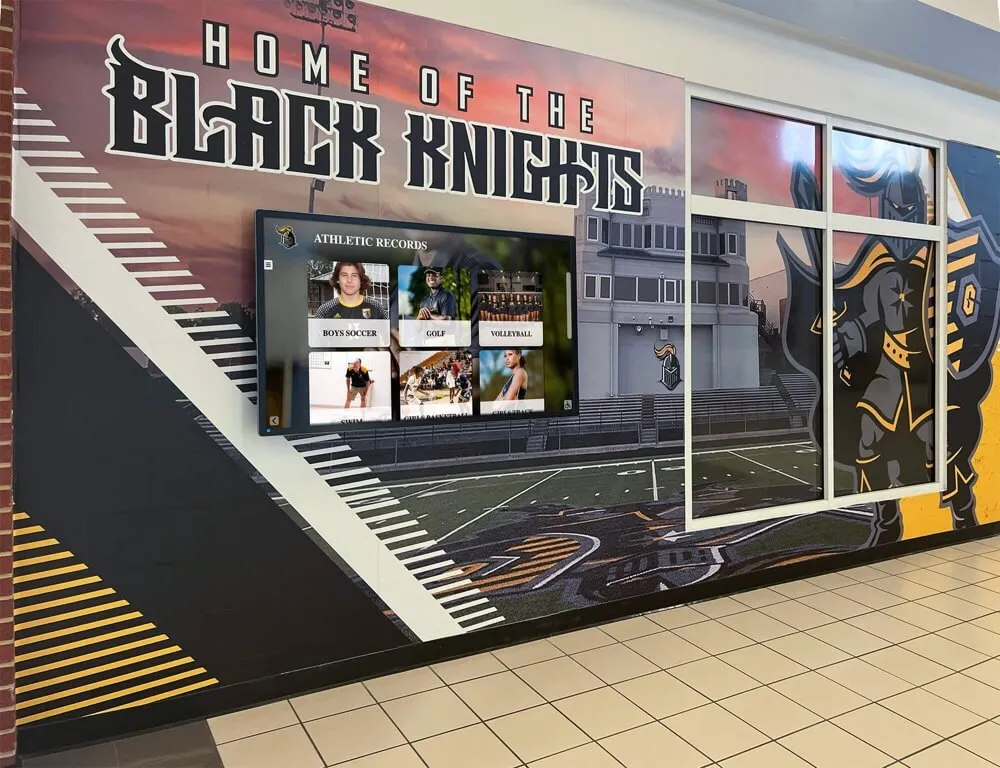
Sport-specific displays celebrate individual athlete excellence through dynamic imagery and branded presentation
Implementation and Activation Plan
Successful digital hall of fame launch requires strategic planning across technology, content, placement, and promotion.
Technology Selection and Platform Evaluation
Choose solutions aligned with institutional needs and capabilities:
Hardware Considerations
- Screen size based on viewing distances and content density (43-55" for close viewing, 65-75" for distance viewing)
- Commercial vs. consumer displays (commercial-grade required for continuous operation)
- Touch technology options (capacitive for responsive consumer-like experience, infrared for larger sizes)
- Mounting requirements and physical space constraints
- Network connectivity options (hardwired Ethernet preferred over WiFi for reliability)
Software Platform Requirements
- Purpose-built recognition software vs. generic digital signage platforms
- Cloud-based management enabling updates from any location
- Multi-user permissions supporting distributed content management
- Web portal integration extending recognition beyond physical displays
- Analytics and reporting demonstrating engagement and value
Vendor Evaluation Criteria
- Demonstrated experience with educational/institutional recognition
- Quality of reference installations and client testimonials
- Technical support availability and response commitments
- Training resources and onboarding assistance
- Total cost of ownership including hardware, software, and support
Organizations should request live demonstrations with actual recognition content, speak with reference clients about implementation experiences, and verify accessibility compliance before committing to platforms. Comprehensive digital recognition buyer guides provide detailed vendor evaluation frameworks.
Strategic Placement and Installation
Display effectiveness depends significantly on strategic location selection:
Optimal Installation Locations
- Main entrance lobbies welcoming visitors immediately upon arrival
- Athletic facilities surrounding current athletes with program tradition
- Cafeterias and common areas where students gather daily
- Hallways connecting high-traffic areas capturing movement
- Administrative offices visited during tours and recruitment
- Alumni centers serving returning graduates and donors
Installation Best Practices
- Professional mounting ensuring weight support and security
- Appropriate viewing height (center of screen at 48-60" for standing adults, lower for seated viewing)
- Adequate lighting avoiding glare and washout
- Power and network access with concealed cable management
- Physical security measures preventing theft or vandalism
- Protective surrounds when in high-traffic or impact-risk areas
Phased Deployment Strategies
Many institutions implement recognition in phases:
- Phase 1: Flagship installation in highest-visibility, highest-traffic location
- Phase 2: Category-specific displays in relevant areas (athletic recognition in gyms, academic recognition in libraries)
- Phase 3: Comprehensive network covering all major spaces and audiences
Phased approaches enable budget spreading while demonstrating value justifying expansion investment.
Refresh Cadence and Content Maintenance
Establish sustainable update workflows maintaining current, engaging content:
Content Update Schedule
- Induction ceremonies: Add new honorees within 24 hours of events
- Quarterly reviews: Verify accuracy and update evolving information
- Annual archives: Add historical content systematically expanding coverage
- Special events: Create featured collections for homecoming, reunions, anniversaries
Content Governance
- Assign clear responsibility for different recognition areas
- Implement approval processes ensuring accuracy before publication
- Document content standards and guidelines for consistency
- Train multiple staff members preventing single-person dependencies
- Archive source materials supporting future updates and corrections
Technical Maintenance
- Monitor display operation through remote management tools
- Schedule regular software updates maintaining security and functionality
- Clean screens and hardware protecting appearance and functionality
- Verify network connectivity and content synchronization
- Document hardware warranties and support contacts
Resources on maintaining digital recognition displays provide detailed operational frameworks ensuring long-term program sustainability.
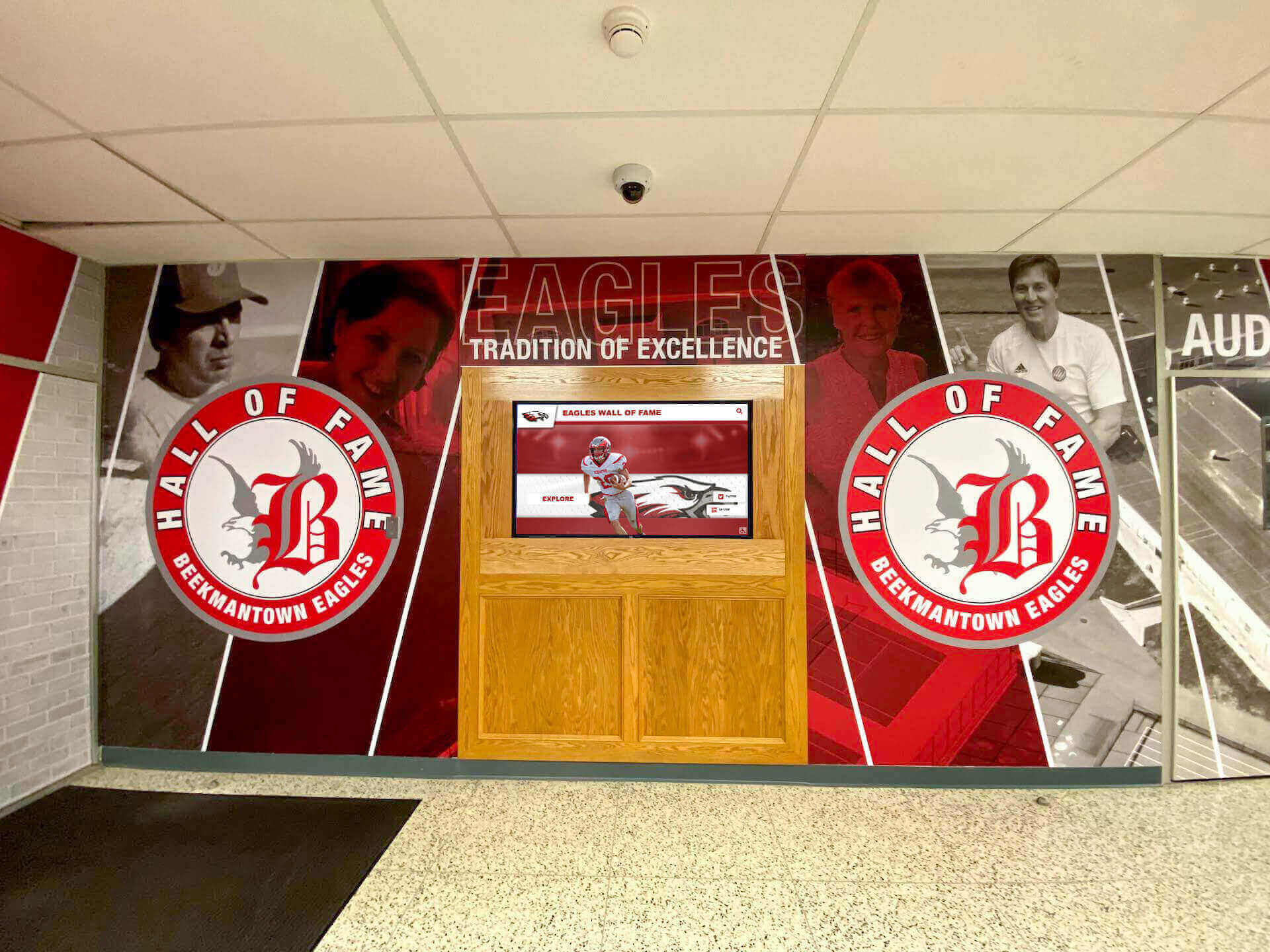
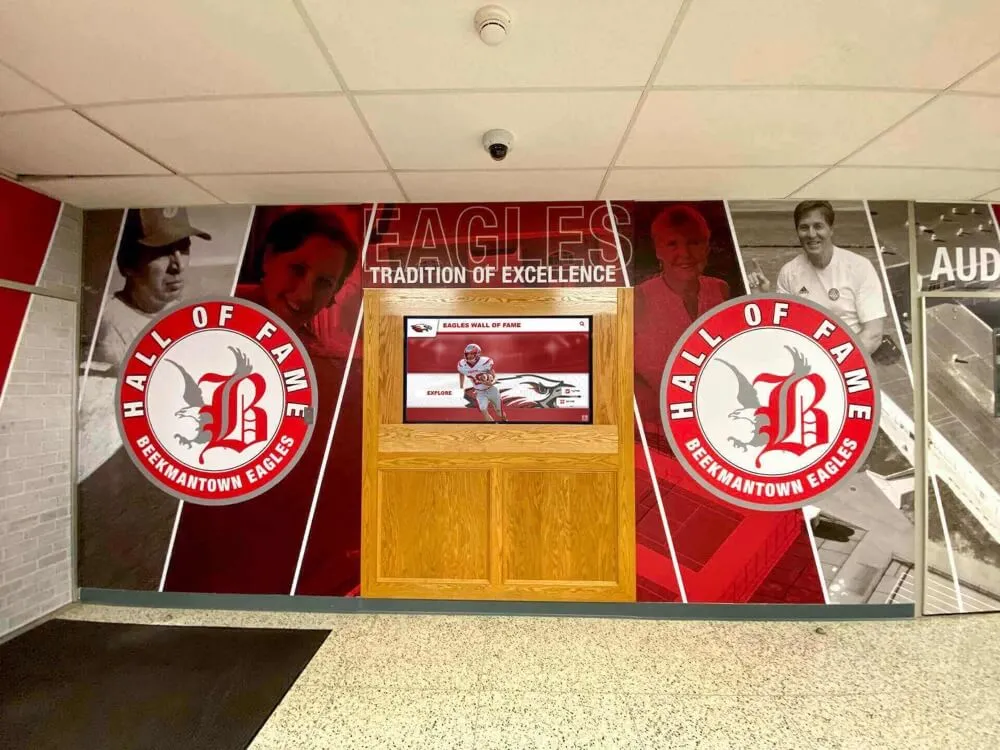
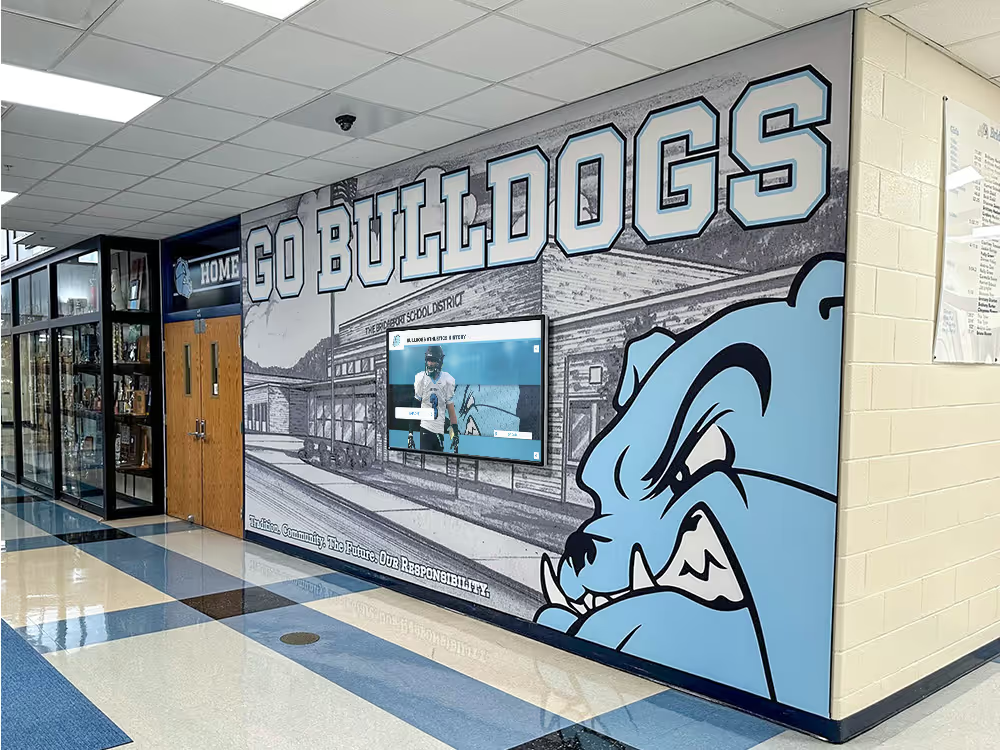
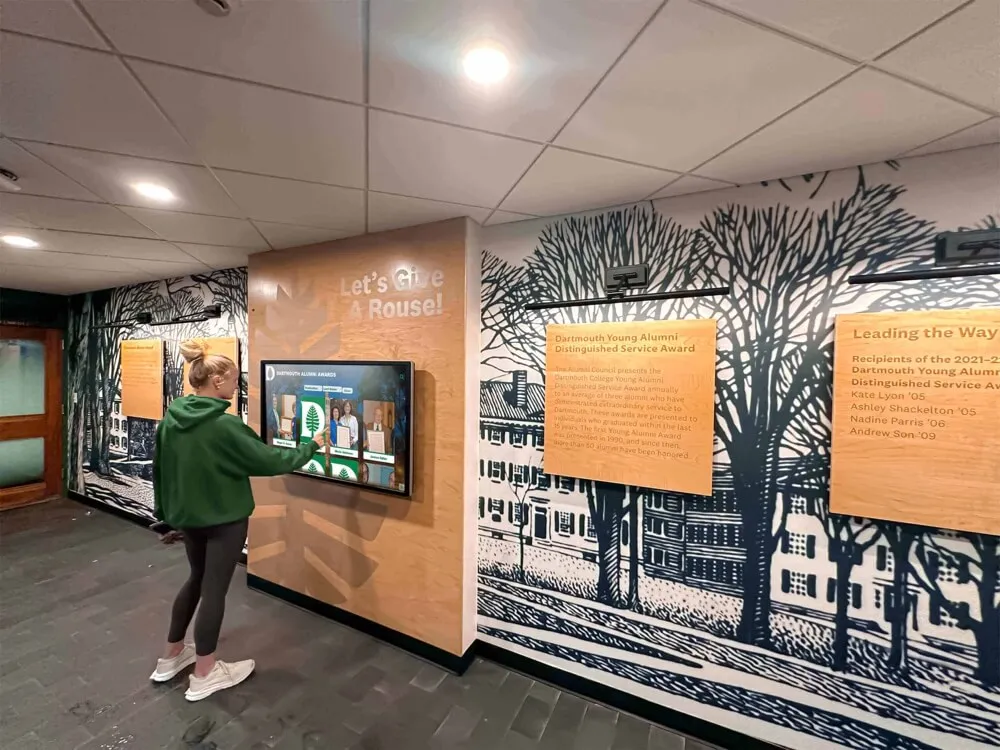
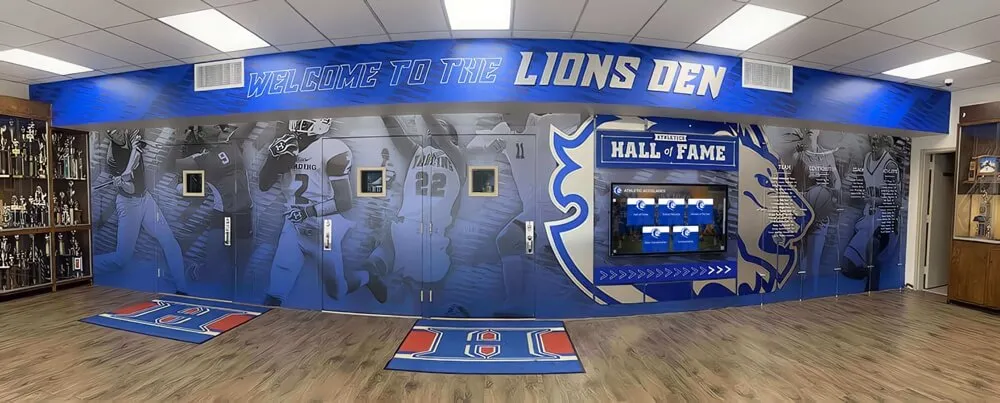
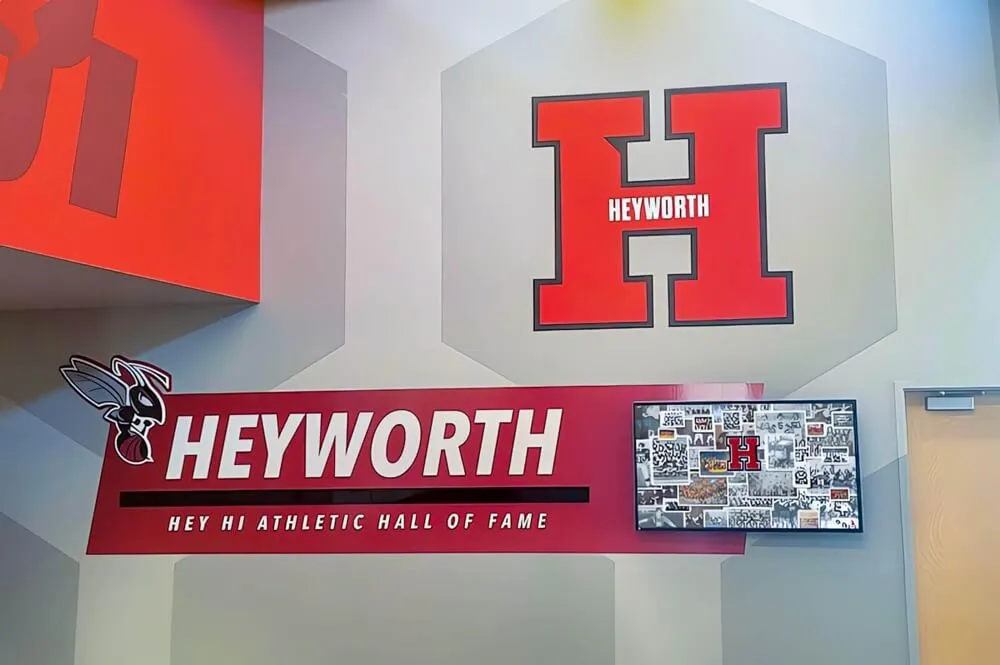
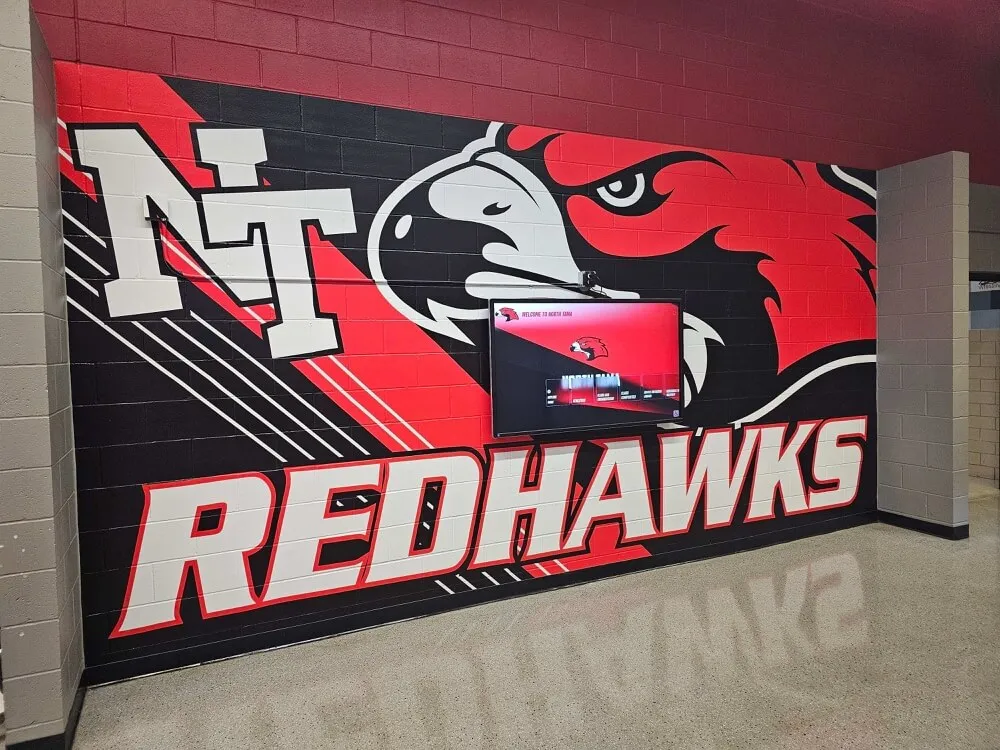
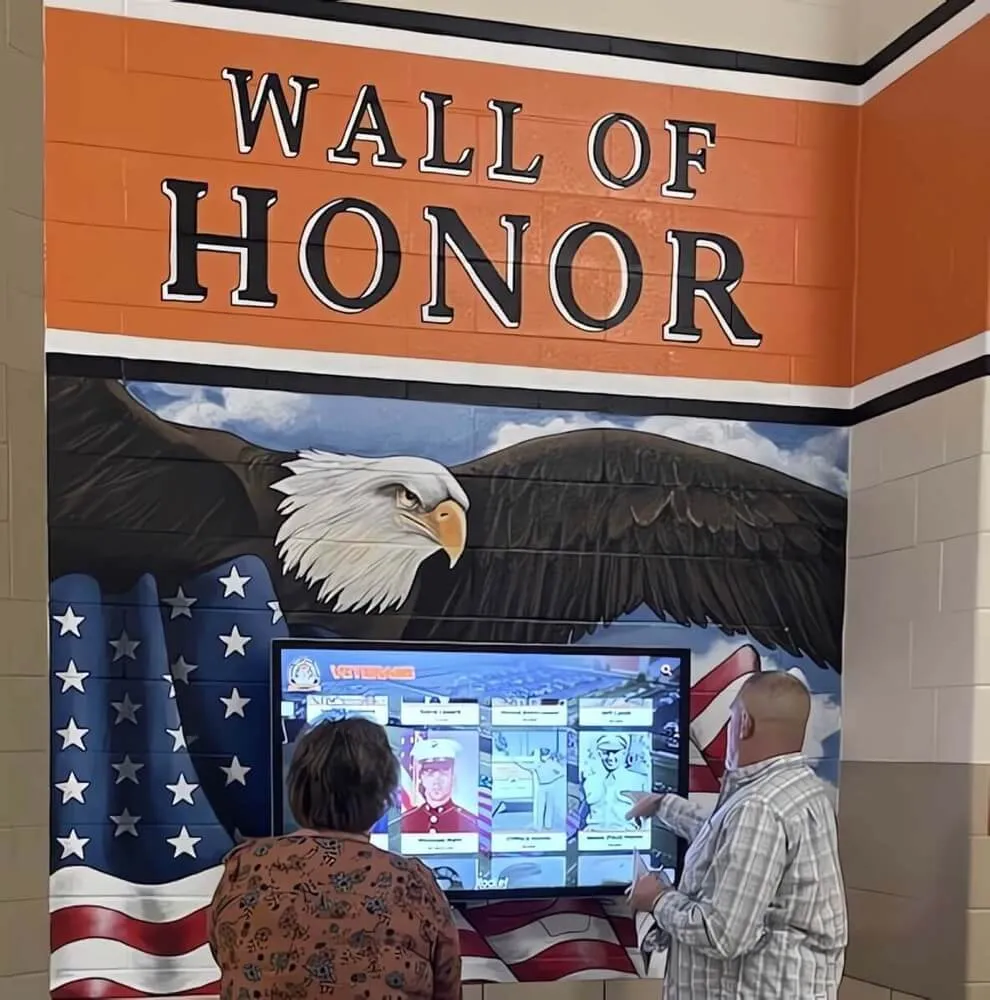
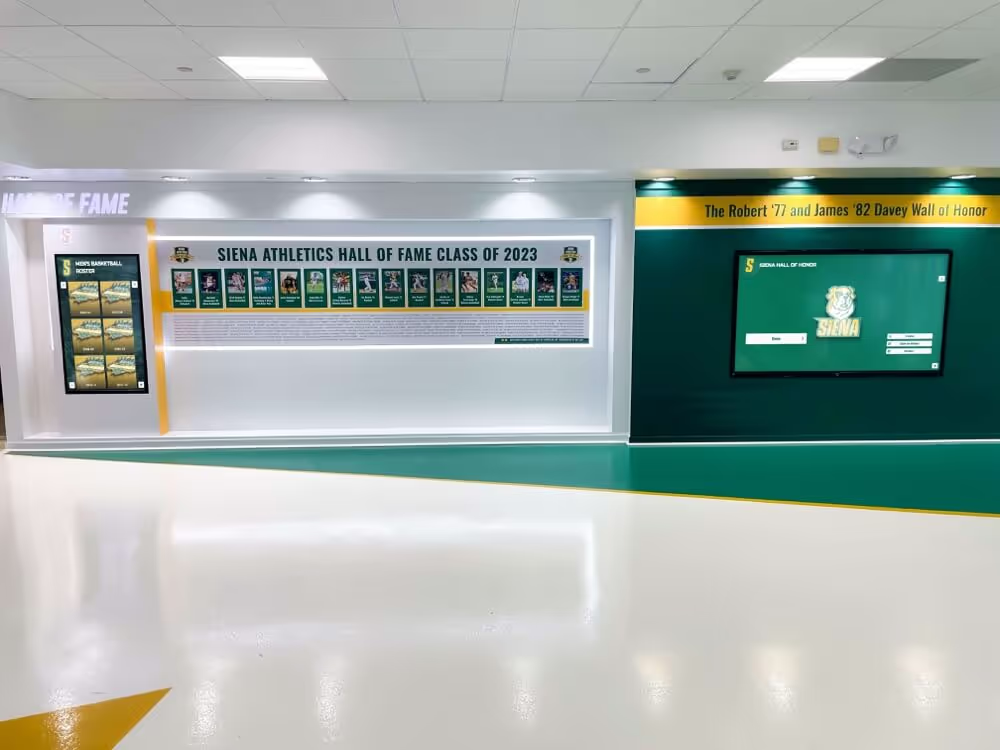
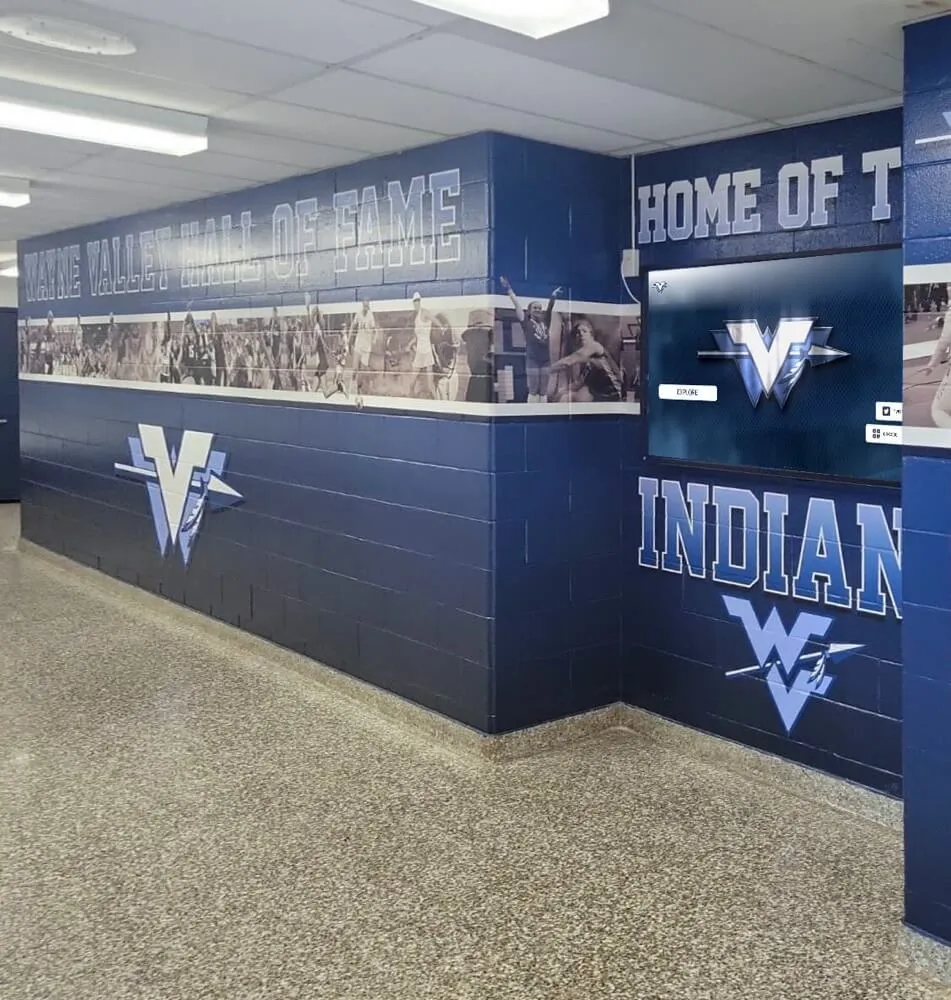
Integrated installations blend digital displays with traditional murals creating comprehensive recognition environments
Measuring Success and Optimizing Engagement
Data-driven evaluation ensures recognition investments deliver value while identifying improvement opportunities.
Engagement Metrics and Analytics
Quality recognition platforms provide comprehensive usage tracking:
Quantitative Engagement Metrics
- Total interaction sessions showing frequency of display use
- Average session duration indicating depth of content engagement
- Most-viewed profiles revealing popular content and community interests
- Search terms demonstrating what visitors seek
- Peak usage times informing content launch strategies
- Return visitor rates showing sustained interest
- Social share counts demonstrating content reaching beyond physical displays
Behavioral Analysis
Analytics reveal patterns informing optimization:
- Navigation paths showing how visitors explore content
- Drop-off points identifying confusing or problematic interfaces
- Search failures highlighting missing or hard-to-find content
- Category popularity guiding content development priorities
- Time-of-day patterns enabling attraction loop optimization
Comparative Performance
Benchmark against goals and similar installations:
- Engagement rates comparing sessions to facility traffic
- Growth trends showing increasing or declining usage
- Category comparisons identifying stronger and weaker content areas
- Pre/post implementation measuring impact on awareness and pride
Qualitative Assessment and Community Feedback
Beyond quantitative analytics, gather qualitative insights:
Direct Feedback Collection
- Surveys assessing recognition program awareness and satisfaction
- Comment cards or digital feedback forms near displays
- Staff observations documenting visitor engagement patterns
- Focus groups with stakeholders exploring detailed perspectives
- Social media monitoring capturing organic comments and shares
Observational Research
Watch visitors interact with displays noting:
- Which navigation paths prove intuitive vs. confusing
- Where visitors hesitate or abandon exploration
- What prompts groups to gather and discuss content
- How different age groups approach and use interfaces
- What content generates visible excitement or emotion
Stakeholder Input
Regularly gather feedback from key constituencies:
- Honorees’ reactions to their own recognition
- Alumni engagement levels and satisfaction
- Current student and athlete awareness and pride
- Administrative assessment of program value
- Donor perspectives when recognition involves fundraising
This qualitative feedback often reveals impact that metrics cannot capture—understanding what truly resonates and what improvements would enhance recognition program effectiveness.
Continuous Improvement and Iteration
Use insights to refine recognition experiences over time:
Content Enhancement
- Add missing profiles or categories revealed through search failures
- Enrich existing profiles responding to visitor interest
- Create featured collections highlighting compelling themes
- Update navigation based on observed usage patterns
- Expand multimedia content in high-engagement profiles
Design Refinement
- Simplify confusing navigation based on usability observations
- Adjust color contrast responding to visibility issues
- Resize touch targets if interaction difficulties observed
- Refine information density balancing comprehensiveness with clarity
- Update attraction loops maintaining freshness and interest
Technical Optimization
- Improve loading speed for smoother experiences
- Fix bugs or errors discovered through usage
- Enhance search algorithms based on query patterns
- Optimize content delivery reducing bandwidth requirements
- Update software maintaining security and capabilities
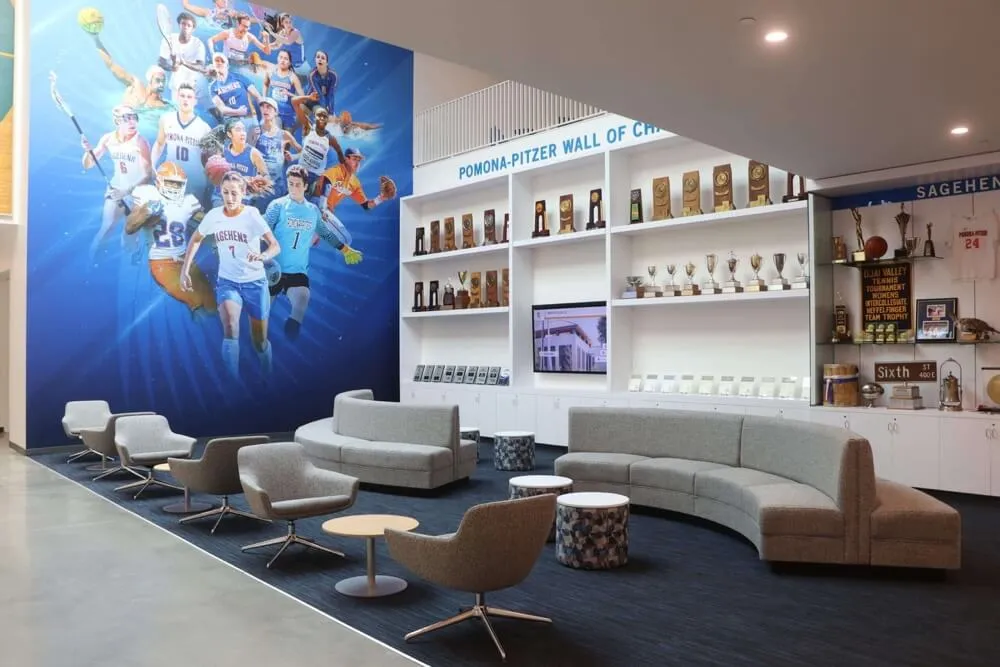
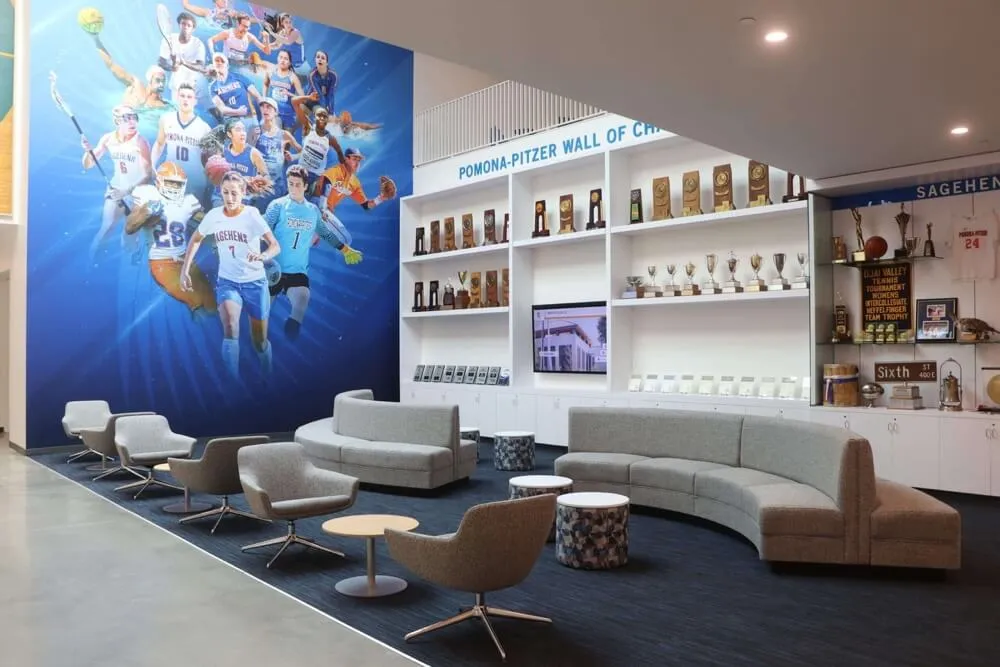
Creating comfortable viewing environments with seating encourages extended engagement and group exploration
Special Recognition Applications and Use Cases
While athletic halls of fame represent common applications, digital recognition serves diverse institutional needs.
Athletic Excellence and Championship Recognition
Athletic recognition benefits tremendously from digital approaches:
Comprehensive Coverage Across All Sports
Digital platforms enable systematic recognition regardless of sport prominence:
- Hall of fame inductees from all sports and eras
- Championship teams with complete rosters and season documentation
- Individual record holders with performance statistics and context
- All-conference, all-state, and national honors
- Coaching excellence spanning program development
Resources on basketball hall of fame recognition and hockey recognition programs demonstrate sport-specific implementation approaches.
Statistical Record Boards
Interactive record displays serve dual purposes of recognition and motivation:
- School records by sport with athlete names and dates
- Season progression showing record evolution over time
- Comparison filters enabling year-by-year or athlete-by-athlete analysis
- Video highlights preserving record-setting performances
- Current season leaderboards motivating ongoing achievement
Guidelines for finding and displaying school sports records provide systematic record compilation frameworks.
Academic Achievement and Scholar Recognition
Academic excellence deserves visibility equal to athletic success:
Comprehensive Academic Recognition
- Valedictorians and salutatorians across graduating classes
- National Merit Scholars and academic competition winners
- Perfect or near-perfect standardized test scores
- Academic honor society members and leadership
- Prestigious scholarship recipients
- Subject-specific achievement in STEM, humanities, arts
Detailed approaches to academic recognition programs demonstrate systematic academic excellence celebration that motivates intellectual achievement and strengthens academic culture.
Alumni Achievement and Distinguished Graduate Recognition
Alumni recognition connects current students with institutional legacy:
Distinguished Alumni Categories
- Professional achievement and career success
- Community service and philanthropic leadership
- Creative accomplishment in arts and entertainment
- Academic achievement and research contributions
- Entrepreneurial success and business leadership
- Athletic achievement beyond school competition
Comprehensive alumni recognition strategies provide frameworks for identifying, honoring, and celebrating distinguished graduates while strengthening alumni engagement.
Donor Recognition and Philanthropic Appreciation
Digital recognition transforms donor acknowledgment beyond traditional walls:
Donor Recognition Tiers
- Major gift profiles with photos, biographical content, and impact stories
- Leadership circle members with enhanced recognition
- Cumulative giving societies organized by lifetime contribution levels
- Campaign-specific recognition celebrating particular initiatives
- Memorial giving honoring individuals through named gifts
Organizations should integrate donor recognition with broader digital donor recognition strategies ensuring philanthropic appreciation receives appropriate visibility and sophistication.
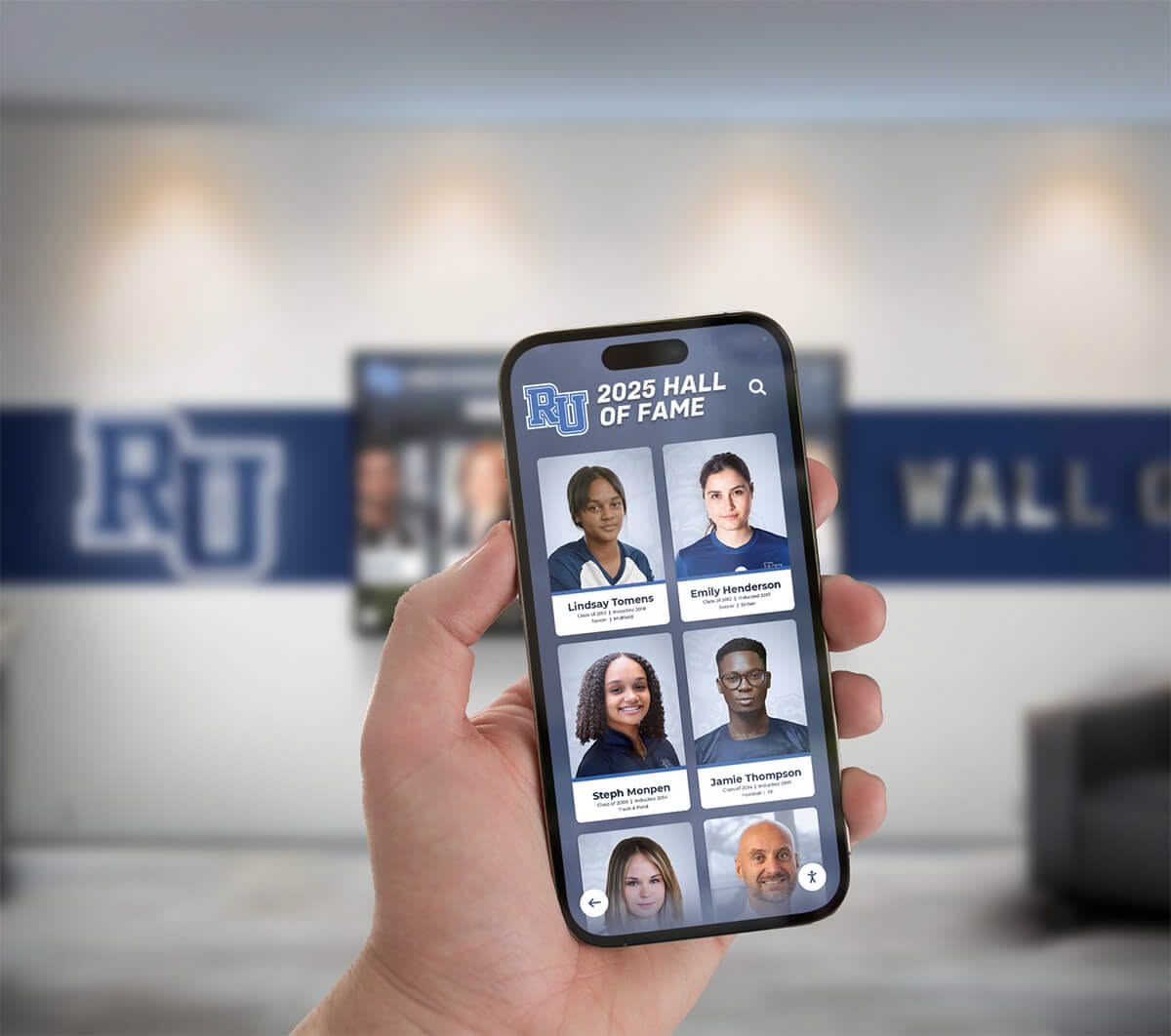
Mobile and web access extends recognition beyond physical displays, enabling exploration from anywhere
Common Implementation Challenges and Solutions
Understanding typical obstacles helps organizations proactively address challenges:
Budget Constraints and Funding Strategies
Digital recognition requires initial investment typically $8,000-15,000 per display:
Alternative Funding Approaches
- Capital campaigns incorporating recognition technology
- Memorial giving programs funding displays honoring deceased community members
- Corporate sponsorships particularly for athletic recognition
- Booster club support from parent and alumni organizations
- Grant opportunities through educational technology foundations
- Phased implementation starting small and expanding
Some institutions incorporate recognition into facility renovation projects, treating displays as permanent infrastructure deserving capital funding rather than limiting consideration to operating budgets.
Content Development Capacity
Comprehensive recognition requires significant content development:
Resource Strategies
- Start focused on recent years before expanding historical coverage
- Engage volunteers, particularly alumni passionate about heritage preservation
- Solicit community assistance gathering information and photos
- Contract professional digitization services for large-scale projects
- Establish student internship programs supporting content development
- Create sustainable workflows distributing effort over time
Launch with achievable content scope demonstrating value, then systematically expand coverage as capacity allows.
Technical Support and Ongoing Maintenance
Organizations without technical expertise worry about long-term support:
Support Strategies
- Select platforms with comprehensive vendor support
- Prioritize cloud-based systems requiring minimal local IT
- Choose commercial-grade hardware with extended warranties
- Establish clear vendor relationships with response guarantees
- Train multiple staff members preventing single-person dependencies
- Document procedures supporting continuity during transitions
Quality vendors understand that schools and nonprofits need reliable, low-maintenance solutions rather than complex systems requiring constant technical intervention.
Organizational Change Management
Introducing new recognition approaches sometimes faces stakeholder resistance:
Change Management Approaches
- Demonstrate how digital enhances rather than replaces valued traditions
- Involve stakeholders in planning ensuring priorities shape implementation
- Provide comprehensive training for content management staff
- Celebrate early wins highlighting positive impacts
- Maintain traditional elements alongside digital during transitions
- Communicate benefits consistently to build understanding and support
Successful organizations treat digital recognition as cultural initiative requiring communication and engagement rather than purely technical deployment. Understanding approaches for effectively implementing digital recognition provides comprehensive change management frameworks.
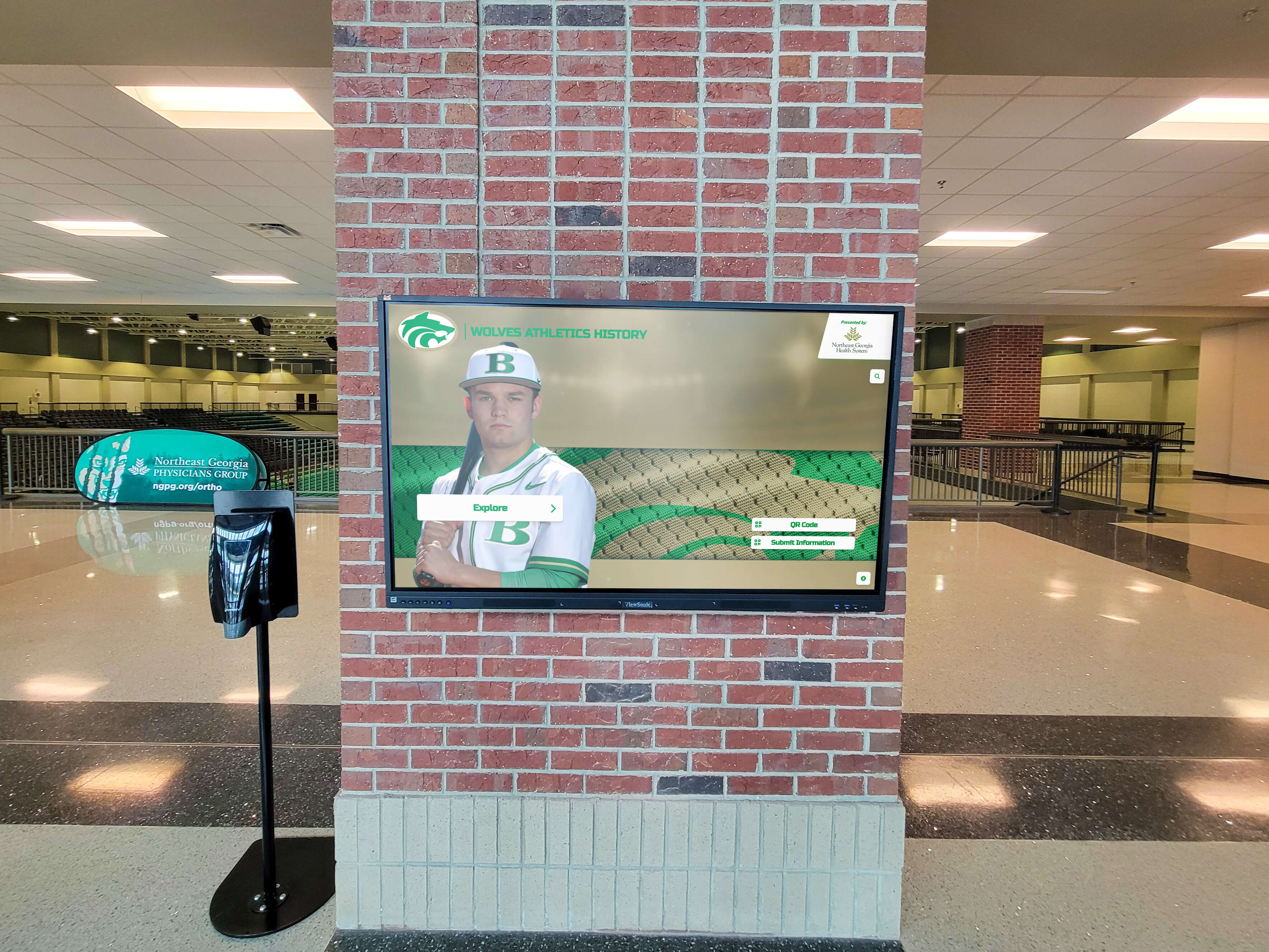
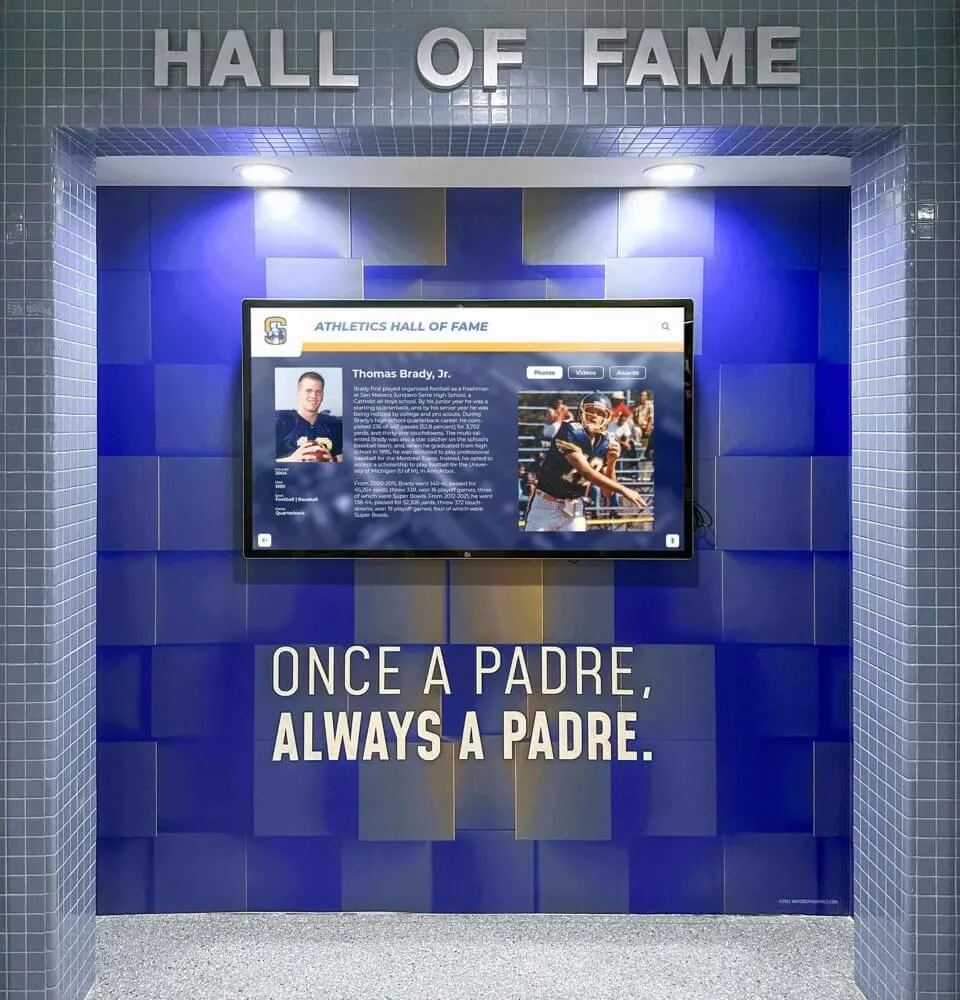
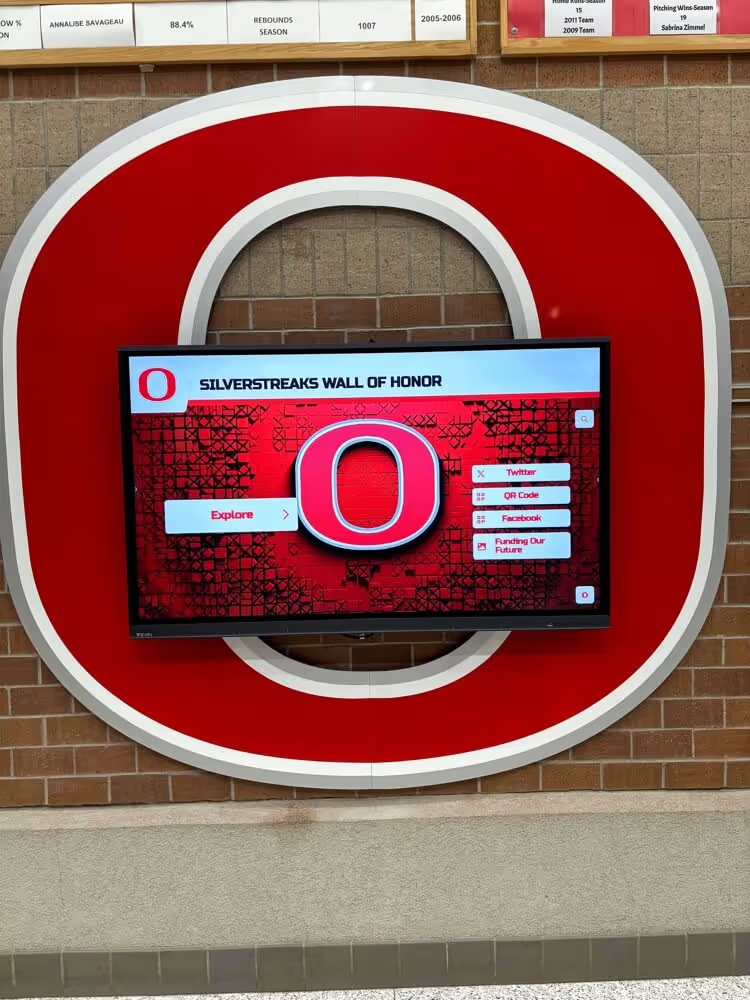
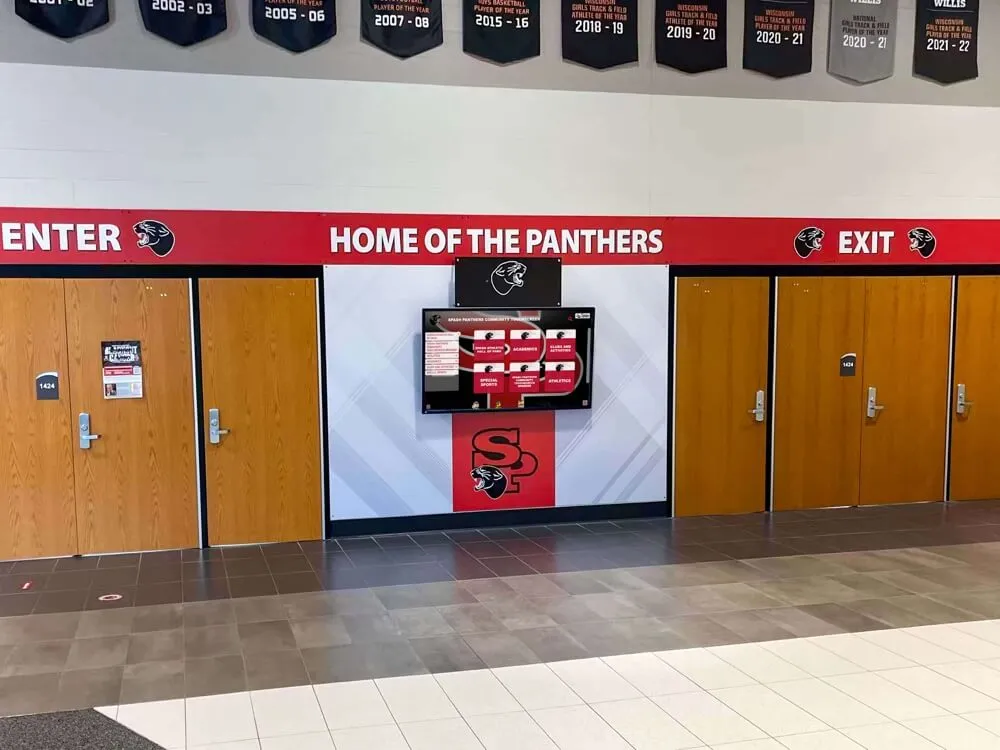
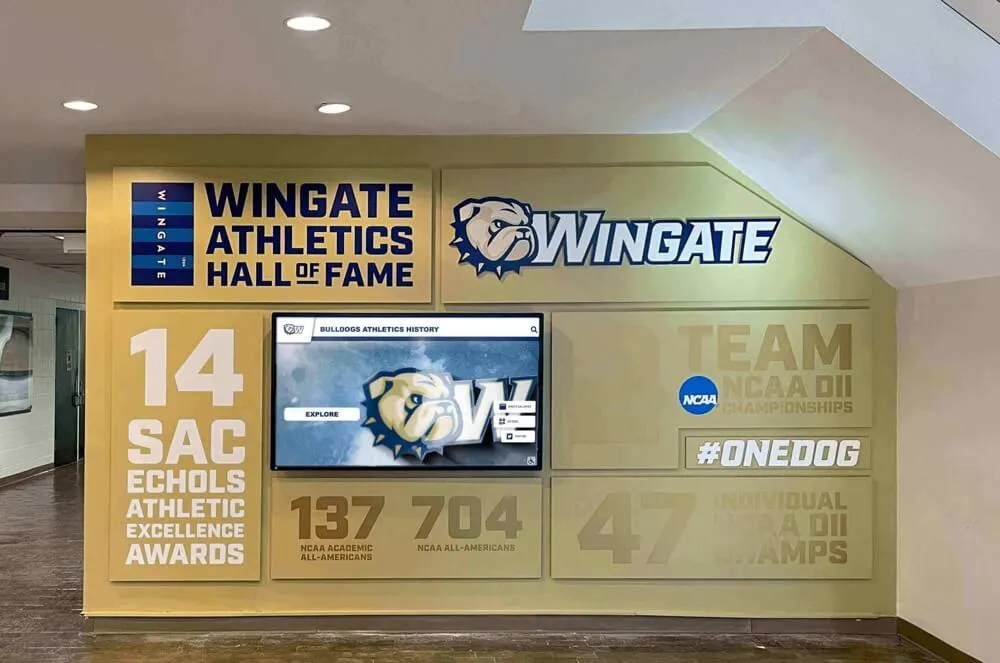
Architectural integration positions displays as permanent features complementing rather than competing with facility design
Best Practices for Long-Term Success
Learn from organizations achieving sustained recognition program success:
Start with Clear Strategy and Goals
Successful recognition begins with fundamental questions:
- What achievement categories require recognition?
- Who are primary audiences and what do they value?
- What outcomes should recognition achieve?
- How will we measure success?
- What resources can we sustainably commit?
This strategic foundation prevents tactical implementations lacking coherence or failing to serve institutional goals.
Prioritize Content Quality Over Quantity
Better to recognize 50 individuals comprehensively than 500 minimally. Rich profiles with photos, narratives, and context create engagement while basic name listings provide limited value beyond documentation.
Establish quality standards and build content systematically rather than pursuing immediate comprehensive coverage at expense of storytelling quality.
Design for Multiple Audiences and Use Cases
Effective recognition serves diverse constituencies:
- Current students and athletes exploring role models and history
- Prospective members evaluating institutional traditions
- Alumni reconnecting with their own recognition
- Families celebrating relatives’ achievements
- Visitors learning about organizational excellence
- Donors understanding philanthropic impact
Design navigation and content supporting all these usage patterns rather than optimizing for single primary audience.
Plan for Sustainability and Evolution
Recognition programs require sustained commitment:
- Budget ongoing software licenses and support contracts
- Assign permanent staff responsibility with backup coverage
- Establish content development workflows integrated with ceremonies
- Schedule regular reviews maintaining accuracy and currency
- Plan technology refresh cycles anticipating hardware lifecycle
- Document procedures supporting continuity during staff transitions
Programs treated as projects rather than permanent initiatives often deteriorate within 2-3 years as initial enthusiasm fades and champions move on.
Integrate Recognition with Broader Programs
Digital halls of fame work most effectively when integrated with comprehensive recognition strategies:
- Connect recognition displays with ceremony and event programming
- Link digital content to recruitment and marketing communications
- Integrate recognition with fundraising and development operations
- Coordinate updates with communications and athletics calendars
- Leverage recognition for social media content and engagement
This integration maximizes recognition value while distributing effort across teams rather than burdening single individuals.
Conclusion: Creating Recognition Experiences That Inspire
Digital halls of fame represent fundamental advancement in celebrating achievement, preserving institutional heritage, and building community pride. By eliminating space constraints limiting traditional recognition, enabling immediate updates maintaining current content, creating engaging interactive experiences connecting audiences with tradition, incorporating rich multimedia storytelling, and extending accessibility beyond physical locations, touchscreen technology delivers solutions that traditional approaches cannot match.
Get Your Touchscreen Mock-Up
Discover how custom-designed digital hall of fame experiences can transform recognition for your school, university, or organization. Rocket Alumni Solutions creates interactive displays that honor achievement while engaging modern audiences through purposeful design.
Schedule Your Design ConsultationThe most successful digital hall of fame implementations start with clear recognition goals, select purpose-built platforms designed specifically for celebration rather than generic signage, develop thoughtful content strategies honoring individuals comprehensively, and position displays strategically where audiences naturally encounter recognition.
Whether implementing athletic recognition inspiring current competitors, academic displays celebrating intellectual achievement, alumni halls of fame demonstrating institutional impact, or donor recognition acknowledging philanthropic support, digital touchscreen technology provides proven solutions strengthening community culture while giving every deserving individual the permanent recognition their accomplishments merit.
Organizations investing in well-designed digital recognition demonstrate commitment to celebrating achievement comprehensively rather than limiting acknowledgment to arbitrary physical space constraints. This comprehensive approach communicates institutional values while building cultures where excellence across all dimensions receives systematic celebration creating motivation, pride, and lasting connection.
Ready to explore digital hall of fame options for your institution? Learn more about designing stunning touchscreen display layouts, discover interactive digital board applications, explore digital trophy wall strategies, and understand how to effectively implement recognition programs that honor achievement through modern interactive technology purpose-built for celebrating excellence and preserving institutional heritage for generations.