



Walk through any university graduation ceremony and you’ll hear Latin phrases that have echoed through academic halls for centuries. Cum laude, magna cum laude, and summa cum laude—these ancient designations continue to distinguish exceptional graduates from their peers, appearing on diplomas, transcripts, and résumés long after commencement ends. The Latin honors system represents one of higher education’s most enduring traditions, recognizing academic excellence through a framework that originated in medieval European universities and evolved to become the standard recognition method at American institutions.
Yet despite its ubiquity, the Latin honors system remains surprisingly complex and varied. Different universities apply dramatically different criteria for the same honors designations. What qualifies as magna cum laude at one institution might barely reach cum laude at another. The percentage of students receiving honors varies from less than 10% at some elite schools to over 50% at others. Meanwhile, ongoing debates about grade inflation, equity in honors distribution, and the relevance of traditional recognition systems continue to reshape how institutions approach academic distinction.
This comprehensive guide traces the Latin honors system from its medieval origins through its American adoption and modern applications. We’ll explore how universities determine honors criteria, examine variations across different types of institutions, investigate controversies surrounding the system, and discover how colleges now celebrate these achievements through both traditional ceremonies and innovative digital recognition platforms that preserve academic excellence for future generations.
Understanding the Latin honors system’s historical evolution and current implementation helps students pursue these distinctions strategically, enables institutions to recognize academic excellence effectively, and provides context for ongoing conversations about how universities should acknowledge scholarly achievement in the 21st century.

Modern institutions combine traditional Latin honors with digital recognition systems that permanently celebrate academic excellence and inspire current students
Medieval Origins: How Latin Honors Began in European Universities
The Latin honors system traces its roots to medieval European universities where Latin served as the universal language of scholarship, law, and church administration.
The Medieval University Context
During the 12th and 13th centuries, the first European universities emerged in Bologna, Paris, and Oxford. These institutions established frameworks for academic degrees that would influence higher education globally for the next millennium:
Medieval Degree Structure:
- Students progressed through defined stages of study
- Comprehensive examinations determined advancement
- Successful candidates received formal recognition from faculty
- Latin served as the universal academic language
- Degrees conferred specific privileges and professional standing
Within this structured environment, universities needed methods to distinguish students who demonstrated exceptional mastery of their subjects from those who merely met minimum requirements. The earliest forms of honors recognition emerged organically from this need.
Early Distinction Methods: Universities began awarding degrees “with praise” or “with highest praise” to candidates whose examination performances significantly exceeded standard expectations. These informal recognitions gradually formalized into specific Latin phrases that conveyed graduated levels of distinction.
The practice spread as universities across Europe adopted similar recognition systems, though specific terms and criteria varied considerably between institutions and over time.
The Three-Tier System Emerges
By the 17th and 18th centuries, a three-level honors structure had become relatively standard across European universities:
Cum Laude (“With Praise”) The foundational level recognizing above-average academic performance without requiring exceptional excellence. This distinction indicated competent mastery deserving commendation.
Magna Cum Laude (“With Great Praise”)
The intermediate level reserved for candidates demonstrating significantly superior scholarly achievement. This designation required not just competence but genuine excellence.
Summa Cum Laude (“With Highest Praise”) The pinnacle recognition awarded only to the most outstanding students whose work represented the highest standards of scholarship. This rare distinction indicated extraordinary academic accomplishment.

Individual recognition profiles celebrate academic journeys and preserve institutional memory of scholarly excellence
These Latin phrases served practical purposes beyond ceremonial tradition. In an era when universities across different regions and countries used various languages for daily operations, Latin provided a universal recognition language. A degree marked summa cum laude communicated exceptional achievement whether presented in Italy, France, England, or the Germanic states.
The longevity of these specific phrases reflects their elegant simplicity and clear hierarchical structure. The parallel construction—cum laude, magna cum laude, summa cum laude—creates an intuitive progression that requires no translation to understand the increasing levels of distinction.
American Adoption: The Latin Honors System Crosses the Atlantic
American colleges and universities gradually adopted the Latin honors system during the 19th century as they modeled themselves after European institutions and established their own academic traditions.
Early American Academic Culture
Colonial American colleges initially focused primarily on producing clergy and civic leaders rather than developing the comprehensive research and professional training missions that would later define universities. Early institutions like Harvard (1636), William & Mary (1693), and Yale (1701) offered relatively limited curricula centered on classical studies, theology, and moral philosophy.
Limited Early Honors Recognition: Through the 18th and early 19th centuries, most American colleges distinguished students through:
- Class rankings (first scholar, second scholar, etc.)
- Commencement speaking roles awarded by competitive selection
- Special examination performances
- Faculty recommendations
Formal Latin honors designations remained rare, with American institutions developing their own recognition traditions that reflected colonial educational values and resources.
The 19th Century Transformation
As American higher education expanded and professionalized during the 19th century, colleges increasingly looked to European universities as models for academic standards and traditions:
Factors Driving Latin Honors Adoption:
- Growing numbers of American scholars studying at European universities
- Desire to establish international academic credibility
- Expansion of curricula requiring more sophisticated achievement assessment
- Development of comprehensive examination systems
- Increasing professionalization of academic degrees
- Growing student populations making individual distinctions more necessary
Harvard adopted the three-tiered Latin honors system in 1872, establishing a model that many other institutions would follow. The system aligned with Harvard’s broader efforts to modernize curriculum, strengthen academic standards, and establish its position among leading global universities.
Gradual Spread Across American Higher Education: Following Harvard’s lead, other prestigious institutions incorporated Latin honors during the late 19th and early 20th centuries. The practice gradually spread from elite private universities to state flagships, liberal arts colleges, and eventually throughout American higher education.
By the mid-20th century, Latin honors had become standard at most four-year institutions, though specific implementation approaches varied considerably. Some schools adopted the European three-tier system directly, while others modified criteria, added additional distinctions, or integrated Latin honors with existing recognition traditions.

Comprehensive achievement profiles capture complete student journeys including academic honors, extracurricular excellence, and post-graduation success
Establishing American Standards
As Latin honors became widespread in American higher education, institutions faced questions about appropriate criteria and standards:
Key Implementation Questions:
- What percentage of graduates should receive each honors level?
- Should honors depend on absolute GPA thresholds or relative class rankings?
- How should departments with different grading cultures be treated equitably?
- What role should comprehensive examinations play beyond GPA?
- Should honors recognize breadth across disciplines or depth within majors?
Different institutions answered these questions differently, establishing the significant variation in Latin honors criteria that persists today. Unlike European systems where national standards often created consistency across universities, American institutional autonomy produced remarkable diversity in honors implementation.
This variation reflects American higher education’s decentralized nature and the wide range of institutional types, missions, and student populations. The same Latin phrases communicate honors recognition universally, but the specific achievements required to earn them vary substantially depending on the institution granting the degree.
How Universities Determine Latin Honors Criteria Today
Modern American universities employ diverse methodologies for calculating Latin honors, each reflecting different institutional philosophies about recognizing academic excellence.
GPA-Based Threshold Systems
The most common approach uses cumulative grade point average as the primary or sole criterion:
Fixed GPA Thresholds: Many institutions establish specific GPA cutoffs for each honors level:
- Summa cum laude: typically 3.9-4.0
- Magna cum laude: typically 3.7-3.85
- Cum laude: typically 3.5-3.7
These thresholds provide transparency and predictability. Students can calculate exactly what performance they need in remaining coursework to achieve specific honors levels. The approach works particularly well at larger universities where percentage-based systems would require complex ranking calculations across thousands of students.
Advantages of GPA Thresholds:
- Clear standards students can track throughout college
- Straightforward calculation requiring minimal administrative burden
- Objective criteria reducing subjective variation
- Transparency supporting student planning
Challenges of GPA Thresholds:
- Doesn’t account for varying course difficulty across programs
- May disadvantage students in departments with rigorous grading cultures
- Susceptible to grade inflation affecting honors distribution over time
- Treats all coursework equally regardless of level or timing
Universities using fixed thresholds must periodically review whether their standards remain appropriate as grading patterns evolve. Some institutions have raised GPA requirements over time to maintain honors exclusivity as grade inflation has increased median GPAs.
Percentage-Based Ranking Systems
Rather than fixed GPA cutoffs, some universities award Latin honors to top percentages of each graduating class:
Typical Percentage Distributions:
- Top 5% or fewer: summa cum laude
- Top 10-15%: magna cum laude
- Top 20-30%: cum laude
This approach ensures consistency in honors scarcity regardless of cohort-specific grade distributions. At schools with significant grade inflation, percentage systems prevent the majority of students from receiving honors simply because high grades have become common.
Benefits of Ranking Systems:
- Maintains consistent honors prestige across different cohorts
- Automatically adjusts for grade inflation or deflation
- Ensures honors remain meaningful distinctions rather than routine achievements
- Creates relative achievement assessment recognizing students exceed peers

Interactive recognition systems allow visitors to explore honors recipients and academic achievements through engaging digital interfaces
Challenges of Ranking Systems:
- Students cannot know with certainty whether their GPA qualifies until final rankings
- Creates competitive dynamics potentially discouraging academic collaboration
- Year-to-year GPA cutoffs may vary based on cohort performance
- Requires administrative capacity to calculate precise class rankings
Some institutions publish historical GPA ranges for different honors levels to provide students general guidance even when exact thresholds fluctuate annually.
Hybrid and Specialized Systems
Many universities implement more complex approaches attempting to address limitations of purely GPA-based or ranking-based methods:
Departmental Honors Integration: Some schools require students to achieve honors both overall and specifically within their major:
- Overall GPA must meet cum laude threshold AND
- Major GPA must meet departmental standards AND
- Possibly completing honors thesis or capstone project
This approach recognizes both breadth across general education and depth within specialized study. Departments with rigorous grading cultures may set lower numeric thresholds while maintaining high achievement standards.
Weighted GPA Systems: A few institutions calculate honors using weighted GPAs that account for course difficulty:
- Advanced, honors, or graduate courses receive grade boosts
- Incentivizes challenging coursework over strategic easy course selection
- Attempts to recognize genuine intellectual achievement beyond raw grades
- Adds complexity to student planning and university administration
Comprehensive Examination Requirements: Some highly selective institutions require exceptional performance on comprehensive exams beyond just GPA:
- Students complete exams covering major field breadth and depth
- Performance combines with GPA to determine honors eligibility
- Reflects European traditions emphasizing examination over coursework grades
- Adds assessment dimension beyond accumulated course grades
Similar to how universities recognize academic achievement, institutions celebrate diverse forms of excellence including senior awards for graduating classes that honor various student accomplishments.
Variation Across Institution Types
Latin honors criteria differ significantly based on institutional mission, student selectivity, and academic culture.
Ivy League and Elite Universities
The most selective institutions often maintain particularly rigorous or unique honors standards:
Harvard’s Approach: Harvard uses a complex system combining GPA with comprehensive examination performance and senior thesis work. The university deliberately avoids publishing specific GPA thresholds, instead awarding honors based on holistic academic record evaluation. Latin honors percentages vary by concentration (major) based on departmental recommendations.
Yale’s System: Yale awards Latin honors to approximately the top 30% of graduates overall but varies considerably by department. Some departments grant honors to over 50% of students while others recognize fewer than 15%, reflecting different disciplinary cultures and grading standards.
Princeton’s Historical Approach: Princeton historically limited summa cum laude to just the top 5% of graduates, magna cum laude to the next 10%, and cum laude to the following 10%, creating an unusually exclusive honors system. The university has periodically adjusted these percentages in response to grade inflation concerns.
Stanford’s Method: Stanford awards Latin honors to the top 15% of each graduating class overall, with specific tier distributions varying by school and department. The university uses a ranking system rather than fixed GPA thresholds.
These elite institutions typically maintain more restrictive honors criteria than less selective universities, reflecting both more competitive academic environments and intentional efforts to preserve honors distinction meaningfulness.
Large Public Universities
State flagship and major public research universities typically implement more transparent, GPA-based systems:
Common Public University Patterns:
- Published GPA thresholds (often 3.5/3.7/3.9 or similar)
- University-wide standards rather than departmental variation
- Separate colleges within universities may have different thresholds
- Transfer credit policies affecting honors eligibility
- Minimum credit-hour requirements at the degree-granting institution
Large public universities often prioritize clarity and administrative efficiency, making fixed GPA thresholds more practical than complex ranking or examination systems. The transparency helps diverse student populations understand requirements and plan strategically.
Variation by College Within Universities: Many large universities allow individual colleges to set their own honors standards:
- Engineering schools may use different thresholds than liberal arts colleges
- Reflects varying grading cultures across disciplines
- Ensures honors remain meaningful within specific academic contexts
- Creates complexity when students have majors in different colleges
Liberal Arts Colleges
Small liberal arts colleges often implement distinctive honors approaches reflecting their educational philosophies:
Departmental Honors Focus: Many liberal arts colleges emphasize honors within majors over general Latin honors:
- Students complete honors thesis or capstone projects
- Departmental faculty evaluate work for honors designation
- General Latin honors may supplement departmental recognition
- Close faculty-student relationships enable qualitative assessment
Higher Standards for Selectivity: Elite liberal arts colleges often maintain particularly rigorous Latin honors criteria given their highly selective student populations. When virtually all students entered with exceptional high school records, honors must recognize genuine undergraduate distinction rather than simply rewarding pre-college preparation.
Comprehensive Assessment: Smaller institutions can sometimes implement more holistic honors determination:
- Faculty committees review candidates beyond just GPA
- Senior work quality influences honors decisions
- Intellectual contribution to campus community may factor into considerations
- Personal evaluation supplements quantitative metrics
Understanding different institutional approaches to recognizing achievement, including digital signage applications for academic recognition, helps universities develop comprehensive celebration strategies.

Comprehensive recognition systems celebrate academic honors alongside alumni achievements, preserving institutional tradition and inspiring current students
Grade Inflation and Latin Honors Controversies
The Latin honors system faces ongoing debates about fairness, grade inflation effects, and whether traditional recognition methods remain appropriate.
The Grade Inflation Challenge
Average GPAs at American universities have risen substantially over recent decades, raising concerns about honors designation meaning:
Historical Grade Trends:
- Median GPAs at many selective universities have increased from approximately 3.0 in the 1960s to 3.4-3.6+ today
- The percentage of grades that are A’s has roughly doubled at many institutions
- Some departments routinely award A’s to the majority of students
- Grade compression makes distinguishing exceptional from merely good performance increasingly difficult
Impacts on Latin Honors: As grades have inflated, the percentage of students qualifying for Latin honors at institutions with fixed GPA thresholds has grown substantially. At some universities, over 50% of graduates now receive some level of Latin honors—raising questions about whether the recognition still distinguishes exceptional achievement.
Institutional Responses: Universities have addressed grade inflation’s impact on honors through various approaches:
- Raising GPA thresholds periodically to maintain honors scarcity
- Switching from fixed thresholds to percentage-based ranking systems
- Implementing more rigorous honors requirements beyond just GPA
- Publishing grade distribution information to contextualize individual grades
- Creating new distinctions (like “highest honors”) for truly exceptional students
Some argue that widespread honors reflect genuinely improved student quality rather than grade inflation, particularly at highly selective institutions where admitted students arrive with exceptional preparation. Others contend that proliferation of honors diminishes distinction value for all recipients.
Equity and Access Concerns
The Latin honors system faces criticism regarding potential equity issues:
Socioeconomic Considerations:
- Students working substantial hours to finance education may struggle to achieve honors GPA while managing employment
- First-generation students may lack strategic academic planning knowledge
- Access to academic support resources varies based on student backgrounds
- Financial constraints may limit ability to reduce course loads or retake courses
Grading Culture Variations: Different departments maintain vastly different grading standards, potentially disadvantaging students in rigorous programs:
- STEM courses often have lower average grades than humanities courses
- Studio arts and laboratory sciences require time investments affecting overall GPA
- Pre-professional programs may grade more stringently than liberal arts departments
- Interdisciplinary students may face inconsistent standards across programs
Transfer Student Challenges: Transfer students often face Latin honors policies that disadvantage them:
- Some institutions only count resident credit hours toward honors GPA
- Transfer credit policies may exclude prior academic work regardless of quality
- Timing of transfer may leave insufficient semesters to establish honors-level GPA
- Community college students may face presumptions about academic rigor
These equity concerns prompt ongoing policy discussions about fair honors criteria and whether traditional systems appropriately recognize diverse student populations and achievement paths.
Debates About Relevance
Some critics question whether Latin honors remain meaningful in contemporary higher education:
Arguments Against Traditional Latin Honors:
- GPA-focused recognition may encourage grade-seeking over genuine learning
- System doesn’t account for co-curricular learning, research, or creative work
- International students and employers may not understand American honors designations
- Recognition occurs only at graduation, missing opportunities for earlier encouragement
- Competitive dynamics may discourage collaborative learning
Alternative Recognition Approaches: Some institutions have experimented with or adopted different systems:
- Narrative evaluations replacing or supplementing letter grades
- Portfolio-based assessment of student work
- Competency demonstrations over grade accumulation
- Expanded honors categories recognizing diverse achievement types
- Digital credentials showcasing specific skills and accomplishments
Despite these debates, Latin honors remain deeply embedded in American higher education culture. The system’s longevity, international recognition, and elegant simplicity continue to support its widespread use even as institutions refine implementation approaches.
Similar discussions occur around other recognition traditions, including hall of fame selection criteria that institutions use to honor various forms of excellence.
Modern Recognition and Celebration of Latin Honors
While Latin honors appear on diplomas and transcripts, many institutions extend recognition through ceremonies, displays, and digital platforms that celebrate academic excellence publicly.
Traditional Ceremonial Recognition
Standard graduation recognition practices include:
Commencement Distinctions:
- Special cords, stoles, or medallions identifying honors graduates visually
- Recognition in printed commencement programs
- Sometimes reading honors designations when conferring degrees
- Separate honors convocation ceremonies at some institutions
- Priority seating or procession positions for honors graduates
Physical Recognition Elements:
- Latin honors notation on diplomas
- Permanent transcript designation
- Honor society inductions (Phi Beta Kappa, etc.)
- Departmental awards ceremonies
- Special communications from university leadership
These traditional approaches provide formal acknowledgment but often lack the ongoing visibility needed to inspire current students or create lasting institutional celebration of academic culture.

Interactive recognition displays integrated into campus architecture create everyday inspiration and accessible exploration of academic achievement history
Digital Recognition Platforms
Progressive institutions increasingly implement digital solutions that expand academic honors celebration beyond commencement:
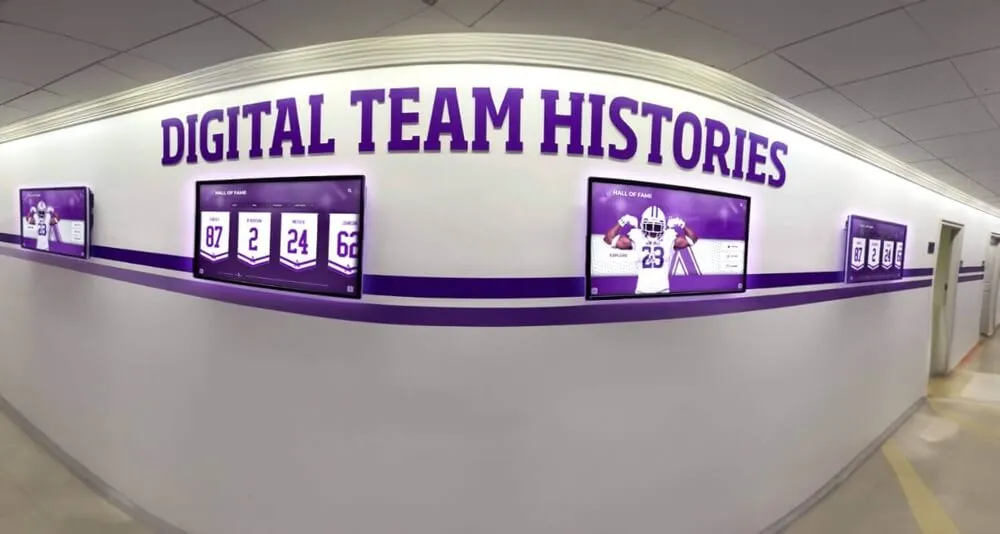
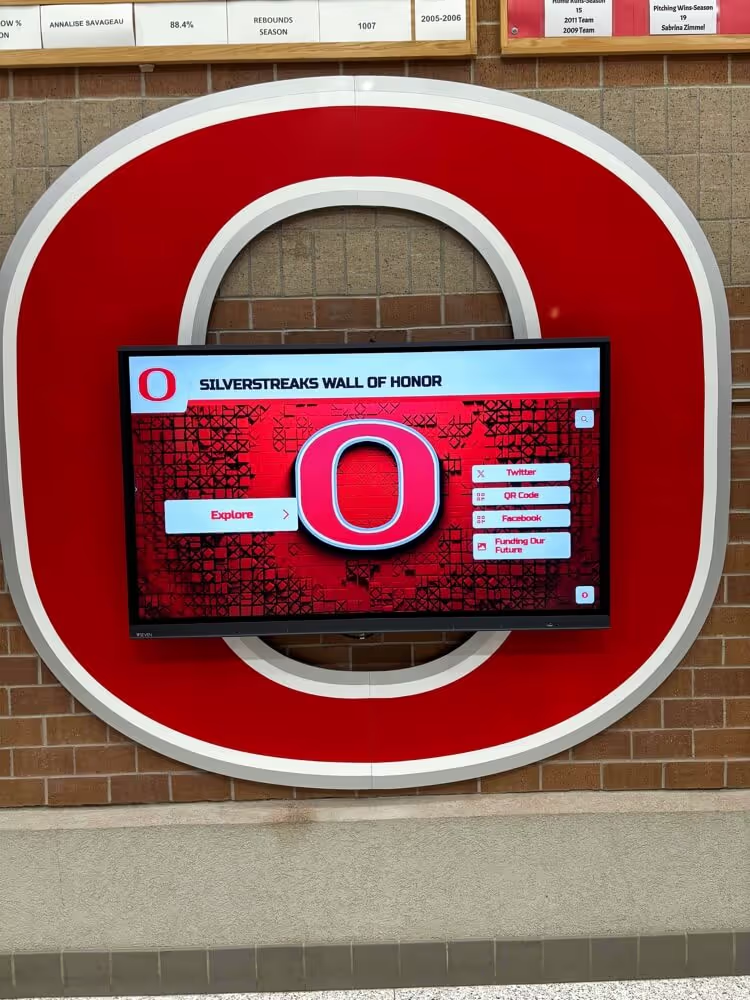
Interactive Recognition Displays: Modern touchscreen systems like those from Rocket Alumni Solutions enable universities to:
- Permanently showcase all Latin honors recipients across graduating classes
- Create searchable databases allowing visitors to explore honors graduates
- Present rich profiles beyond simple name listings
- Update content easily as new graduates earn honors
- Integrate academic recognition with athletic and alumni achievements
Unlimited Recognition Capacity: Unlike physical plaques limited by wall space, digital platforms accommodate comprehensive historical archives:
- Complete institutional honors history preserved indefinitely
- Equal recognition for all honors levels and graduation years
- Detailed graduate profiles including majors, activities, and post-graduation outcomes
- Photography and personal narratives celebrating individual journeys
- Statistical displays showing honors trends across decades
Engagement and Inspiration: Interactive features create exploration experiences impossible with static displays:
- Students browse honors recipients in their intended majors
- Families discover graduates from their hometowns or high schools
- Alumni reconnect with classmates and honor academic traditions
- Prospective students see evidence of intellectual culture
- Analytics demonstrate recognition program engagement and impact
These digital approaches ensure academic excellence receives visibility comparable to athletic achievement, reinforcing institutional values around intellectual accomplishment while inspiring current students pursuing their own honors recognition.
Social and Digital Communication
Modern recognition extends beyond physical campus through online channels:
Web-Based Recognition:
- Online honor rolls accessible globally
- Graduate profile pages celebrating individual achievement
- Social media spotlights highlighting honors recipients
- Email newsletters celebrating academic excellence
- Alumni network integration maintaining graduate connections
Student Recruitment and Institutional Pride: Visible academic honors recognition serves multiple institutional purposes:
- Demonstrates commitment to intellectual excellence for prospective students
- Provides evidence of rigorous academics for accreditation and rankings
- Creates alumni pride in institutional academic reputation
- Supports fundraising by showcasing educational quality
- Builds campus culture valuing scholarly achievement
Universities implementing comprehensive interactive exhibits for engaging displays create immersive recognition experiences that celebrate academic traditions.
Special Latin Honors Considerations
Several nuanced situations affect how Latin honors apply to different student populations and academic paths.
Transfer Students and Honors Eligibility
Transfer student policies vary considerably across institutions:
Common Transfer Policies:
- Minimum residency requirements (often 60+ credits at degree-granting institution)
- Only resident coursework counts toward honors GPA at many schools
- Some universities consider all collegiate work in honors calculations
- Articulation agreements may include special honors provisions
- Community college transfer students may face additional barriers
Transfer students should verify their institution’s specific policies immediately upon enrollment to understand requirements and strategically plan coursework to achieve honors eligibility if possible.
Study Abroad and International Programs
International study affects honors calculations differently depending on institutional policies:
Study Abroad Grade Transfer:
- Some schools incorporate study abroad letter grades into GPA
- Others accept international credits only as pass/fail
- Pre-approved programs may receive different treatment than independent study
- Strategic program selection can optimize honors GPA impact
- Students should clarify policies before committing to international study
Understanding these policies helps honors-oriented students make informed decisions about study abroad timing and program selection.
Graduate and Professional School Honors
Latin honors extend beyond undergraduate education at many institutions:
Professional School Honors: Law schools, medical schools, and other professional programs often award Latin honors using criteria adapted to their specific contexts:
- JD programs frequently use class ranking to determine honors
- Medical schools may award honors based on clinical performance and board scores
- MBA programs often recognize academic and leadership excellence
- Honors criteria typically differ from undergraduate standards
Graduate Academic Honors: Master’s and doctoral programs less commonly use traditional Latin honors, instead recognizing excellence through:
- Departmental honors or distinctions
- Thesis or dissertation awards
- Research accomplishment recognition
- Competitive fellowships and grants
The Latin honors tradition remains most firmly established at the undergraduate level, where it serves as the standard academic excellence recognition across American higher education.
Institutions celebrating diverse achievements often integrate Latin honors with other recognition programs, similar to how they approach digital boards for photos, videos, and recognition.

Accessible recognition displays allow families and visitors to explore institutional achievement history and celebrate academic excellence together
International Perspectives and Global Recognition
While rooted in European tradition, Latin honors implementation varies globally, with American practices distinct from other educational systems.
European Honors Systems Today
Modern European universities have evolved beyond or away from traditional Latin honors:
United Kingdom: British universities typically use degree classifications rather than Latin honors:
- First-class honours (equivalent to summa cum laude)
- Upper second-class honours (2:1)
- Lower second-class honours (2:2)
- Third-class honours
- Pass degree (without honours)
This classification system provides more granular distinction than the American three-tier Latin honors approach.
Continental Europe: Many European universities have moved toward numerical grading systems:
- Germany uses grades from 1.0 (excellent) to 5.0 (fail)
- France employs percentage-based or mention systems (très bien, bien, assez bien)
- Italy uses a 110-point scale with 110 e lode (110 with praise) as highest distinction
- Bologna Process harmonization has created some standardization while preserving national variations
Ironically, Latin honors remain more prevalent in American universities than in modern European institutions where the tradition originated.
Asian Educational Systems
Asian universities typically use different recognition frameworks:
Variation Across Asian Systems:
- Japanese universities often don’t employ honors distinctions comparable to Latin honors
- Chinese institutions use various systems including percentage grades and rankings
- Indian universities award “first class,” “second class,” or “third class” distinctions
- Korean universities use letter grades without honors designations
- Some international programs in Asia have adopted American-style Latin honors
Recognition of American Honors: Graduate programs and employers in Asia generally understand American Latin honors as indicators of academic excellence, though specific meanings may not be fully appreciated without context.
Latin Honors in Global Context
For American students pursuing international opportunities, Latin honors provide recognized credentials:
International Graduate School Applications: Latin honors help distinguish applications at competitive international graduate programs. While admissions committees may not know exact institutional standards, the honors designations signal academic excellence within American higher education.
Global Employer Recognition: Multinational employers recruiting American graduates generally understand Latin honors as academic distinction markers, though specific prestige levels may not translate perfectly across cultural contexts.
Understanding how different cultures approach academic recognition, including how consolidated schools preserve merged institutional histories, provides perspective on recognition traditions.
The Future of Latin Honors in American Higher Education
As universities evolve to meet changing student needs and educational philosophies, the Latin honors system faces both continuity and transformation.
Enduring Elements
Certain aspects of Latin honors seem likely to persist:
Continued Widespread Use: The system’s deep integration into American higher education culture, combined with its elegant simplicity and international recognition, supports ongoing use despite periodic criticism and refinement.
Diploma and Transcript Notation: Latin honors designations will likely remain standard components of official academic credentials given their established role in distinguishing academic achievement.
Ceremonial Recognition: Graduation ceremonies will probably continue incorporating Latin honors through regalia distinctions and program recognition, maintaining visible celebration of academic excellence.
Emerging Adaptations
Universities are adapting honors systems to address contemporary challenges:
More Rigorous Criteria: To combat grade inflation effects, many institutions are raising GPA thresholds or limiting honors percentages, attempting to preserve distinction meaningfulness.
Holistic Assessment: Some schools are incorporating elements beyond GPA—senior projects, comprehensive examinations, service learning—creating more comprehensive honors determination.
Digital Credentials and Micro-Credentials: Emerging digital badging and micro-credential systems may supplement traditional Latin honors by recognizing specific competencies, achievements, and skills that GPA-based honors don’t capture.
Enhanced Recognition Platforms: Universities are implementing sophisticated digital recognition systems that celebrate honors recipients more comprehensively than traditional approaches allowed.
Alternative and Supplementary Recognition
Forward-thinking institutions are developing recognition approaches that complement Latin honors:
Multiple Honor Categories: Rather than replacing Latin honors, some universities are adding parallel recognition systems:
- Research excellence honors
- Service and leadership distinctions
- Creative achievement recognition
- Interdisciplinary accomplishment honors
Competency-Based Recognition: As some programs move toward competency-based assessment, new forms of distinction may emerge recognizing demonstrated mastery beyond traditional grades.
Lifelong Learning Integration: Digital credentials enable ongoing recognition of post-graduation learning and achievement, extending the celebration of academic excellence beyond the undergraduate degree.
Despite these innovations, the Latin honors system’s longevity suggests it will remain a core component of American academic recognition for the foreseeable future, adapting to address concerns while maintaining its essential role in distinguishing scholarly achievement.
Institutions developing comprehensive recognition ecosystems often explore touchscreen software solutions for sports and academic facilities that celebrate diverse forms of excellence.
Conclusion: Latin Honors as Living Tradition
The Latin honors system represents a remarkable continuity in higher education—ancient phrases still meaningfully distinguishing academic excellence in 21st-century American universities. From medieval European examination halls to modern American commencement ceremonies, cum laude, magna cum laude, and summa cum laude have celebrated scholarly achievement across eight centuries of educational evolution.
This endurance reflects the system’s elegant simplicity, universal recognition, and fundamental alignment with academic values around excellence, merit, and intellectual accomplishment. The three-tier structure provides clear hierarchical distinction without excessive complexity, while Latin terminology creates linguistic neutrality and historical gravitas that English alternatives might lack.
Yet as we’ve explored throughout this guide, the apparent simplicity of three Latin phrases masks substantial complexity in actual implementation. Universities apply dramatically different criteria determining who receives these honors. Institutional philosophies about grade inflation, equity, exclusivity, and academic culture shape specific policies that vary from fixed GPA thresholds to complex ranking systems to holistic evaluations incorporating comprehensive examinations and senior projects.
For students pursuing these distinctions, understanding your specific institution’s criteria and strategies for achieving honors recognition proves essential. For institutions, thoughtfully implementing Latin honors policies that align with mission and values while addressing equity concerns and grade inflation effects requires ongoing attention and periodic refinement.
Most importantly, universities that prominently celebrate Latin honors recipients through both traditional ceremonies and modern digital recognition platforms create cultures where intellectual achievement receives the visibility, honor, and inspiration it deserves. When academic excellence appears as visibly throughout campus as athletic achievement, institutions reinforce their fundamental educational mission and inspire students to pursue scholarly distinction.
Celebrate Academic Excellence with Permanent Digital Recognition
Discover how your institution can honor Latin honors recipients alongside other academic achievers through interactive digital recognition systems that inspire current students, engage families and alumni, and preserve your university's proud intellectual tradition for generations to come.
Explore Recognition SolutionsThe conversation about Latin honors continues to evolve as higher education addresses changing student populations, educational philosophies, and assessment approaches. Yet the fundamental purpose remains constant: recognizing exceptional scholarly achievement in ways that honor individual accomplishment, inspire continued excellence, and celebrate the intellectual values at the heart of university missions.
Whether you’re a student beginning your undergraduate journey with honors goals in mind, an educator supporting academic excellence, or an institution seeking to recognize scholarly achievement effectively, the Latin honors system provides a time-tested framework that, when implemented thoughtfully and celebrated comprehensively, distinguishes genuine academic distinction and reinforces cultures of intellectual excellence that define great universities.
Ready to explore related academic recognition? Discover how institutions celebrate Principal’s Honor Roll achievements and other academic milestones, or learn about comprehensive recognition approaches for team celebrations that can inspire academic recognition strategies.