



Schools face a recognition design challenge that’s evolved significantly over the past decade. Walk through any high school or university hallway and you’ll encounter trophy cases, award plaques, and recognition displays competing for limited wall space. As achievements accumulate across athletic programs, academic departments, arts organizations, and community initiatives, administrators must decide how to showcase accomplishments without exhausting physical space or relegating important achievements to storage.
School display cases serve as more than mere storage—they function as visual storytelling environments that celebrate excellence, inspire current students, and preserve institutional memory. The design choice between traditional glass trophy cases and modern digital recognition displays fundamentally shapes how communities experience these stories. Traditional cases offer tangible presence with ceremonial weight. Digital solutions provide unlimited capacity with rich multimedia experiences that extend recognition beyond physical locations.
This comprehensive design guide explores both approaches through the lens of user experience, layout strategy, and creative implementation. You’ll discover how traditional and digital display cases each create recognition environments, what layout principles maximize their effectiveness, and how schools successfully combine both approaches to serve diverse stakeholder preferences while building cultures that celebrate achievement systematically across all dimensions.
The recognition display landscape has transformed dramatically as touchscreen technology matured from experimental novelty to reliable infrastructure. Schools implementing modern recognition systems report 3-5x longer visitor engagement compared to traditional cases, measurable increases in alumni connection, and enhanced recruitment effectiveness as prospective families encounter professional achievement celebration during campus tours.

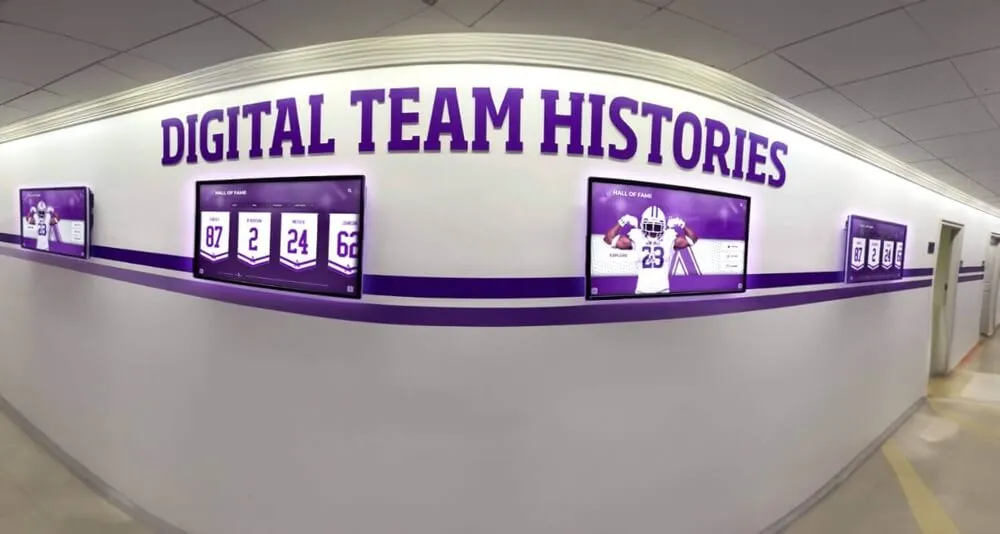
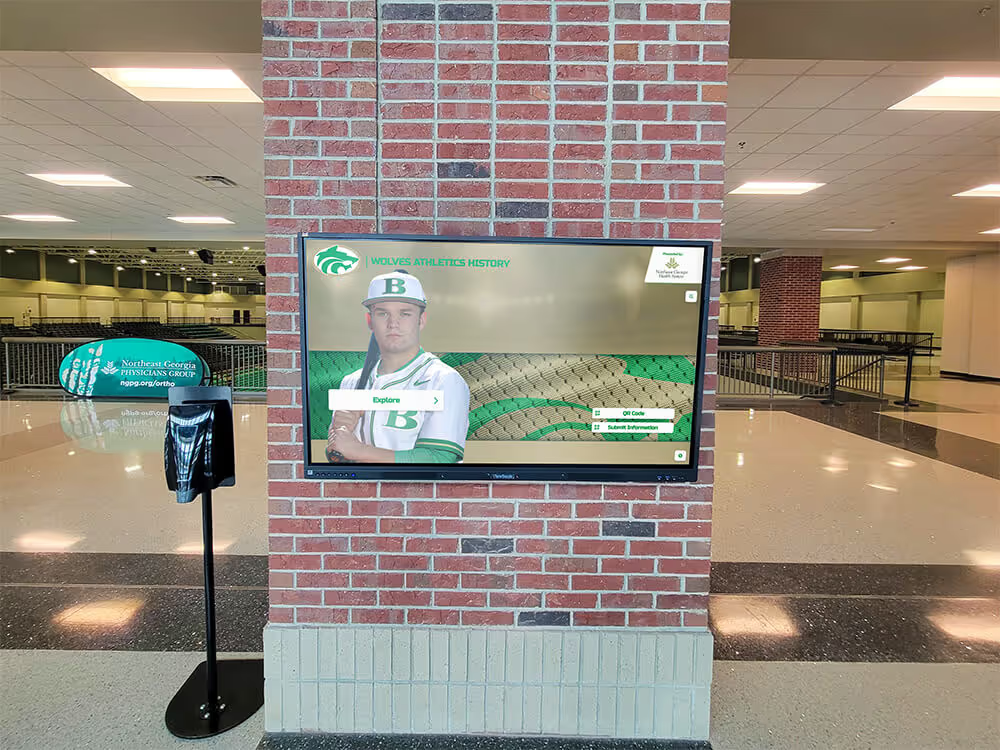
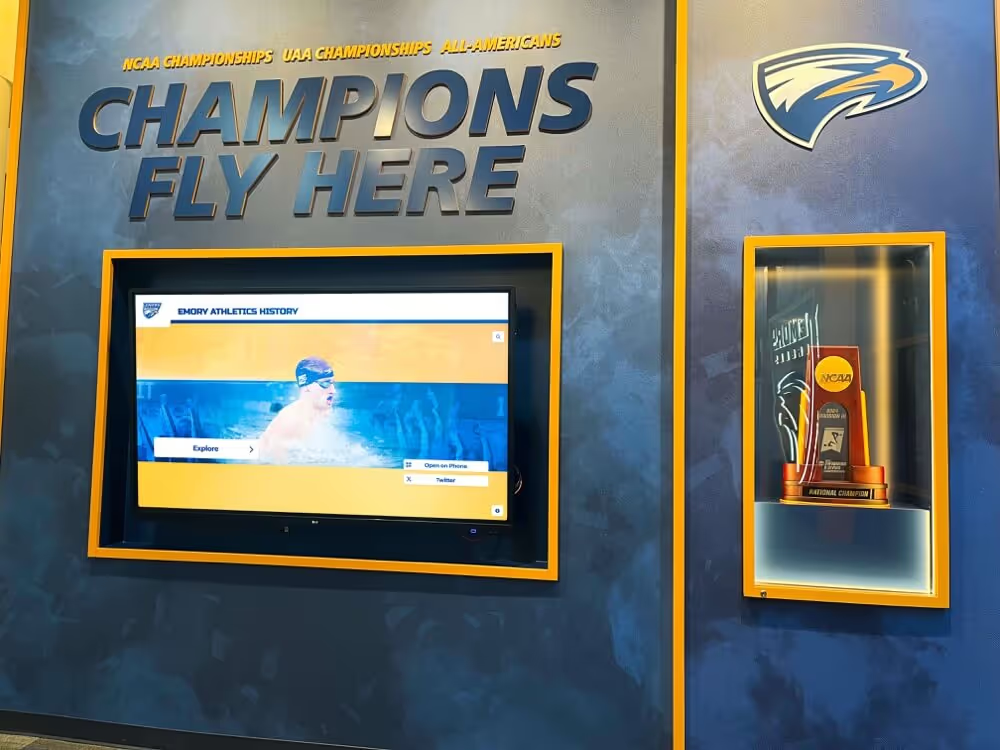
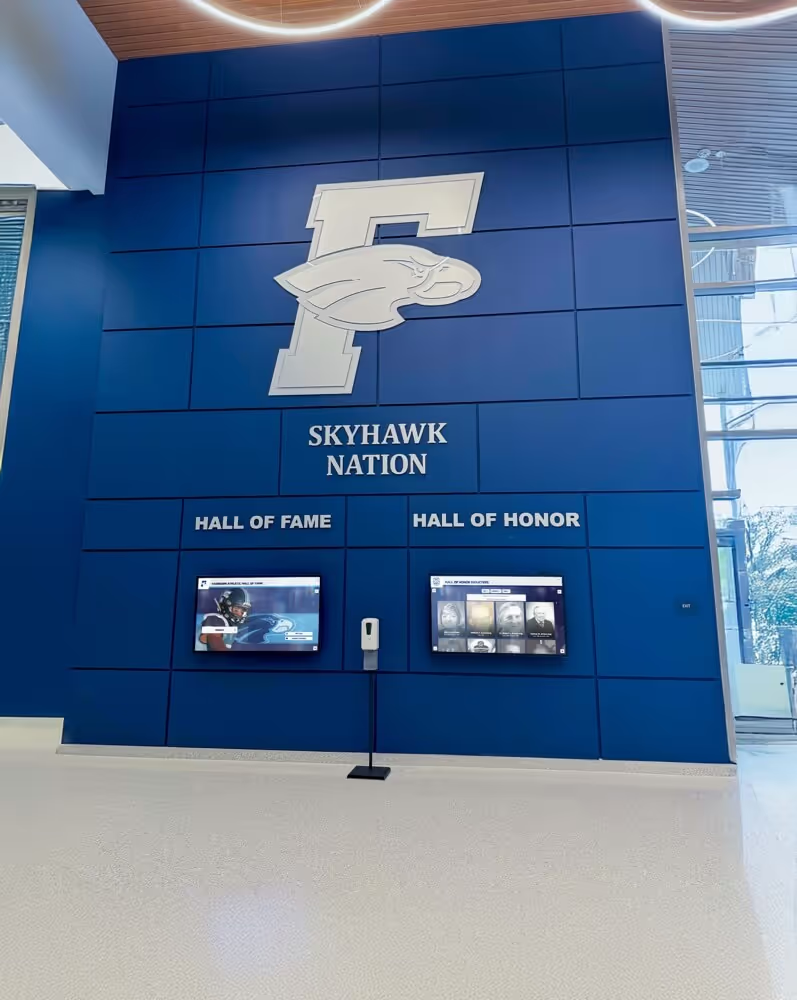
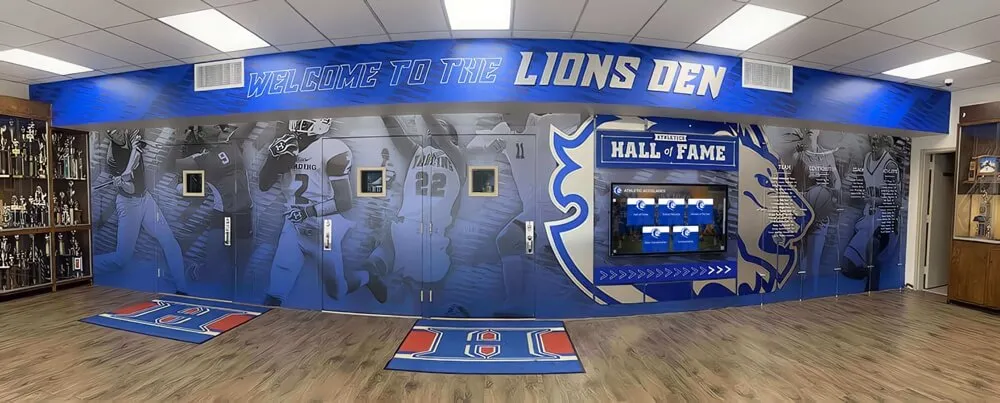
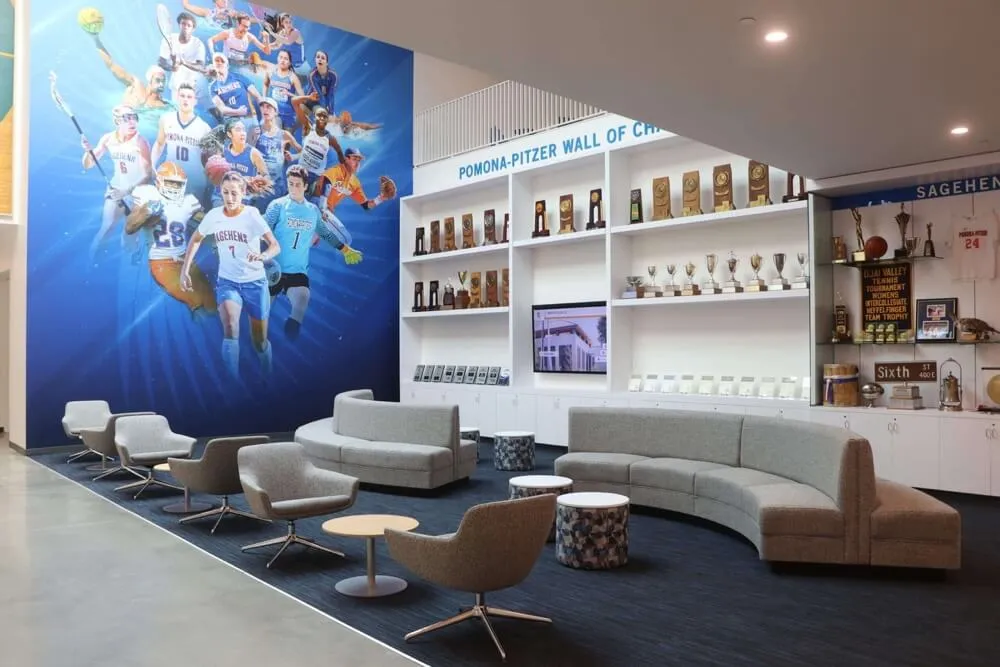
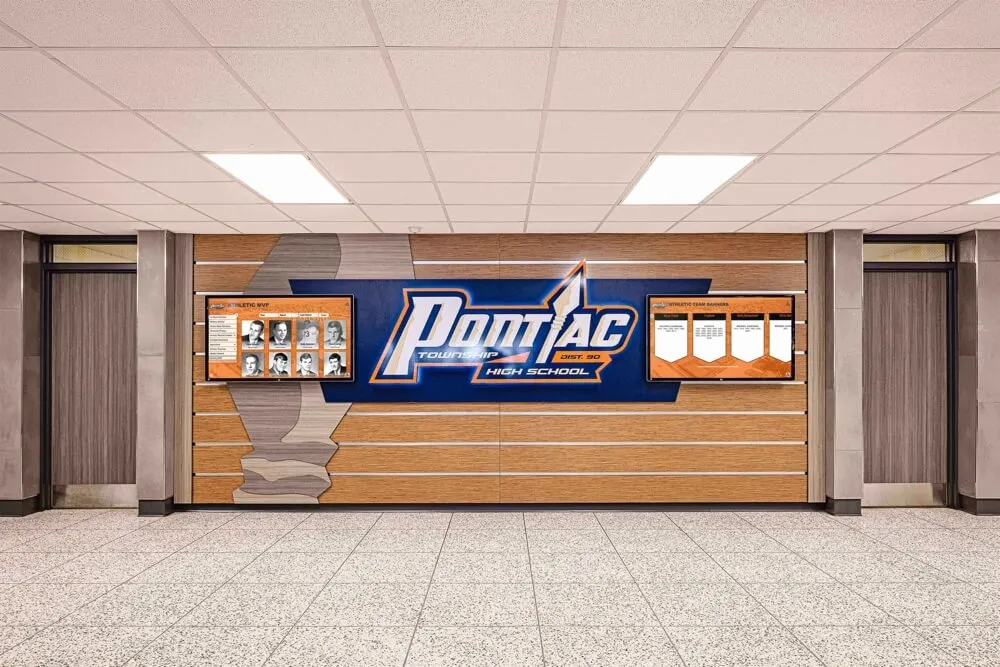
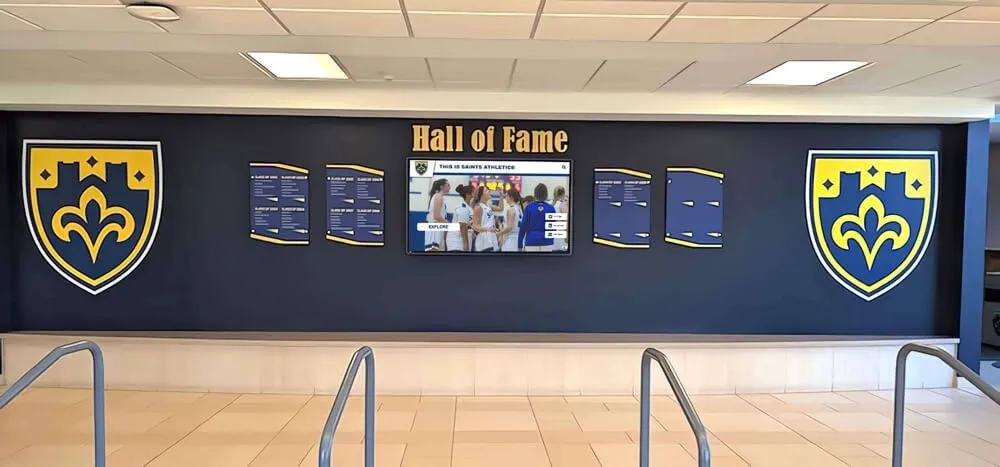
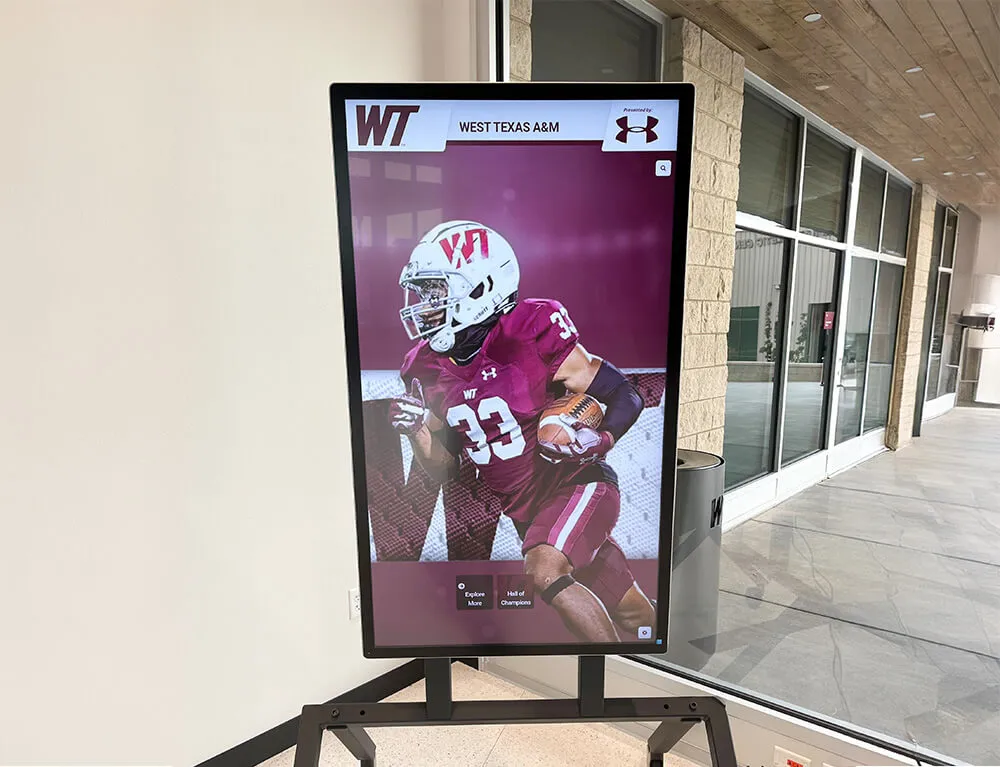
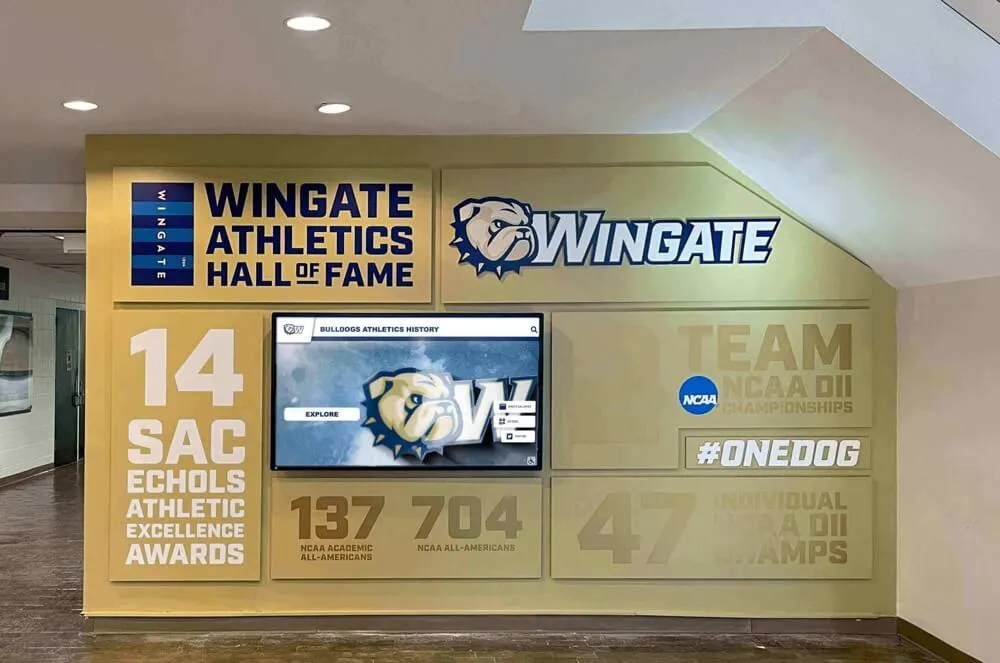
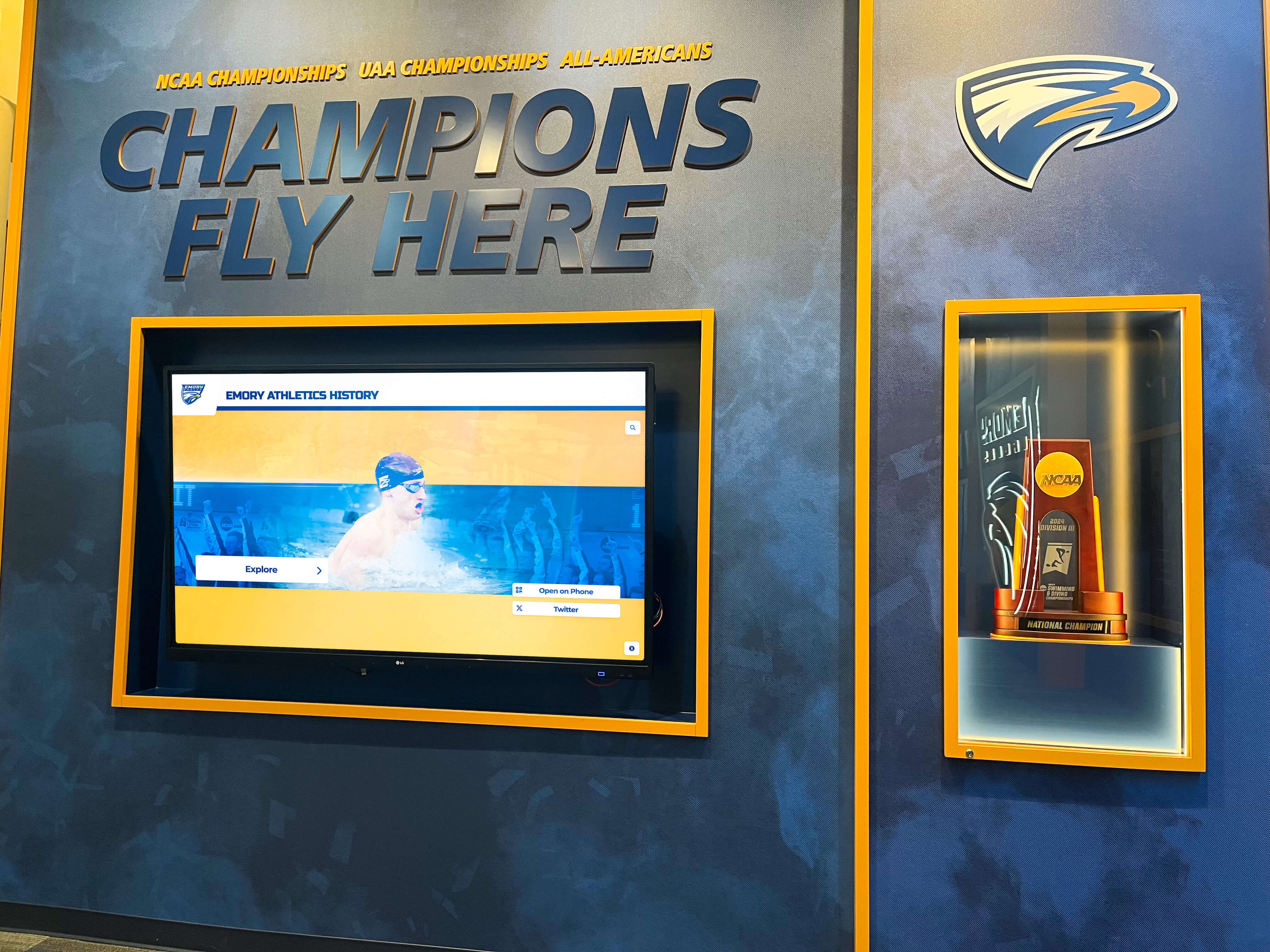
Hybrid installations combine traditional trophy presence with digital capacity, creating recognition environments that honor both heritage and innovation
Experience Layout: Traditional Trophy Case Design
Traditional school display cases follow established design patterns developed over decades of institutional recognition. Understanding their spatial organization reveals both inherent strengths and fundamental limitations shaping recognition capacity.
Physical Case Architecture and Spatial Constraints
Glass trophy cases typically mount along hallway walls or occupy dedicated alcoves in gymnasiums and academic buildings. Standard cases measure 4-8 feet wide by 6-8 feet tall by 16-24 inches deep, creating approximately 25-40 cubic feet of display volume per unit. Internal organization follows predictable patterns:
Shelf Configuration and Visual Hierarchy
Fixed shelving divides vertical space into 4-6 horizontal zones stacked from floor to ceiling. Top shelves typically showcase championship trophies and highest-level achievements leveraging eye-line dominance and architectural prominence. Middle sections display supporting awards, tournament recognition, and team photographs. Lower zones accommodate overflow items or chronological collections arranged by decade or program evolution.
This vertical hierarchy creates natural storytelling flow but introduces accessibility challenges—bottom-shelf achievements become literally and figuratively diminished, while top-shelf recognition may exceed comfortable viewing angles for shorter visitors or wheelchair users. The physical depth limitation means larger trophies dominate foreground positions while smaller awards recede visually regardless of achievement significance.
Lighting Design and Atmospheric Impact
Internal LED or fluorescent lighting illuminates case contents creating focal points in otherwise standard hallways. Well-designed lighting emphasizes trophy metalwork and engraving while minimizing reflections on glass doors that obscure visibility. Poorly executed lighting produces glare, shadows, or uneven illumination that undermines presentation quality regardless of achievement significance.
The lighting creates ceremonial atmosphere elevating recognition beyond ordinary hallway features, but requires electrical infrastructure and generates ongoing energy consumption that digital solutions can match while providing additional functional advantages.
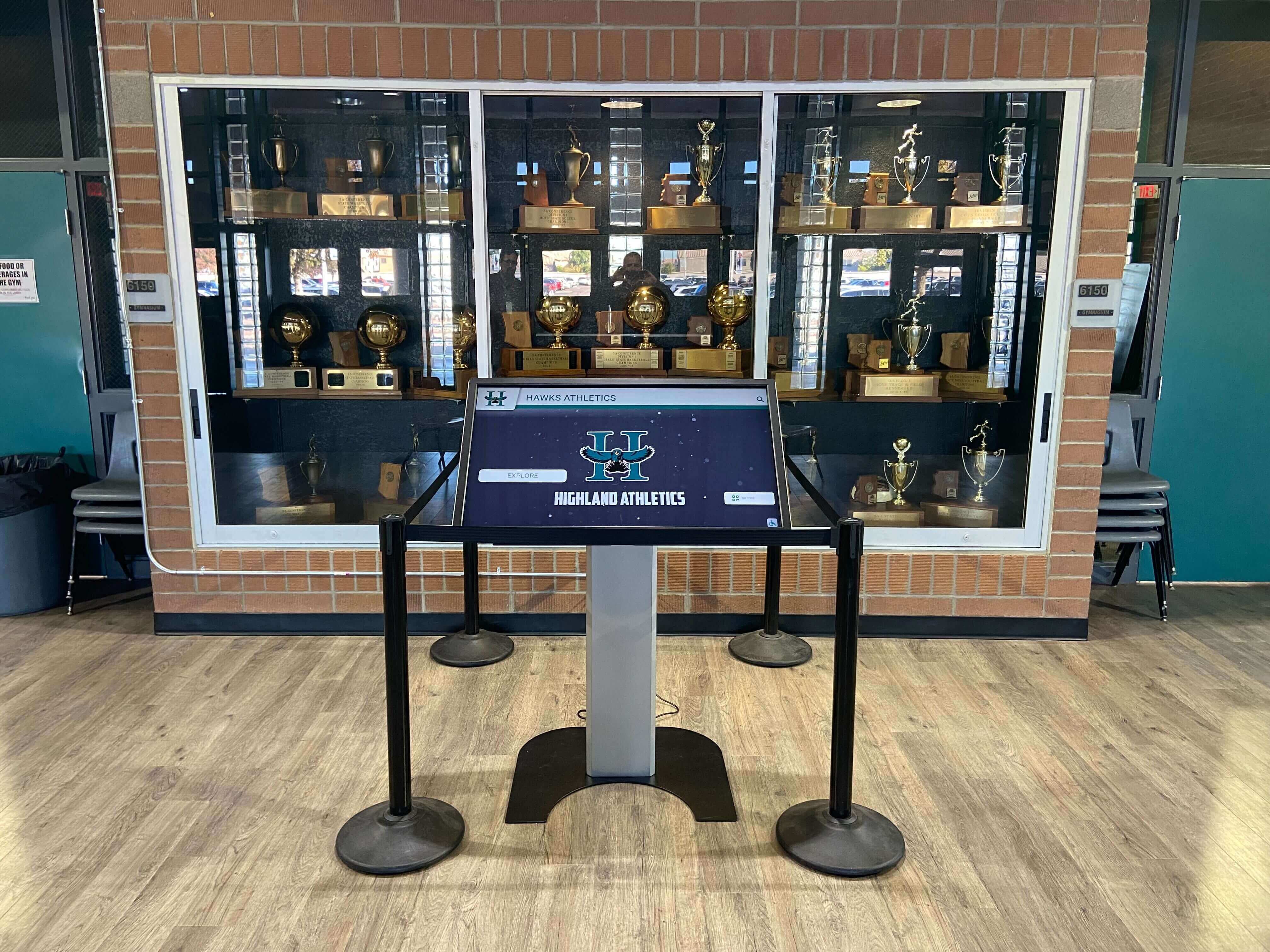
Traditional cases provide tangible trophy presence that creates immediate visual impact and ceremonial significance
Content Density Limitations and Recognition Mathematics
The defining limitation of traditional school display cases involves finite capacity measured in physical dimensions. Consider recognition accumulation for comprehensive athletic programs:
Achievement Volume Analysis
A high school fielding 15-20 sports generates substantial annual trophy volume. Assume each sport produces 2-3 significant achievements annually across regular season, conference tournaments, and state playoffs—that’s 30-60 trophies per year. Over a single decade, the program accumulates 300-600 pieces requiring display space.
Average trophies occupy 6-12 inches of linear shelf space depending on base dimensions. Standard 6-foot-wide cases provide approximately 24-30 linear feet of total shelf space across all internal shelves. Mathematical reality becomes unavoidable: comprehensive 10-year recognition requires 150-300 linear feet of shelf space—equivalent to 6-10 large trophy cases costing $12,000-80,000 plus installation.
Schools face impossible decisions: limit recognition to highest achievements only, establish rotating displays where older trophies move to storage, or pursue expensive facility expansions creating additional wall space dedicated exclusively to trophy accommodation. Each choice sends implicit messages about whose accomplishments deserve permanent visibility and whether recognition remains truly perpetual or merely temporary until space constraints force removal.
Plaque Accumulation and Wall Space Exhaustion
Beyond three-dimensional trophies, schools recognize individuals through wall-mounted plaques honoring hall of fame inductees, distinguished alumni, academic achievement, and service contributions. Standard 12x15 inch plaques require approximately 1.5 square feet of wall space including spacing for visual organization.
Athletic programs inducting 5-8 hall of fame members annually accumulate 100-160 honorees over 20 years—requiring 150-240 square feet of dedicated wall space. That’s equivalent to 25-40 linear feet of 6-foot-tall recognition wall, far exceeding what most facilities allocate for single-purpose recognition displays.
As wall space fills, schools create second-tier hallways for overflow recognition, establish hierarchies determining which inductees receive prominent versus secondary placement, or cease recognition programs when space exhausts. Traditional case design provides no solution to this inevitable capacity crisis beyond costly construction expanding physical infrastructure.
Approaches to managing athletic hall of fame programs demonstrate systematic strategies schools employ balancing comprehensive recognition desires against physical space realities that constrain traditional approaches.
Update Workflows and Recognition Lifecycle Complexity
Traditional school display cases require multi-step processes for each recognition addition that create administrative burden and delay achievement visibility:
Annual Recognition Cycle Choreography
Schools typically conduct recognition updates annually during summer breaks when facilities remain accessible without disrupting academic activities. The process involves designing new plaques or selecting purchased trophies, coordinating with engraving vendors for customization requiring 3-6 week production timelines, arranging installation contractors for case access and plaque mounting, and physically reorganizing existing displays to accommodate new additions often requiring complete case rearrangement.
This annual cycle means achievements earned during fall sports seasons don’t receive physical display until following summer—8-10 month delays between winning championships and seeing recognition mounted. The timing disconnect diminishes psychological impact as celebration becomes retrospective rather than immediate acknowledgment during peak community excitement.
Maintenance Requirements and Ongoing Costs
Each trophy and plaque added to traditional displays incurs recurring expenses: engraved plates cost $50-200 depending on size and customization complexity, professional engraving services charge setup and production fees, installation labor requires contractor coordination at $75-150 per hour, and periodic case reorganization demands planning and execution time from already-stretched administrative staff.
Programs adding 30-60 recognitions annually spend $1,500-12,000 yearly on traditional update maintenance—recurring costs that accumulate substantially over decades while consuming staff time better invested in program development rather than vendor coordination and physical arrangement logistics.

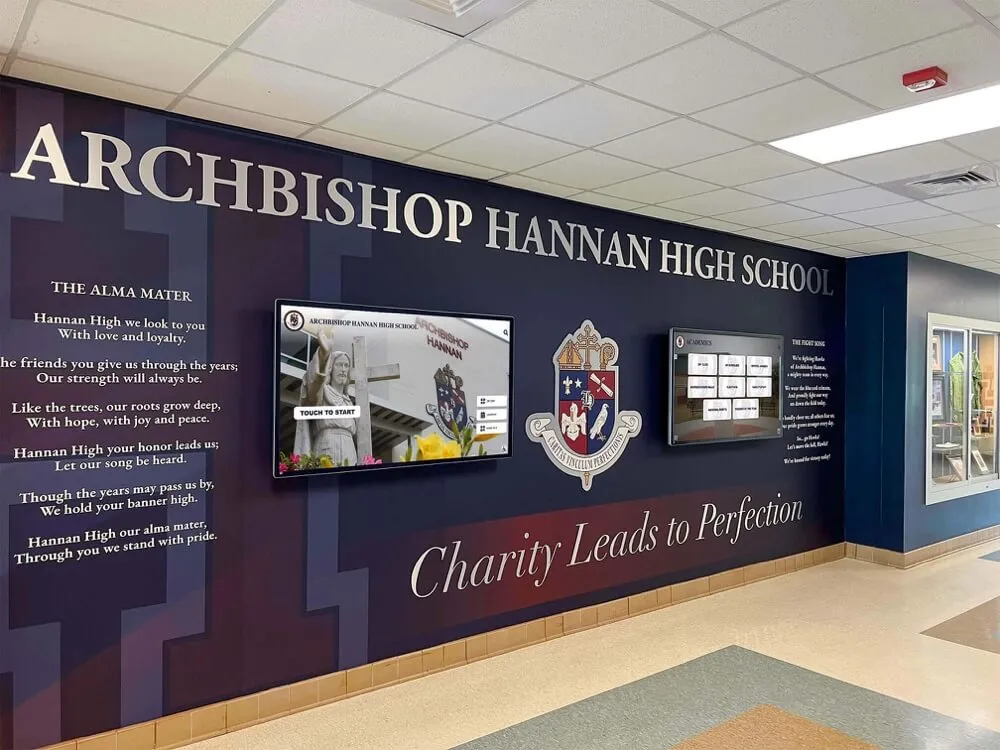
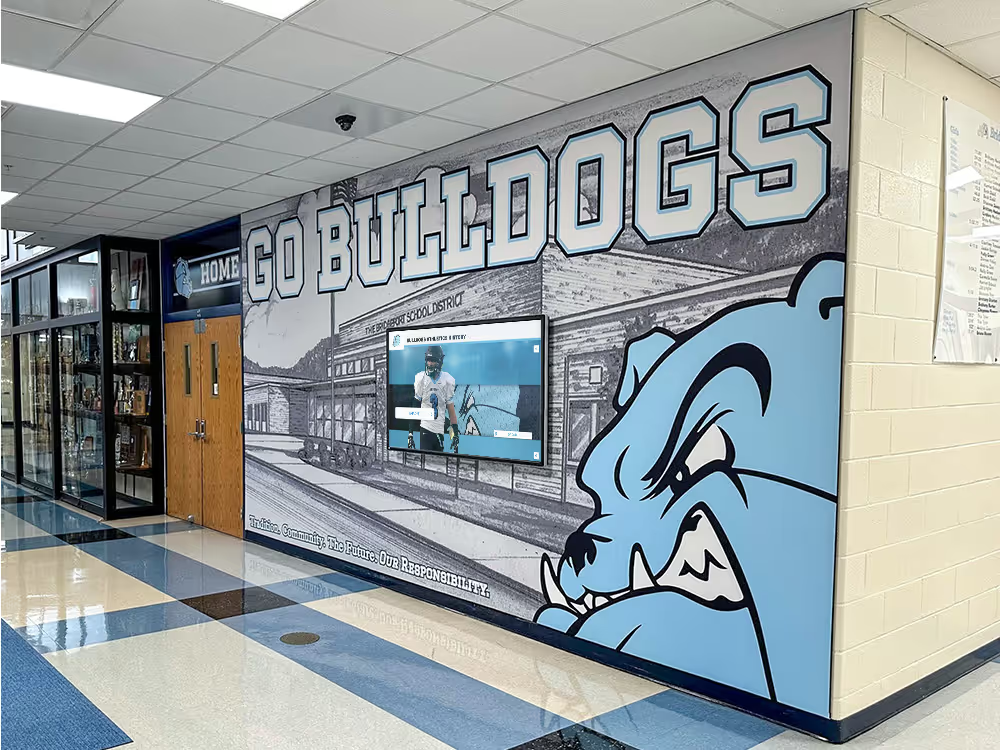
Thoughtful integration positions traditional design elements alongside modern recognition capacity, creating cohesive visual environments
Experience Layout: Digital Display Case Architecture
Digital recognition systems reimagine school display cases as interactive experiences rather than static storage. Understanding their spatial and interaction design reveals how they solve traditional limitations while introducing new design opportunities and considerations.
Screen Real Estate and Zone-Based Interface Architecture
Digital displays organize recognition content through carefully designed zones that guide visitor attention and enable intuitive navigation. Professional implementations follow established UX patterns optimized through thousands of school deployments:
Hero Zone and Institutional Identity (Top 15-20%)
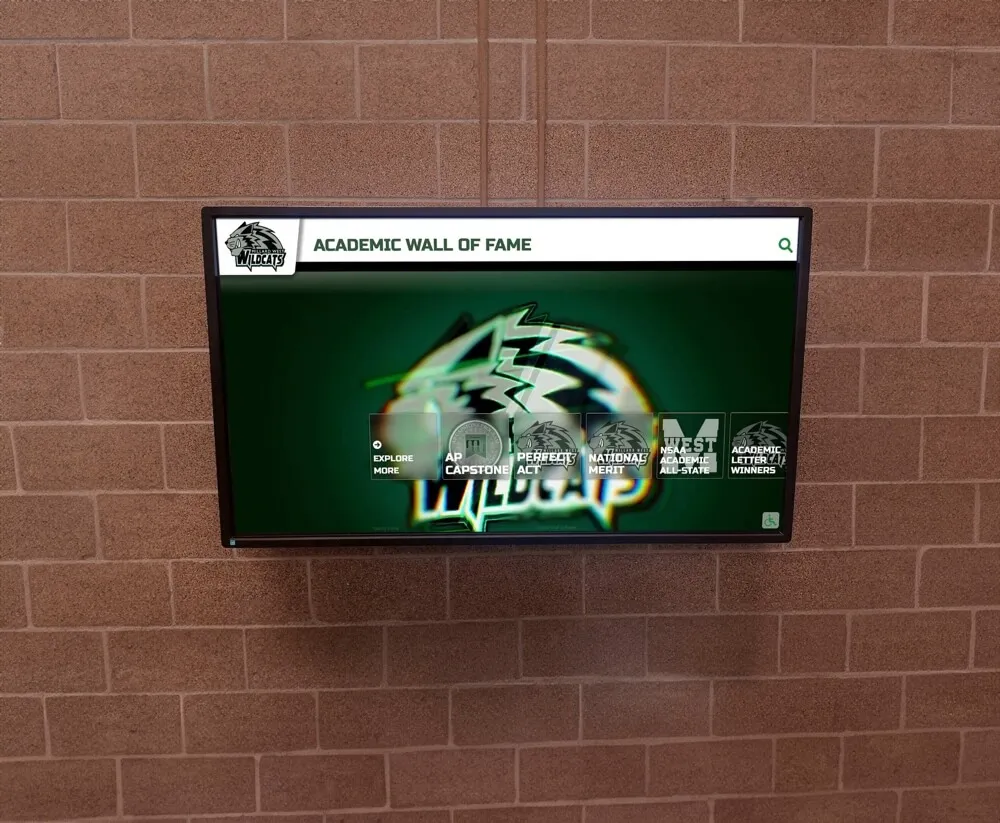
The uppermost screen region establishes immediate context through school logos, mascot integration, and color schemes creating instant institutional connection. This branded header anchors the entire experience, ensuring visitors immediately understand what recognition they’re exploring regardless of where they enter navigation flows.
Featured content carousels often occupy this zone, rotating spotlights on recent championships, milestone achievements, or upcoming recognition ceremonies. Motion graphics and transitions add visual interest while communicating that displays remain actively maintained with current content rather than static installations abandoned after initial setup.
Background imagery should enhance rather than distract—subtle school facility photography, abstract motion graphics using institutional colors, or carefully chosen action imagery that doesn’t compete with primary recognition content for visitor attention.
Primary Navigation Bar (10-15% Height)
Below the hero zone, horizontal navigation enables content discovery through clear, touch-friendly controls. Essential navigation categories include:
- Browse by sport/department organizing achievements according to program structure
- Browse by year enabling chronological exploration across institutional history
- Browse by achievement type filtering championships versus individual honors versus academic recognition
- Search functionality allowing direct name-based discovery when visitors seek specific individuals
Touch targets must meet minimum 44x44 pixel dimensions with adequate spacing preventing accidental selections. Labels should use plain language rather than administrative terminology—“Championships” rather than “Athletic Hall of Fame Inductees” unless institutional culture specifically values formal nomenclature.
Visual hierarchy through color, size, and position guides visitors toward primary discovery paths while keeping secondary options accessible without cluttering interfaces. Consistent placement throughout experiences enables predictive interaction—once visitors learn navigation location and function, they can apply that knowledge across all content areas without relearning for each section.
Content Display Zone (Central 50-60%)
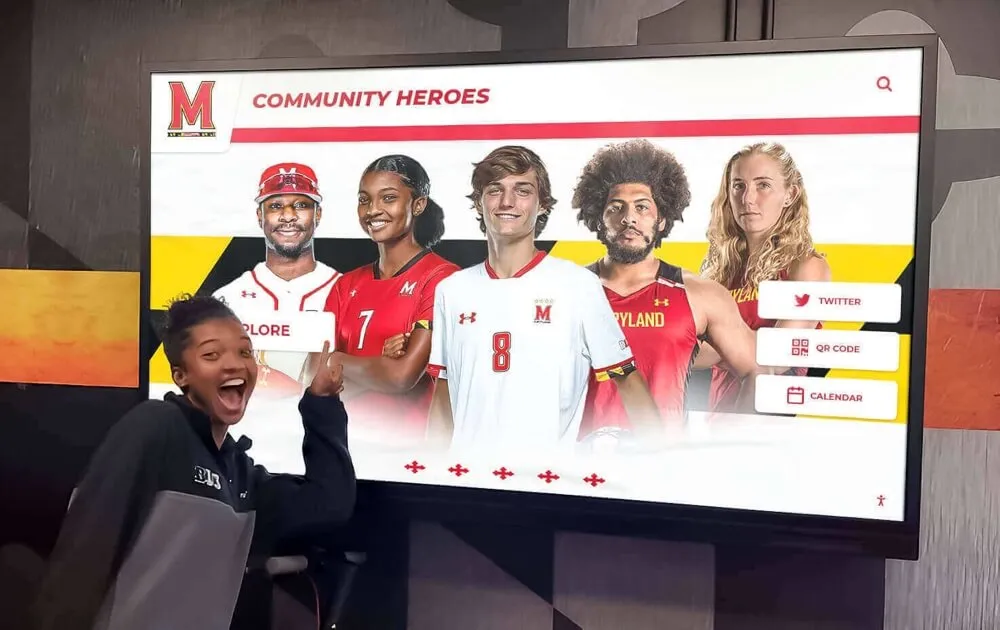
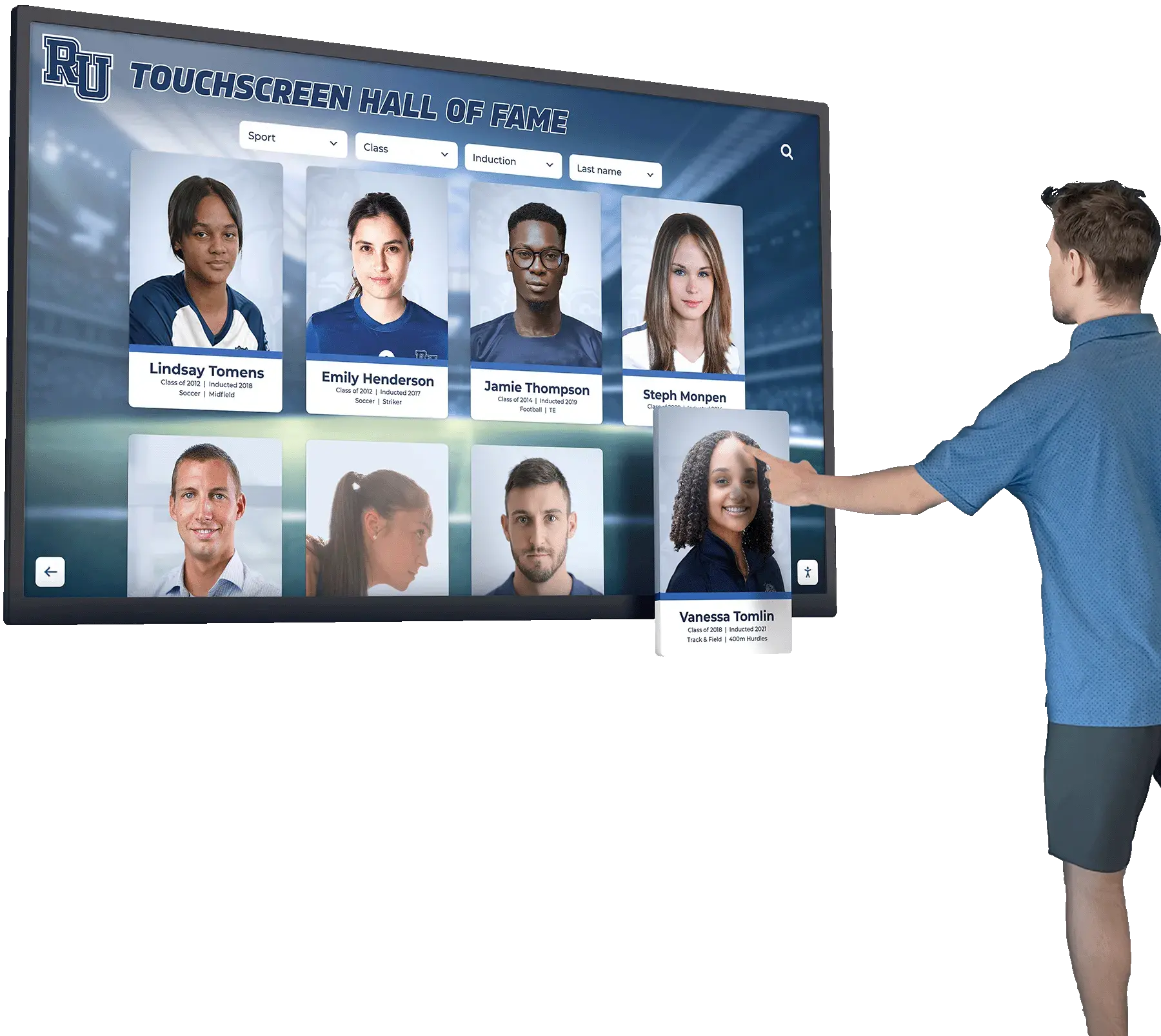
The largest screen region presents recognition content through carefully designed card-based layouts. Grid systems display multiple achievements simultaneously—typically 6-12 trophies or profiles per screen depending on display size and resolution. Each card includes trophy or individual photography, achievement title and year, brief description providing context, and visual indicators like championship badges or sport icons enabling quick categorical identification.
Card-based interfaces enable efficient scanning while maintaining visual appeal. Visitors process multiple options simultaneously, selecting items that capture interest rather than navigating linear sequences where discovery depends on viewing order alone. Touch interactions should provide clear feedback—cards lift slightly when selected, transitions feel responsive, and navigation paths remain obvious preventing visitors from feeling lost within content structures.
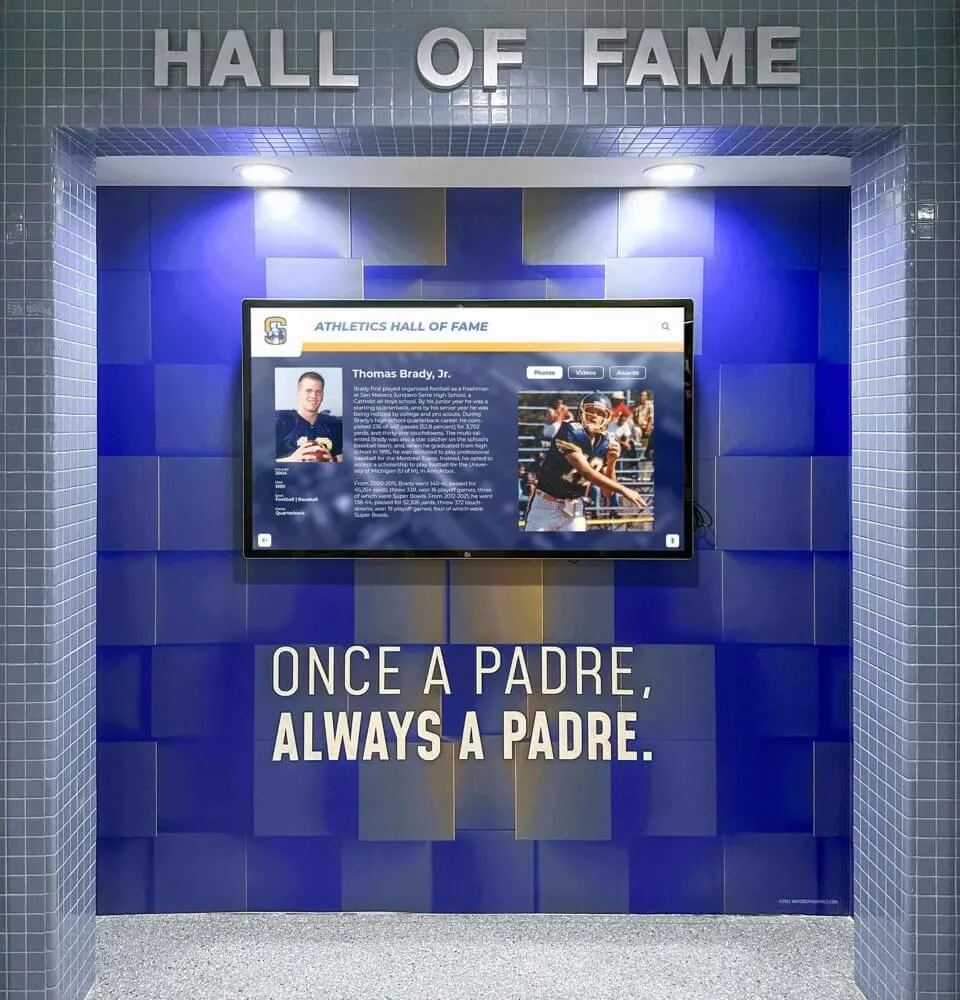
Detailed profile views replace grid displays when visitors select specific achievements, using full screen space for large photography, comprehensive achievement narratives, related content suggestions, embedded video highlights when available, and clear back/home navigation enabling exploration path reversal without confusion.
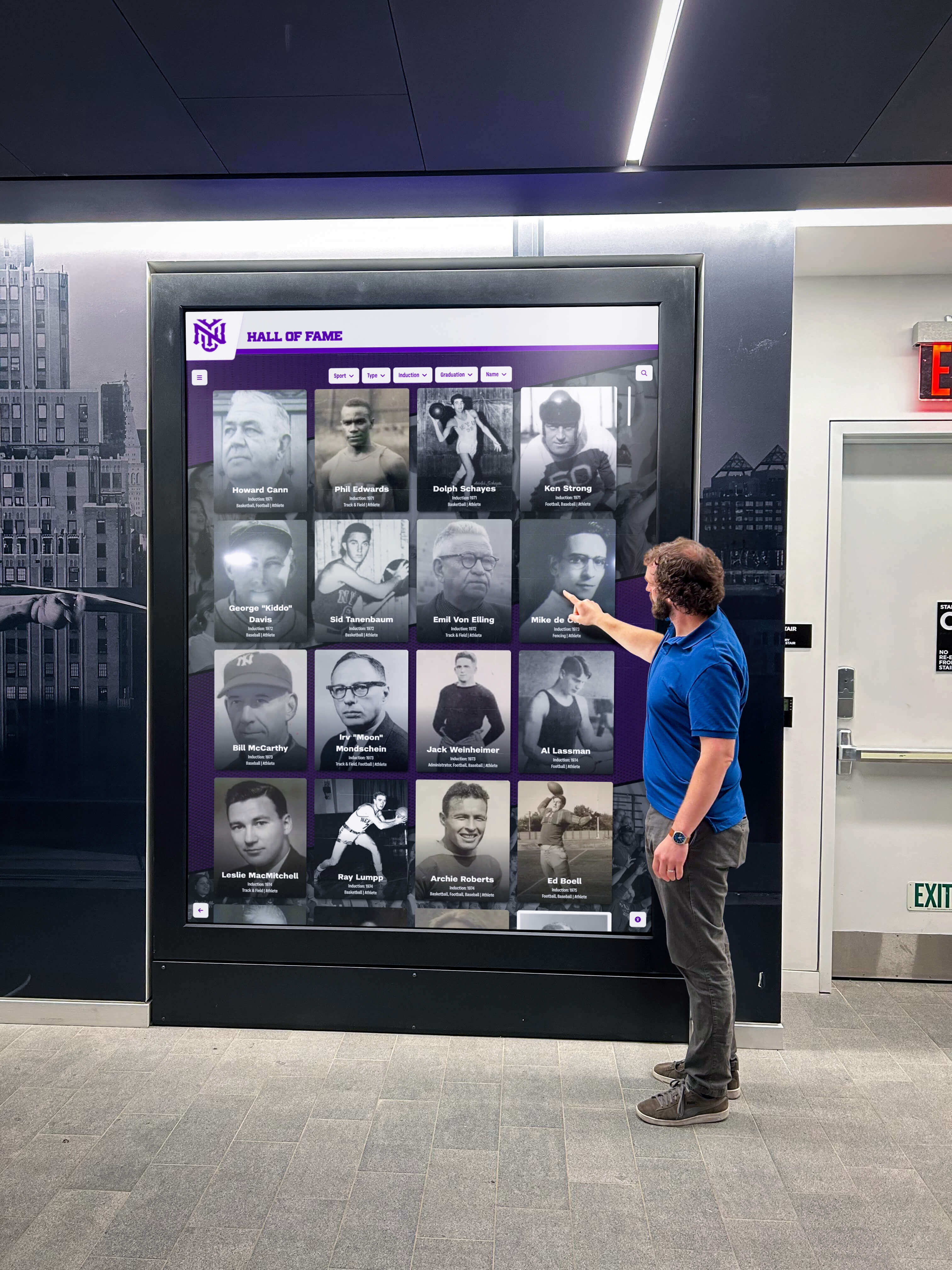
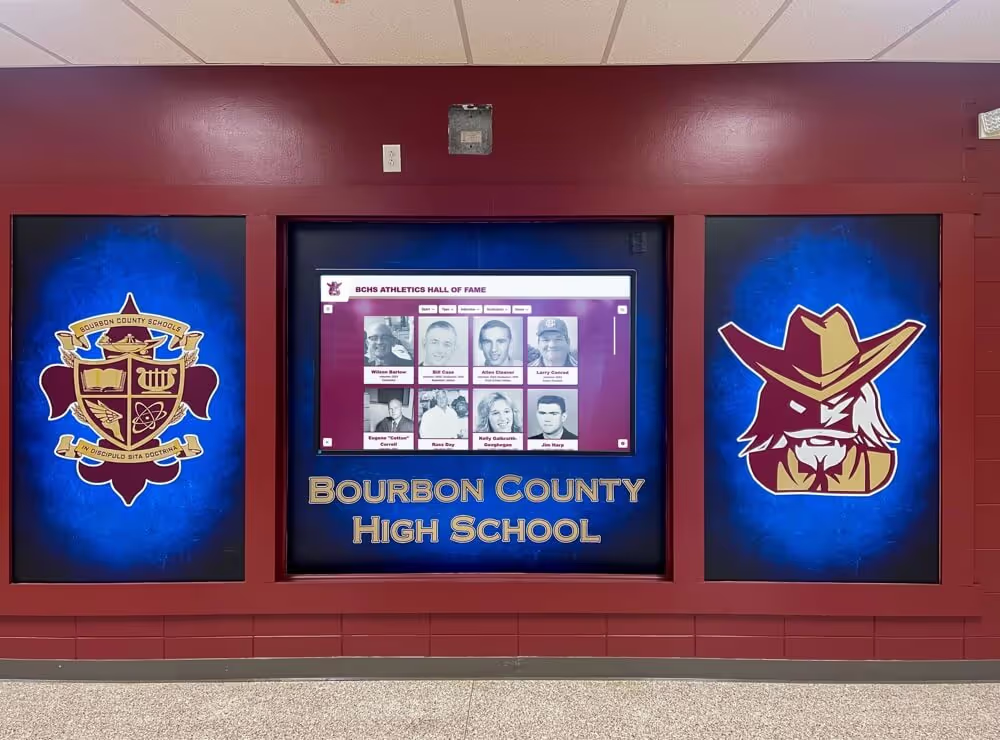
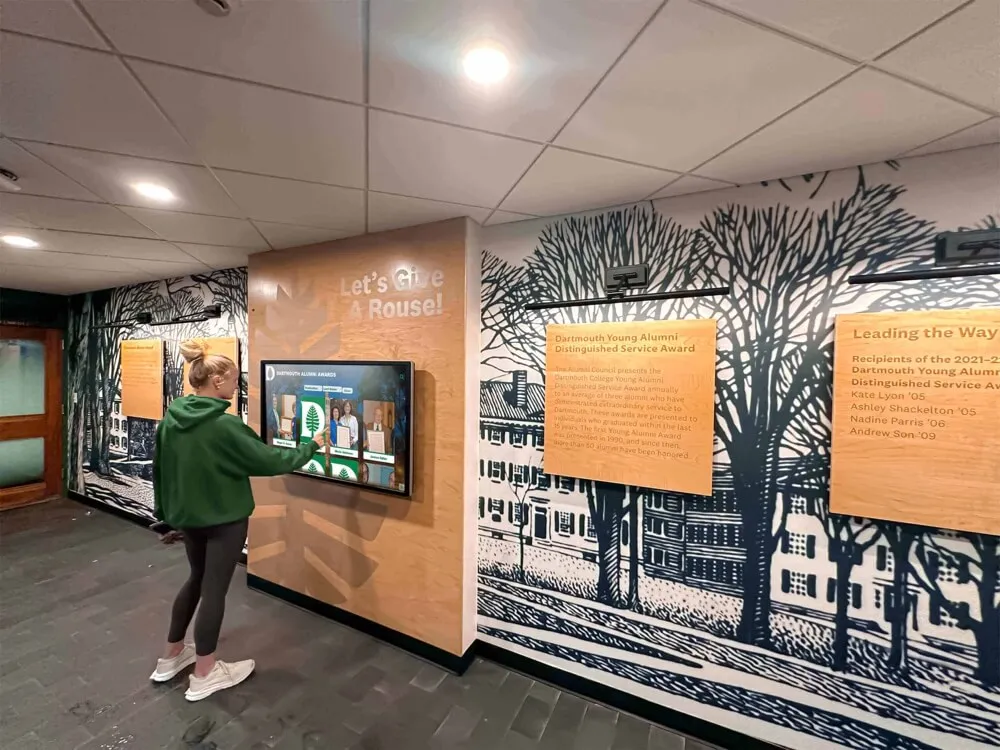
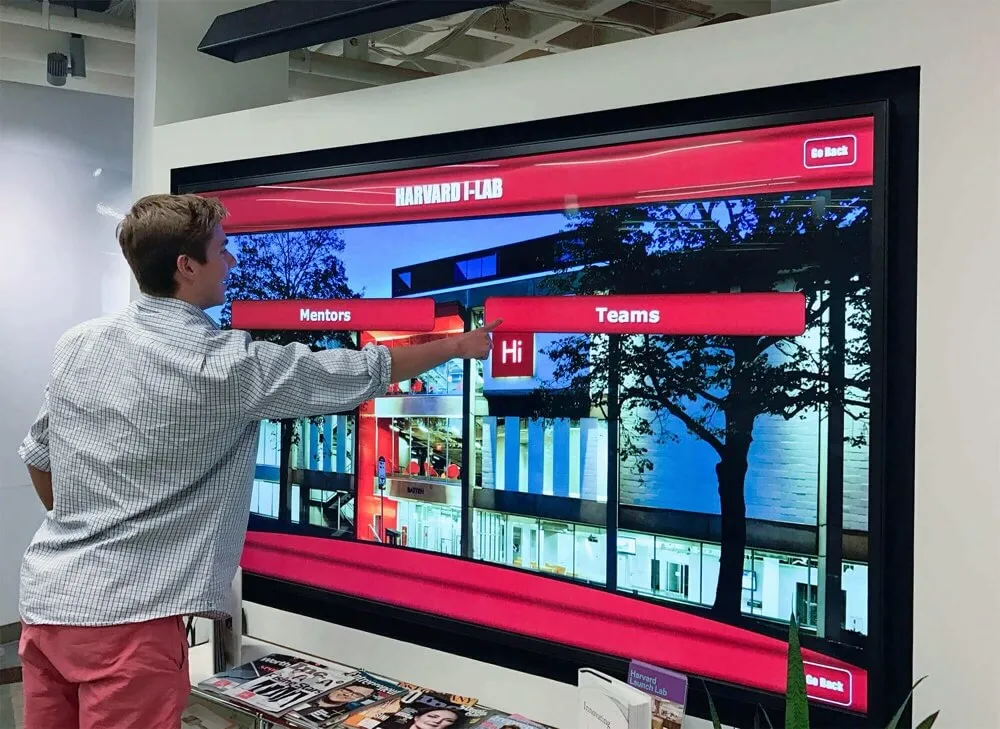
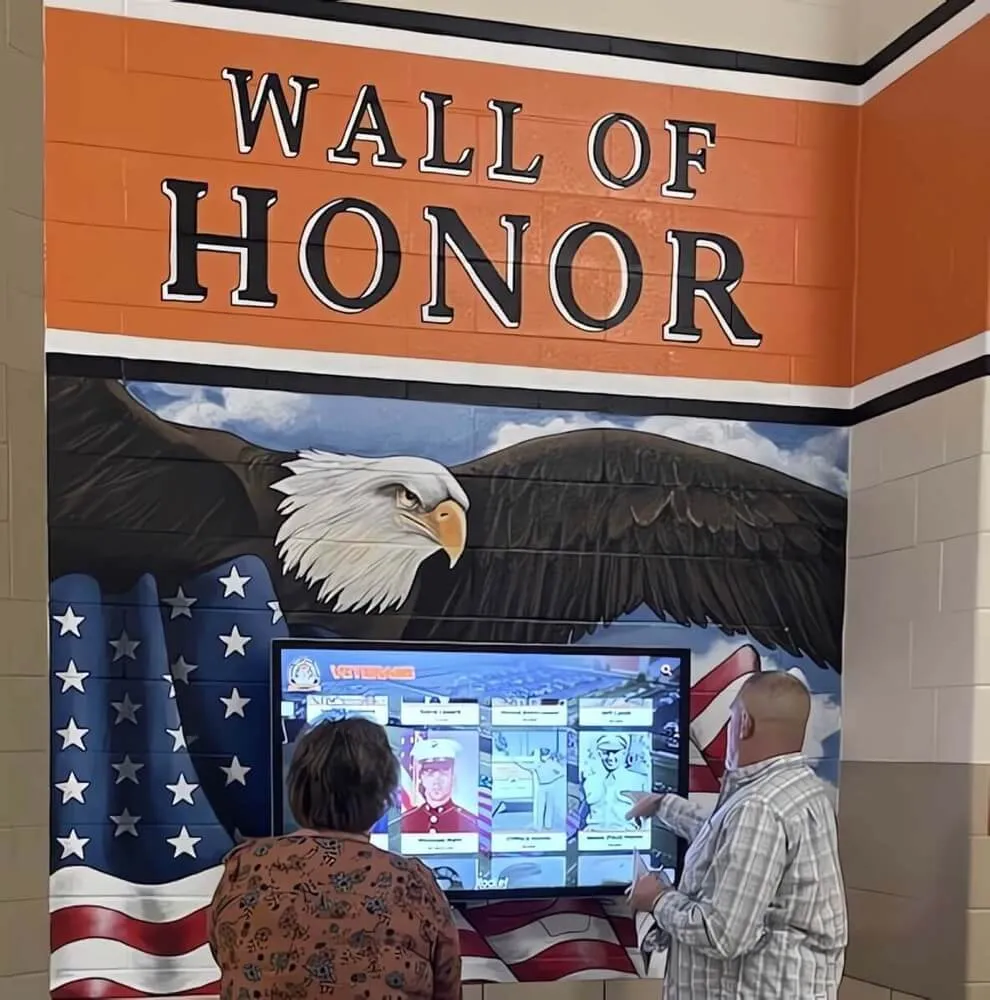
Intuitive touch interfaces mirror smartphone interaction patterns familiar to modern users, requiring zero instructions for natural exploration
Unlimited Recognition Capacity Through Database Architecture
The transformative advantage of digital school display cases involves eliminating physical capacity constraints through content database systems that store unlimited achievements without requiring additional hardware or space:
Scalable Content Management
Digital platforms organize recognition through relational databases where each achievement exists as discrete record containing photos, text descriptions, statistical data, video files, and relationship connections to related profiles. A single 55-inch touchscreen can host comprehensive databases containing 500-1,000+ detailed profiles without approaching storage limitations or requiring physical expansion.
This unlimited capacity enables truly comprehensive recognition strategies. Athletic departments showcase every championship trophy regardless of sport prominence. Academic programs honor all valedictorians, National Merit Scholars, and academic competition winners across institutional history. Arts departments celebrate theatrical productions, musical performances, and visual arts achievements spanning decades of creative excellence.
When traditional cases force recognition hierarchies determining which achievements deserve limited physical space, digital systems accommodate everything deserving acknowledgment. Students competing in Olympic sports receive equal visibility to football and basketball. Emerging programs with limited trophy accumulation display their complete histories alongside established programs with century-long traditions. And historical achievements from founding decades receive permanent accessibility rather than storage relegation as recent accomplishments consume finite display capacity.
Content Layering and Depth Exploration
Digital interfaces support information layering impossible with physical displays. Initial grid views provide efficient browsing showing 6-12 achievements simultaneously with essential information—trophy images, championship titles, years. Visitors interested in specific achievements select cards for detailed exploration revealing comprehensive narratives including complete game and season stories, full team rosters with individual athlete profiles, coaching staff recognition and career accomplishments, statistical contexts and performance data, championship game highlights through embedded video, and historical significance within program traditions.
This layered approach serves diverse engagement depths. Casual hallway passersby quickly scan featured achievements during brief 30-second interactions. Prospective students during campus tours spend 3-5 minutes exploring program traditions and championship histories. Alumni attending reunion events invest 5-10 minutes or more discovering teammates, revisiting their own recognition, and exploring how programs evolved since graduation.
Traditional displays present single information depth—whatever fits on engraved plaques. Digital systems accommodate surface-level browsing and deep exploration within identical physical footprints, serving varied visitor intentions through flexible content architectures rather than forcing single fixed presentation approach.
Resources on digital trophy case implementation demonstrate systematic content organization strategies that leverage database flexibility for comprehensive school recognition serving all stakeholder groups effectively.
Motion Graphics and Animation Language
Static images and text alone fail to leverage digital medium capabilities fully. Professional digital display case designs incorporate motion and animation that enhance rather than distract from primary recognition content:
Subtle Motion That Invites Interaction
Attract loops play when displays sit idle, featuring gently animated content that draws hallway traffic attention without aggressive movement that becomes annoying after repeated exposure. Typical attract sequences include slow carousel rotations through featured achievements, parallax scrolling effects revealing content depth, subtle particle effects or light animations using school colors, and periodic video clips from championship moments or institutional heritage footage.
These attract sequences communicate that displays remain active and interactive rather than static digital posters, encouraging visitors to approach and touch screens to begin exploration. Motion should remain subtle enough that displays blend into hallway environments rather than creating overwhelming visual noise, but noticeable enough that passing traffic registers interactivity and invitation.
Transition Animations and Interaction Feedback
Once visitors begin interaction, animation provides essential feedback confirming touch recognition and system responsiveness. Cards should lift slightly when selected, panels slide smoothly when navigation occurs, content fades elegantly during transitions between screens, and loading indicators provide reassurance during any delays retrieving content from network servers.
Professional animation timing follows established UX guidelines—transitions complete within 200-300 milliseconds feeling instantaneous while avoiding jarring snap cuts that feel broken or incomplete. Easing functions create natural motion acceleration and deceleration mimicking physical world movement patterns rather than mechanical constant-speed translations that feel artificial and uncomfortable.
These animation details separate professional implementations from amateur efforts. Visitors may not consciously notice smooth transitions and responsive feedback, but poor animation creates friction that undermines confidence in system reliability and reduces willingness to continue exploration beyond initial screens.
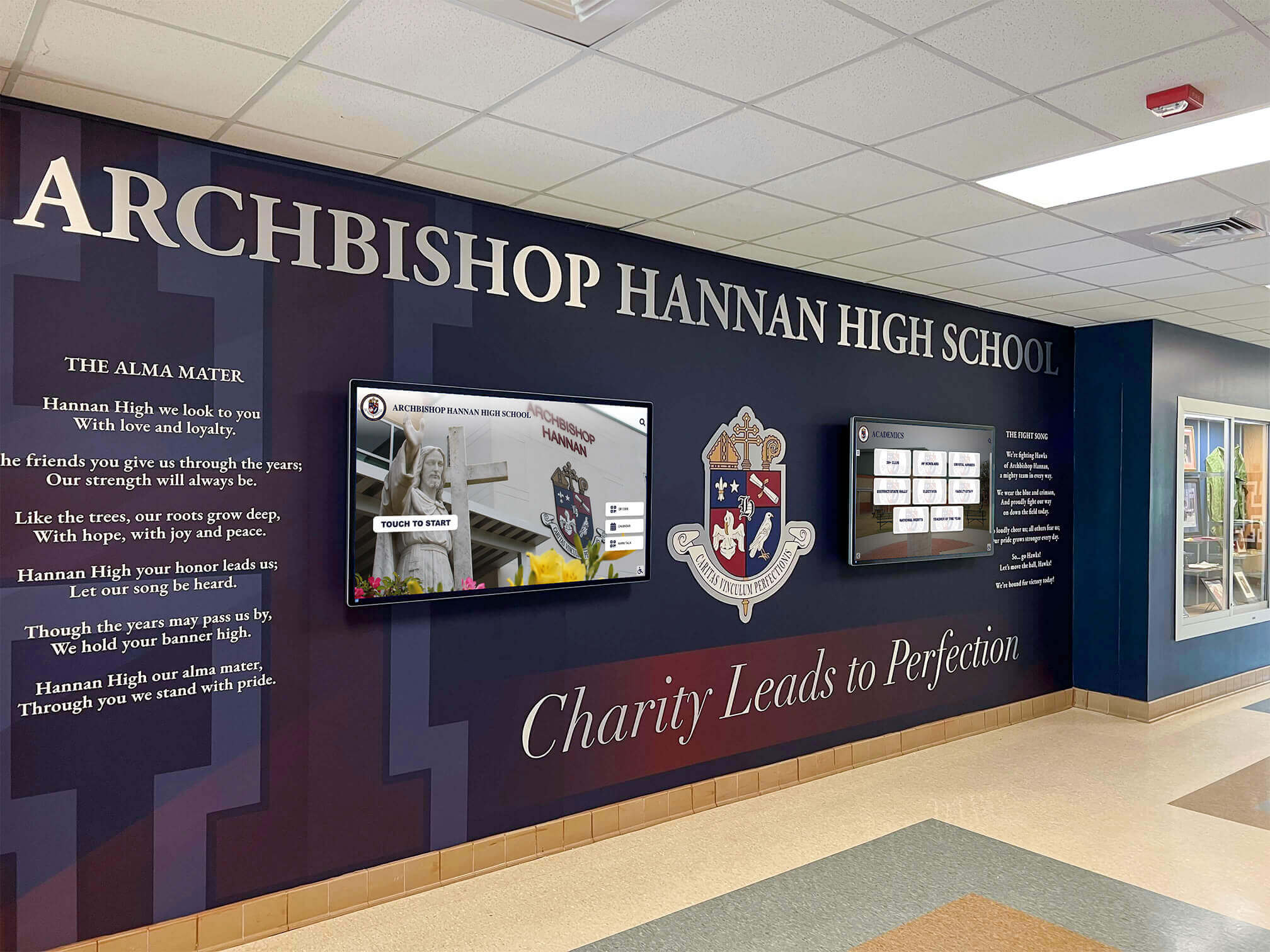
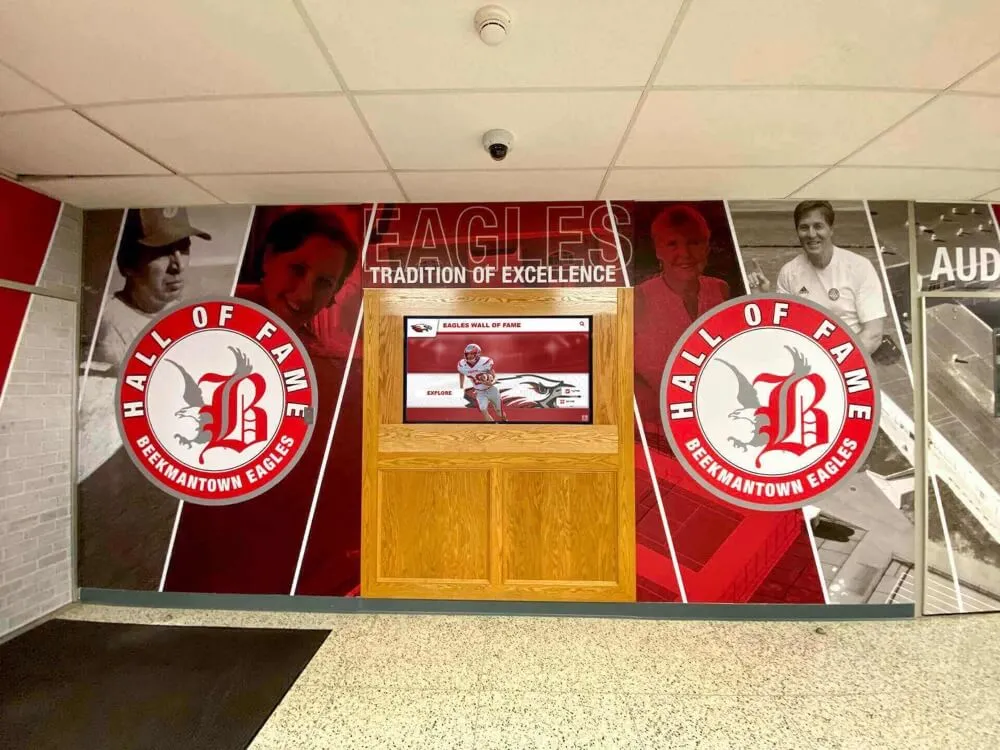
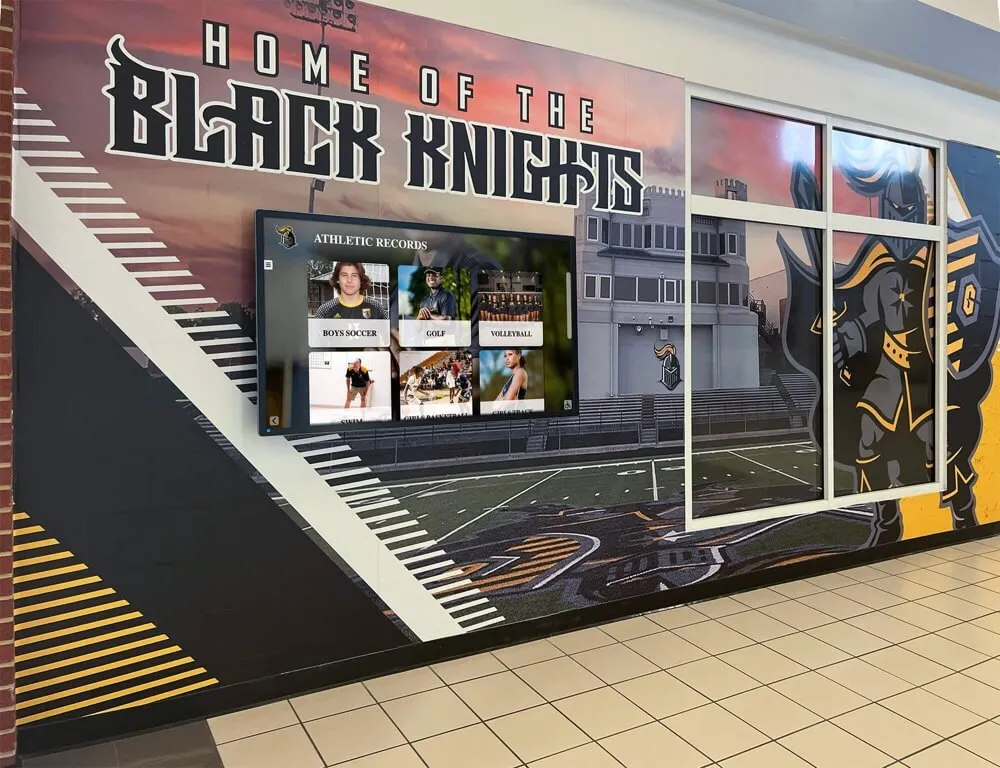
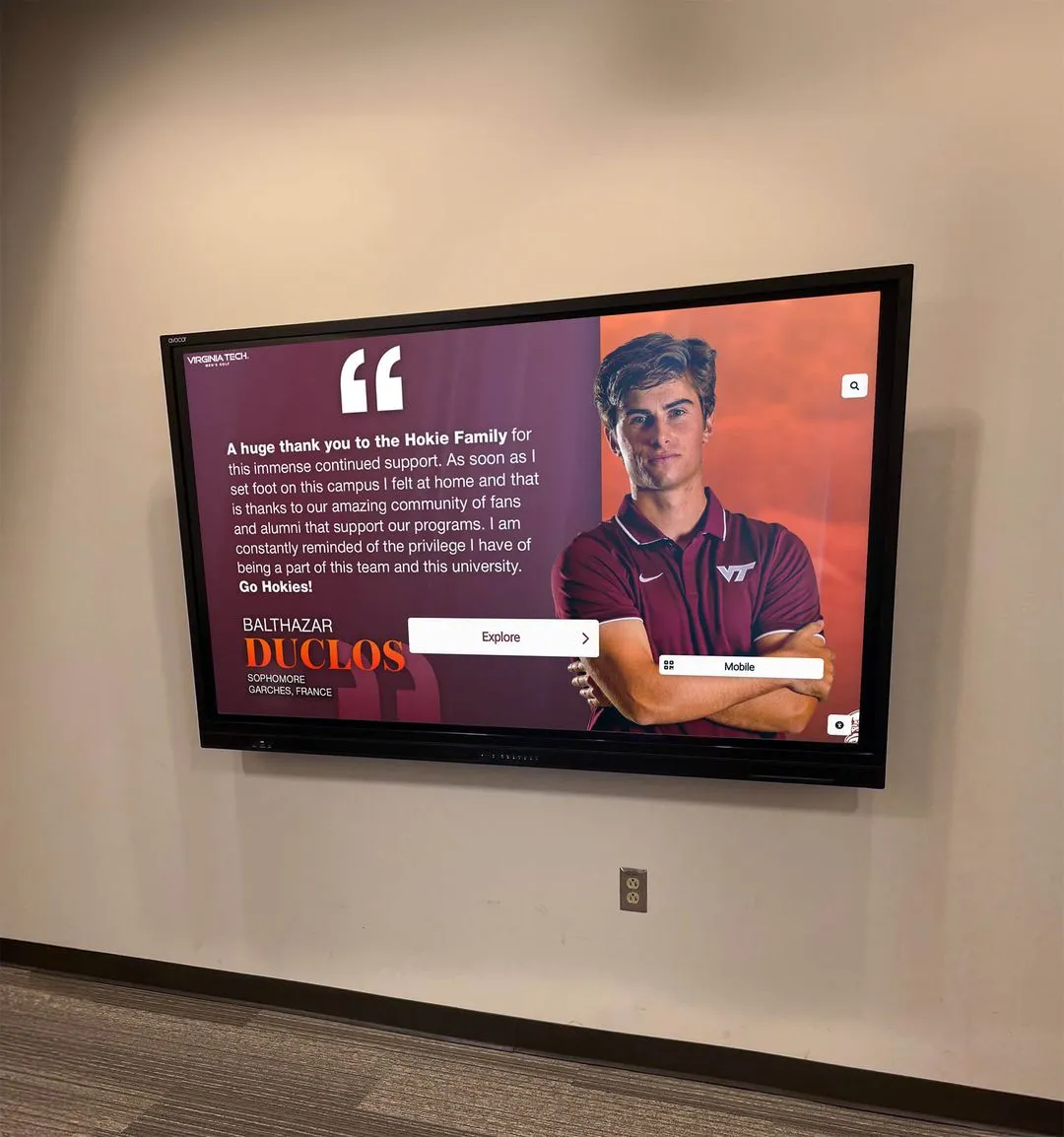
Strategic color integration and architectural positioning create cohesive design environments where digital systems enhance rather than compete with traditional school aesthetics
Accessibility and Inclusive Design Considerations
Both traditional and digital school display cases must serve all community members regardless of physical ability, age, or technical comfort. Design decisions directly impact whether recognition systems genuinely accommodate diverse audiences or inadvertently exclude constituencies deserving equal access.
Physical Accessibility Standards for Traditional Cases
Glass trophy cases present inherent accessibility challenges that design can mitigate but not entirely eliminate:
Viewing Height and Wheelchair Accessibility
ADA guidelines recommend that operable controls and critical content fall within reach ranges of 15-48 inches from floor level for wheelchair users. Trophy cases typically mount at conventional wall height with internal shelving spanning floor to 6-8 feet elevation. This arrangement places bottom-shelf content within accessible viewing range but positions top shelves beyond comfortable sight lines for seated visitors.
Schools committed to inclusive design can specify shorter cases with content concentrated within the 20-60 inch vertical range maximizing accessibility. However, this approach reduces total display capacity exacerbating space limitations, creating tension between accommodation and recognition comprehensiveness that traditional systems cannot fully resolve.
Alternative approaches include angled glass doors tilting upper sections slightly forward improving visibility from seated positions, supplementary photo documentation at wheelchair height providing alternate access to high-mounted trophies, or digital companion displays positioned accessibly that catalog case contents enabling complete recognition exploration regardless of physical trophy visibility.
Visual Clarity and Engraving Readability
Trophy engraving typically employs 10-16 point fonts on metal plates positioned 3-8 feet from viewer positions. At these distances, small text challenges visitors with vision impairments while glass reflections and internal lighting inconsistencies further reduce legibility for anyone not viewing from optimal angles.
Design strategies addressing readability include maximum contrast engraving using dark text on light backgrounds or vice versa, larger font specifications within space constraints, anti-reflective glass reducing glare that obscures engraving, and consistent internal lighting eliminating shadows across trophy surfaces.
Yet traditional cases fundamentally limit how much accommodation design can provide. Physical distance, engraving size constraints, and glass barriers will always create visibility challenges that some community members experience more acutely than others regardless of well-intentioned design refinements.
Digital Display Accessibility and WCAG 2.1 AA Compliance
Digital recognition platforms can achieve higher accessibility standards than physical cases when designed deliberately with universal access prioritized from initial conception:
Screen Positioning and Physical Reach Requirements
Touchscreen displays should mount with primary interactive zones falling within the 15-48 inch height range ADA guidelines specify. For wall-mounted displays, this typically means positioning screen centers approximately 48-54 inches from floor level placing the majority of content within comfortable reach and visibility for both standing and seated visitors.
Free-standing kiosks offer design advantages allowing complete control over display positioning and approach geometry. Quality kiosks provide knee and toe clearance enabling wheelchair users to approach within comfortable reaching distance while angled screens optimize viewing angles from seated positions. Forward reach depth—the horizontal distance visitors must extend to touch screen surfaces—should not exceed 25 inches ensuring comfortable interaction without overextension.
Schools should verify physical accessibility during installation, testing that wheelchair users can comfortably approach displays, reach all interactive elements, and read screen content without straining or requiring assistance. Simple walk-through testing with diverse users during installation prevents deployment of theoretically accessible systems that prove difficult in actual use.
Visual Design and Text Contrast Requirements
WCAG 2.1 AA standards require minimum 4.5:1 contrast ratios for normal body text and 3:1 for large headings (18pt+ or 14pt+ bold). Professional digital recognition platforms implement high-contrast color schemes ensuring text remains readable for vision-impaired visitors and in varying ambient lighting conditions from bright sunlit hallways to dimmer athletic facility corridors.
Text sizing should support comfortable reading from 3-4 feet—typical standing viewing distances for wall-mounted displays. Body text below 16-18 points challenges readability at these distances regardless of contrast levels. Navigation elements and interactive buttons require even larger sizing with generous touch targets preventing mis-selection frustration.
Dynamic text scaling capabilities enable visitors to adjust content sizing based on personal vision needs, though this remains rare in current implementations. Future systems may incorporate accessibility controls allowing visitors to customize contrast levels, text sizes, and interface layouts matching their specific accommodation requirements.
Audio Alternatives and Multimodal Content
Video content should include captions supporting deaf and hard-of-hearing community members. Many schools capture oral history interviews with hall of fame inductees, championship team reflections, or institutional heritage narratives. These audio-dependent materials require text captions or transcripts ensuring accessibility to visitors unable to hear audio playback.
Some advanced implementations incorporate screen reader compatibility enabling vision-impaired visitors to navigate content using audio descriptions, though touchscreen interfaces present inherent challenges for non-visual navigation that remain active research areas in accessibility design. Schools serving populations with significant vision impairment should consider supplementary web-based access where screen readers function more reliably than on public touchscreen kiosks.
Detailed accessibility requirements appear in guides covering academic recognition program implementation, demonstrating systematic approaches ensuring inclusive design serves all community members equitably.
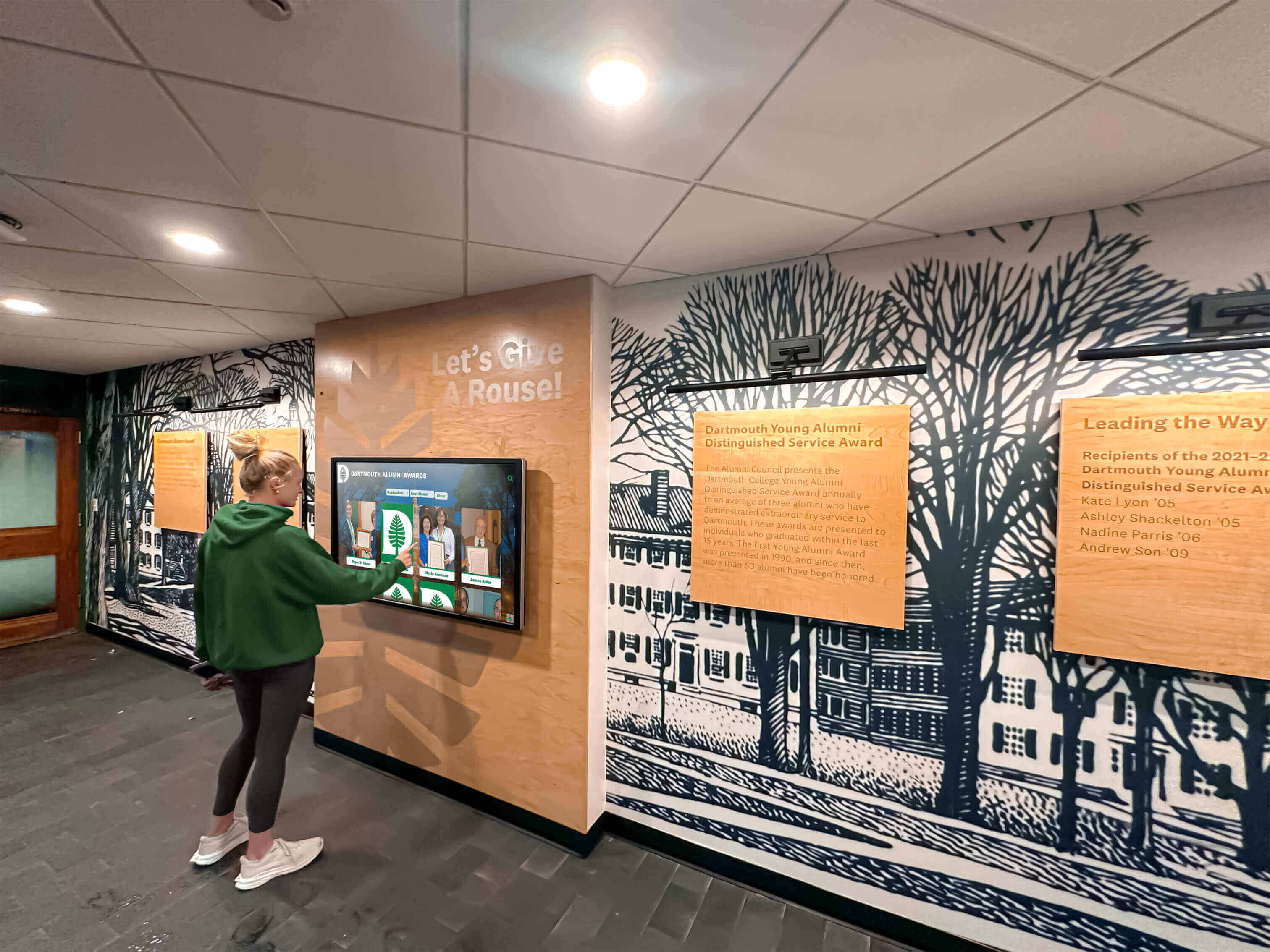
Well-designed digital interfaces enable natural interaction across all age groups and technical comfort levels without requiring instructions
Content Development and Storytelling Frameworks
Recognition effectiveness depends equally on content quality and display medium selection. Both traditional and digital school display cases require systematic content strategies that honor achievements through compelling narratives rather than perfunctory documentation.
Photography Standards and Visual Documentation
Quality visual content forms the foundation of recognition impact regardless of display technology:
Trophy and Award Photography for Traditional Cases
Physical cases display actual trophies making supplementary photography optional, but many schools create photographic archives documenting collections for insurance, historical preservation, and digital companion systems. Professional trophy photography follows established conventions: neutral backgrounds eliminating distractions, proper lighting showing metal detail without glare, multiple angles capturing trophy dimensions and craftsmanship, close-ups of engraved plates with legible text, and consistent sizing across collections maintaining visual continuity.
For trophies remaining in current display, photograph in place documenting contextual arrangement but also create clean individual images allowing flexible usage in digital systems or printed materials. Trophies in storage absolutely require photography before details fade from institutional memory and physical deterioration compromises preservation.
Portrait and Action Photography for Digital Recognition
Digital platforms leverage photography extensively for individual recognition, team profiles, and achievement storytelling. Essential photographic content includes formal portraits showing individuals during their involvement era, action shots capturing athletic performances or activity participation, team photographs with complete rosters and coaching staff, facility and campus imagery providing environmental context, and historical documentation including vintage photographs and archival materials.
Photography should meet minimum resolution standards—1920x1080 pixels at minimum for featured images displayed at large sizes, higher resolution for photos supporting zoom functionality. Consistent aspect ratios (16:9 for horizontal, 3:4 for portraits) simplify layout design preventing awkward cropping or distortion addressing mixed dimensions.
Many schools engage student photography programs or volunteer photographers capturing current achievements while gradually digitizing historical collections from yearbooks, archives, and community donations. The photography quality directly impacts recognition presentation professional appearance—grainy, poorly lit, or inappropriately cropped images undermine recognition gravitas regardless of achievement significance.
Text Content and Narrative Development
Words bring recognition to life by providing context, telling stories, and explaining significance that images alone cannot convey:
Engraving Constraints in Traditional Displays
Trophy plaques and engraved plates impose severe text limitations—typically 50-150 words maximum depending on plaque size and engraving font specifications. This constraint forces extremely concise recognition covering only essential facts: individual name or team designation, achievement category and level, year earned, and perhaps brief context like championship opponent or score.
These limitations reduce recognition to documentation rather than storytelling. Visitors learn that someone won a championship but rarely understand the complete journey, obstacles overcome, lasting impact on program culture, or connections to broader institutional traditions that make achievements meaningful beyond simple fact recording.
Schools maximize limited engraving space through hierarchy emphasizing critical information while minimizing formulaic language, parallel structure enabling efficient communication without repetition, selective detail choosing one or two specific accomplishments representing broader achievement, and careful editing removing unnecessary articles and prepositions without sacrificing clarity or tone.
Narrative Depth in Digital Platforms
Digital recognition eliminates text constraints enabling comprehensive storytelling through profiles containing 300-800 words of biographical and achievement narrative. This space allows meaningful storytelling including early background and path to involvement, defining moments and turning points during achievement pursuit, statistical accomplishments and performance highlights with full context, challenges overcome and adversity faced, lasting impact on programs and institutional culture, and post-graduation achievements demonstrating continued excellence.
Quality narratives balance factual documentation with emotional resonance. Rather than stating “Led team to 24-3 record and state championship,” compelling recognition explains “Demonstrated remarkable leadership as team captain during program’s first state championship season, rallying teammates through mid-season adversity after season-opening injuries threatened playoff hopes. Game-winning performance in championship contest remains defining moment in program history, establishing competitive standard that inspired three subsequent title runs.”
This depth creates engagement transforming recognition from directories into compelling archives that current students explore discovering institutional heritage while building authentic pride in traditions and achievement cultures they inherit.
Frameworks for donor recognition wall design demonstrate storytelling principles applicable across recognition categories from athletic achievement through philanthropic contribution to academic excellence.
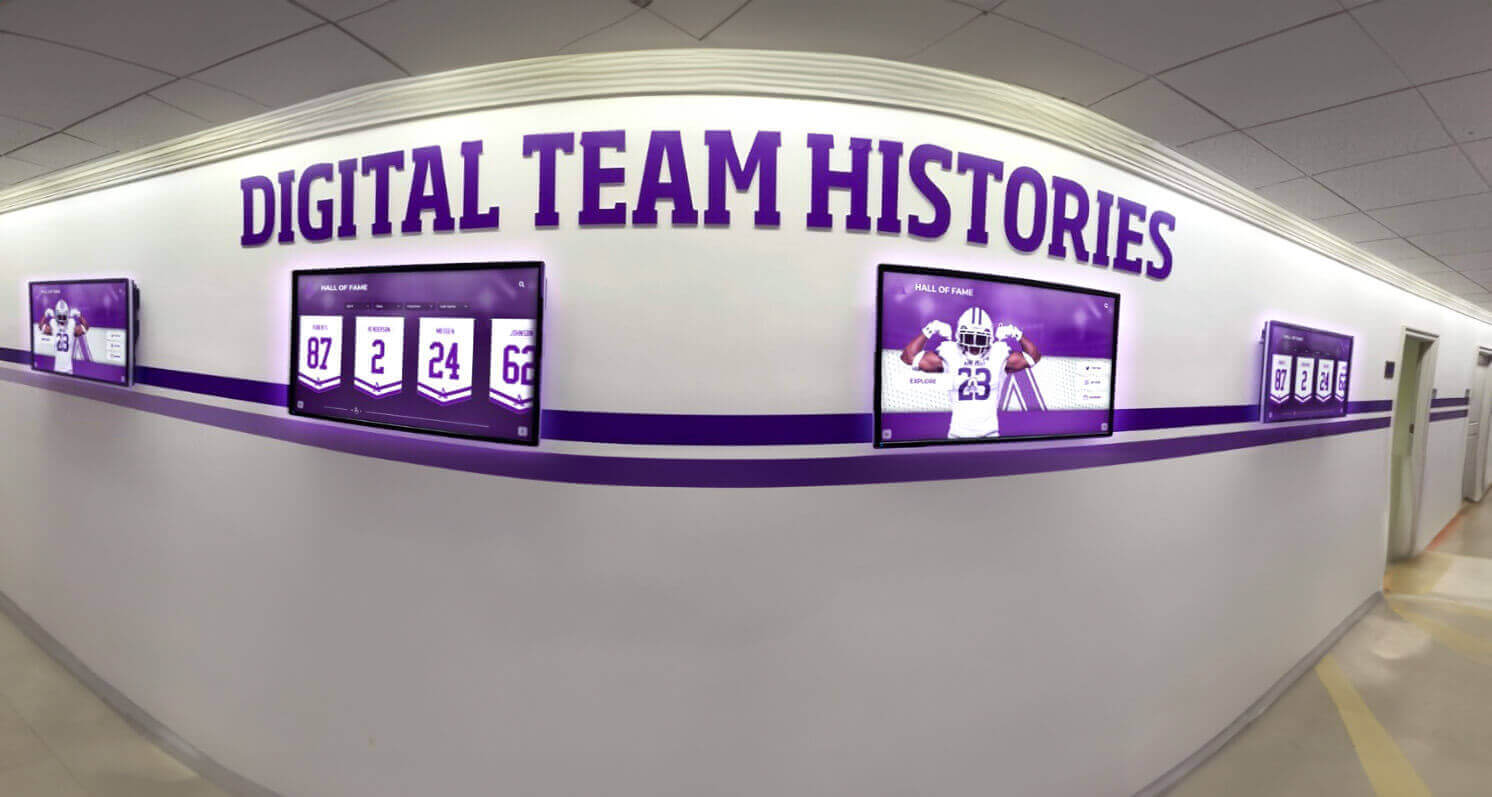
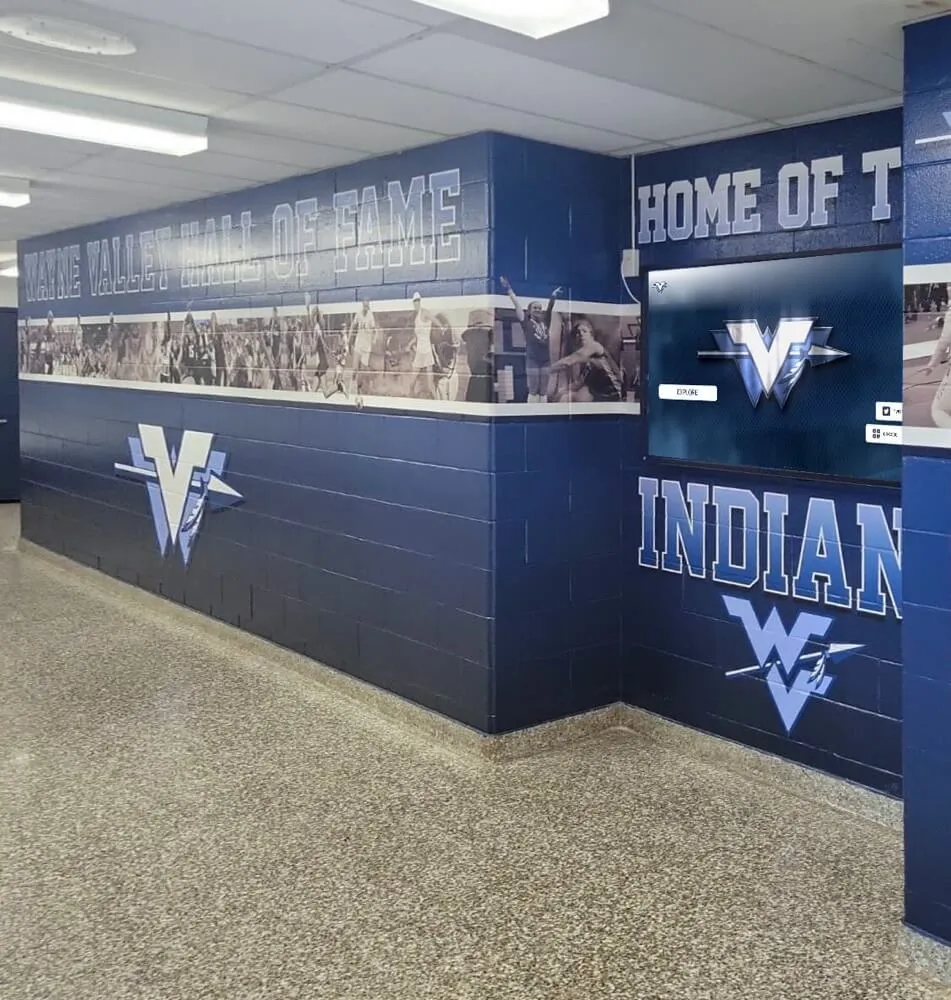
Multi-display networks enable comprehensive recognition serving diverse achievement categories while maintaining consistent design language throughout facilities
Strategic Placement and Facility Integration
Display positioning significantly impacts recognition effectiveness regardless of technology choice. Strategic placement ensures recognition reaches target audiences during natural facility usage patterns rather than requiring dedicated visits to isolated locations.
High-Traffic Corridor Positioning for Maximum Visibility
Both traditional and digital school display cases achieve greatest impact when positioned in hallways and common areas where students, staff, visitors, and community members pass regularly during normal activities:
Main Entrance Lobbies and Welcome Areas
Entrance positioning ensures recognition reaches all facility visitors immediately upon arrival creating powerful first impressions. Athletic programs typically install primary display cases in gymnasium lobby areas serving competition attendees and daily practice participants. Academic buildings position recognition in main entrance corridors welcoming students, faculty, and administrative visitors throughout operating hours.
These prominent positions communicate institutional priorities—recognition receives prime real estate rather than secondary hallways suggesting afterthought status. Prospective families touring campuses during enrollment decision processes invariably encounter entrance-positioned recognition, experiencing professional achievement celebration that influences perceptions of institutional quality and culture.
Athletic Facility and Training Spaces
Recognition surrounding current athletes in spaces they occupy daily provides ongoing motivation and standard-setting influence. Display cases in locker room corridors, training facility entrances, and field house concourses surround athletes with program heritage and championship traditions during every practice and competition preparation.
This immersive positioning makes recognition unavoidable rather than optional—students cannot help encountering excellence standards and achievement expectations throughout daily athletic participation. The environmental influence shapes culture more powerfully than occasional recognition ceremony attendance or voluntary display exploration during spare moments.
Cross-Campus Integration Beyond Athletic Facilities
Schools maximizing recognition impact position displays throughout campuses rather than concentrating solely in athletic or administrative areas. Installation in main academic building corridors ensures whole-school visibility rather than limiting recognition to athletic program participants. Cafeteria and commons area placement reaches all students during daily gathering periods. Library and student services positioning connects achievement with academic mission and support resources.
This distributed approach communicates that athletic, academic, and activity excellence matters to entire school communities rather than representing isolated program concerns relevant only to direct participants. Integration throughout campuses normalizes achievement celebration as central institutional value rather than specialized interest.
Resources on exciting hallway displays for schools provide comprehensive facility integration strategies maximizing recognition reach and cultural impact through thoughtful positioning aligned with traffic patterns and community gathering behaviors.
Lighting, Sightlines, and Environmental Integration
Physical positioning represents only one design consideration—environmental factors significantly affect recognition visibility and visitor engagement regardless of content quality:
Lighting Optimization and Glare Management
Traditional cases require internal illumination creating visibility in standard hallway lighting conditions while minimizing glass reflection that obscures trophy viewing. LED strip lighting along shelf edges provides even illumination without hot spots while consuming minimal energy. Anti-reflective glass coatings reduce reflection from opposing windows or overhead fluorescent lighting that creates visual barriers preventing clear case interior viewing.
Digital displays face different lighting challenges. Direct sunlight creates screen wash-out making content illegible regardless of display brightness specifications. Positioning displays perpendicular to windows rather than directly opposite prevents most sunlight interference. High-brightness commercial displays rated 500+ nits maintain visibility in bright ambient conditions that render standard consumer displays useless.
Schools should evaluate lighting conditions during installation planning, testing visibility at different times of day and throughout academic year as sun angles shift seasonally. Simple repositioning or supplementary window treatments often resolve lighting problems that expensive display upgrades cannot address if fundamental positioning creates insurmountable environmental challenges.
Architectural Integration and Design Cohesion
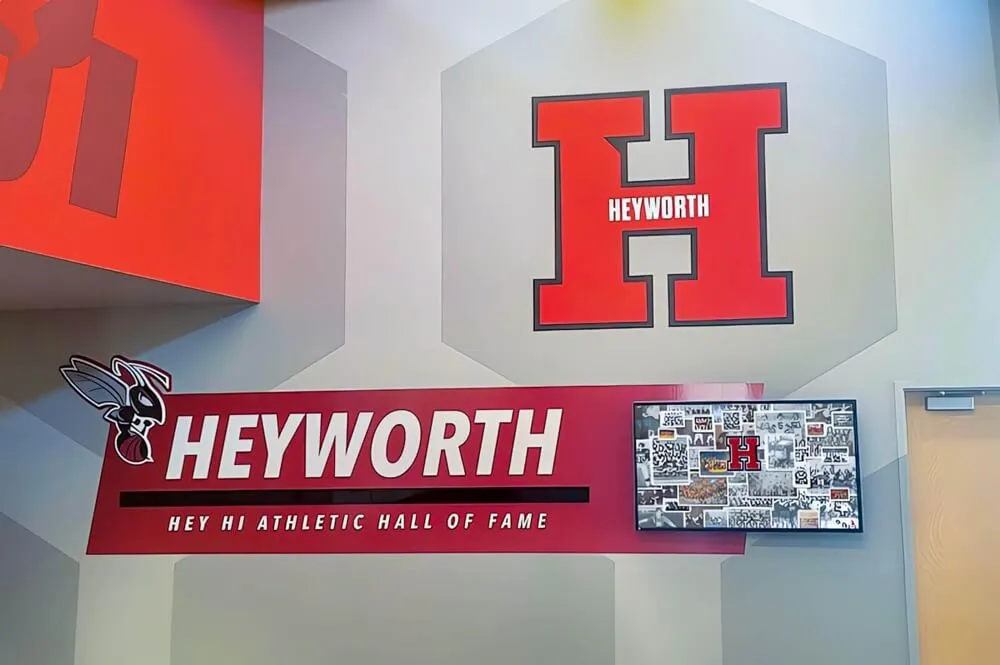
Recognition displays work most effectively when integrated thoughtfully with facility architecture rather than appearing as afterthought additions disrupting visual environments. Traditional cases can incorporate school colors through frame finishes, backing materials, or external signage identifying display purpose and content organization. Custom millwork surrounding cases creates polished installations that appear built into facilities rather than bolted onto walls.
Digital systems offer extensive customization opportunities through screen content design incorporating school colors, logos, mascots, and branded backgrounds creating immediate institutional connection. Physical kiosk enclosures can match facility finishes—wood tones coordinating with existing millwork, powder-coated steel matching architectural metals, or custom wraps featuring school imagery and branding.
Cohesive integration communicates that recognition receives appropriate investment and institutional priority rather than representing minimal-budget afterthoughts that undermine rather than celebrate achievement significance. Professional appearance worthy of accomplishments honored demonstrates respect for excellence through presentation quality matching recognition importance.
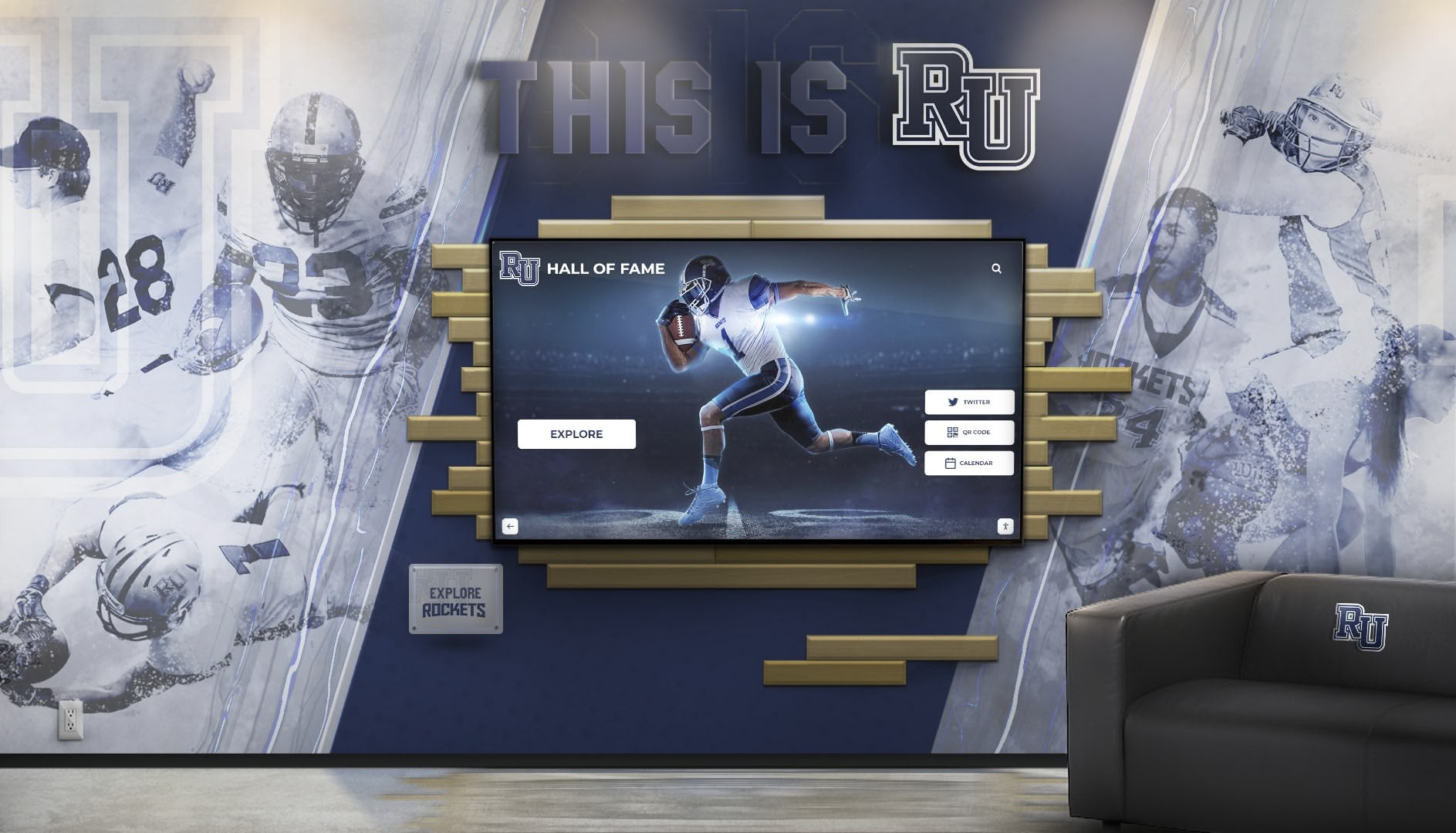
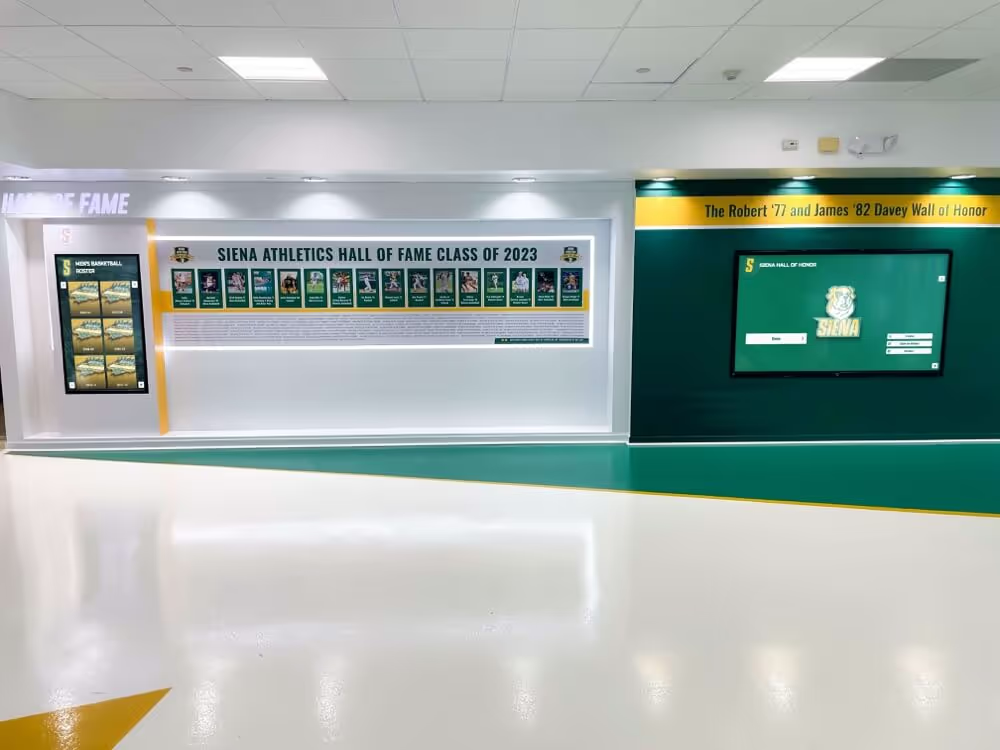
Thoughtful installations blend traditional architectural elements with modern technology creating recognition environments that honor both heritage and innovation
Hybrid Recognition Strategies Combining Traditional and Digital Approaches
Many schools discover that combining selective physical trophy displays with comprehensive digital systems creates optimal recognition serving diverse stakeholder preferences while maximizing both ceremonial impact and practical functionality.
Selective Physical Prominence for Highest Achievements
Traditional cases excel at showcasing most prestigious trophies where physical presence carries ceremonial significance that digital representations cannot fully replicate:
Championship Trophy Physical Display Criteria
Maintain traditional case displays for state championship trophies representing highest competitive achievements commanding special recognition, historic trophies with exceptional aesthetic or symbolic value representing founding achievements or institutional turning points, recent championship trophies during 1-3 years immediately following victories while celebration momentum remains strong, and specially commemorated trophies donated by boosters or community supporters with expectations of physical display visibility.
These selective displays preserve tangible trophy presence satisfying constituencies valuing physical recognition while avoiding capacity constraints that force comprehensive programs into impossible space requirements. When traditional cases showcase only highest-level achievements rather than attempting complete collections, they maintain focus and impact that cluttered overcrowded displays cannot achieve.
Architectural Focal Points and Ceremonial Spaces
Physical trophy cases work particularly effectively as architectural focal points in specific facility locations. Entrance rotundas, lobby alcoves, or dedicated trophy rooms create concentrated recognition environments where physical cases receive appropriate presentation investment through custom millwork, specialized lighting, and architectural detailing worthy of achievements celebrated.
These dedicated recognition spaces offer ceremonial significance that hallway installations cannot replicate. Hall of fame induction ceremonies, championship celebrations, and major recognition events gain gravitas when conducted in purpose-designed spaces where physical trophies and achievement documentation create immersive environments focused entirely on excellence celebration rather than serving dual purposes as circulation corridors.
Digital Depth for Comprehensive Capacity and Storytelling
Alongside selective physical displays, digital platforms provide unlimited capacity enabling complete achievement recognition without physical space limitations:
Comprehensive Digital Archives
Digital systems document complete trophy collections including all championships, tournament victories, and significant awards regardless of physical display capacity, full team rosters and individual athlete recognition ensuring complete rather than selective acknowledgment, detailed trophy photographs showing pieces even when not physically displayed enabling virtual access to entire collections, searchable databases allowing instant discovery of any achievement across complete program histories, and multimedia storytelling through video, audio, statistical context, and narrative depth impossible with physical case placards.
This comprehensive digital layer ensures nothing deserving recognition faces storage relegation or omission due to physical limitations. Every achievement receives permanent accessibility through digital platforms while selective physical display highlights highest accomplishments with ceremonial tangible presence.
Web Extensions and Universal Accessibility
Digital recognition platforms extend beyond physical displays through responsive web portals making recognition universally accessible. Alumni living anywhere worldwide can revisit championships they earned exploring complete team rosters and season narratives decades after graduation. Prospective families research programs during enrollment decisions accessing complete achievement histories demonstrating institutional traditions and competitive excellence. Current students share recognition with distant relatives through social media integration enabling pride sharing beyond campus boundaries.
This universal access dramatically expands recognition reach from hundreds of daily hallway visitors to thousands of web visitors monthly accessing content from anywhere at any time. The combination of physical displays serving on-campus constituencies and web platforms serving worldwide audiences maximizes recognition value across all stakeholder groups rather than limiting visibility to those physically present during facility hours.
Comprehensive approaches to state championship trophy display demonstrate hybrid strategies combining physical prominence for highest achievements with digital depth ensuring comprehensive recognition serving all program dimensions effectively.
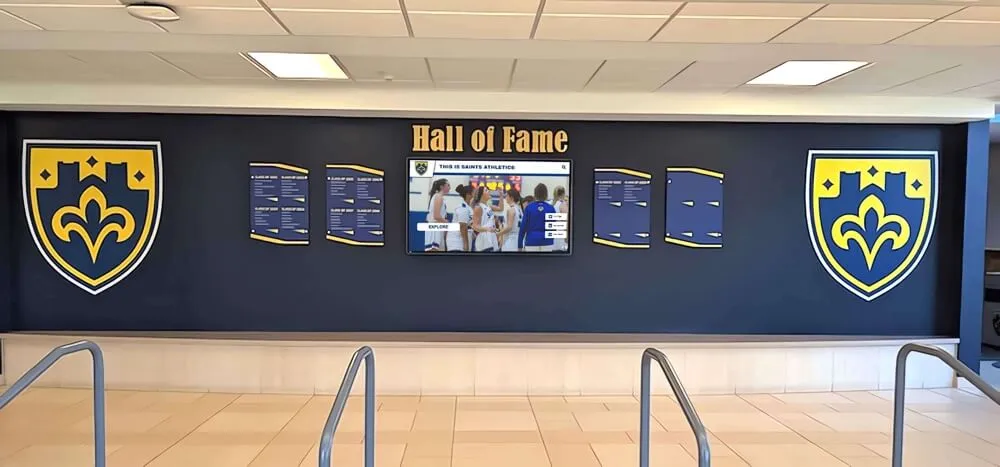
Hybrid installations leverage strengths of both approaches—physical awards provide ceremonial presence while digital systems enable unlimited capacity and rich storytelling
Budget Considerations and Total Cost Analysis
Financial constraints significantly influence recognition approach selection. Understanding complete lifecycle costs rather than only initial investment enables informed decisions balancing budget realities against long-term recognition needs.
Traditional Case Costs and Ongoing Expenses
Physical trophy case implementation involves both substantial initial investment and recurring costs that accumulate significantly over recognition program lifespans:
Initial Purchase and Installation Investment
Quality wall-mounted trophy cases range from $2,000-8,000 per unit depending on size, materials, glass quality, lighting systems, and custom millwork integration. Professional installation adds $500-2,000 per case covering mounting hardware, electrical work for internal lighting, and final positioning ensuring level installation and secure wall attachment supporting 200-400 pound loaded weights.
Schools establishing comprehensive recognition programs require multiple cases accommodating diverse achievement categories and growing collections. Athletic programs commonly install 3-6 cases initially with plans for expansion as trophy accumulation continues. Total initial investment frequently reaches $10,000-50,000+ for robust traditional case installations serving comprehensive recognition needs.
Recurring Recognition Maintenance Expenses
Each trophy or plaque added to traditional displays incurs incremental costs that compound annually across decades of recognition program operation:
- Engraved plaques cost $50-300 depending on size, materials, and customization complexity
- Trophy purchasing (when schools buy rather than receive donated awards) ranges $75-500 per piece
- Engraving services charge setup fees and production costs adding $25-75 per item
- Installation labor requires contractor coordination at $75-150 per hour typically totaling $200-500 per annual update session
- Display reorganization becomes necessary as cases fill requiring additional labor and planning
Athletic programs adding 30-60 annual recognitions spend $2,500-15,000 yearly on traditional recognition maintenance. Over 20-year program lifespans, recurring costs total $50,000-300,000+—substantially exceeding initial case purchase investments and representing ongoing budget commitments competing with program development, equipment, and student experience priorities.
Digital Display Investment and Lifecycle Economics
Digital recognition systems involve higher initial investment but substantially lower recurring costs creating favorable long-term economics for most comprehensive programs:
Hardware, Software, and Installation Costs
Complete digital display case implementations including all components typically cost $8,000-20,000 per installation depending on screen size (43-75 inches), mounting approach (wall-mount versus freestanding kiosk), software platform selection (specialized recognition systems versus generic digital signage), professional installation requirements, and network infrastructure needs.
Cost breakdowns typically allocate $2,000-6,000 for commercial-grade touchscreen displays rated for continuous operation, $1,500-5,000 for freestanding kiosks when applicable (wall mounting costs substantially less), $2,000-5,000 for recognition software licenses and initial content development, and $1,000-3,000 for professional installation including electrical, network connectivity, and mounting labor.
While higher than single traditional case costs, digital systems replace multiple physical cases through unlimited capacity. The appropriate cost comparison involves digital display investment against 4-8 traditional cases plus 20 years of recurring maintenance costs that digital platforms largely eliminate.
Annual Operating Costs and Long-Term Economics
Digital recognition platforms incur modest ongoing expenses primarily covering software licensing and support. Annual costs typically range $1,200-3,600 per display depending on platform provider, support level, storage capacity for multimedia content, and optional services like professional content development assistance.
These recurring costs remain relatively fixed regardless of how many new recognitions schools add annually. Whether programs add 10 or 100 honorees, software costs remain constant—dramatic contrast to traditional approaches where each recognition incurs incremental expense. This economic structure favors comprehensive recognition programs where per-honoree costs decline as recognition volume increases.
Over 15-20 year typical digital display lifecycles, total costs including initial investment and recurring fees range $25,000-90,000 per display. This compares favorably to traditional approaches requiring $60,000-350,000+ for multiple cases plus decades of recurring maintenance serving equivalent recognition scope. Schools report complete return on investment within 3-7 years as avoided traditional maintenance costs offset higher digital initial investment.
Detailed cost analyses appear in resources covering high school wall of fame programs, demonstrating financial modeling approaches that account for complete lifecycle economics rather than limiting consideration to initial purchase prices alone.
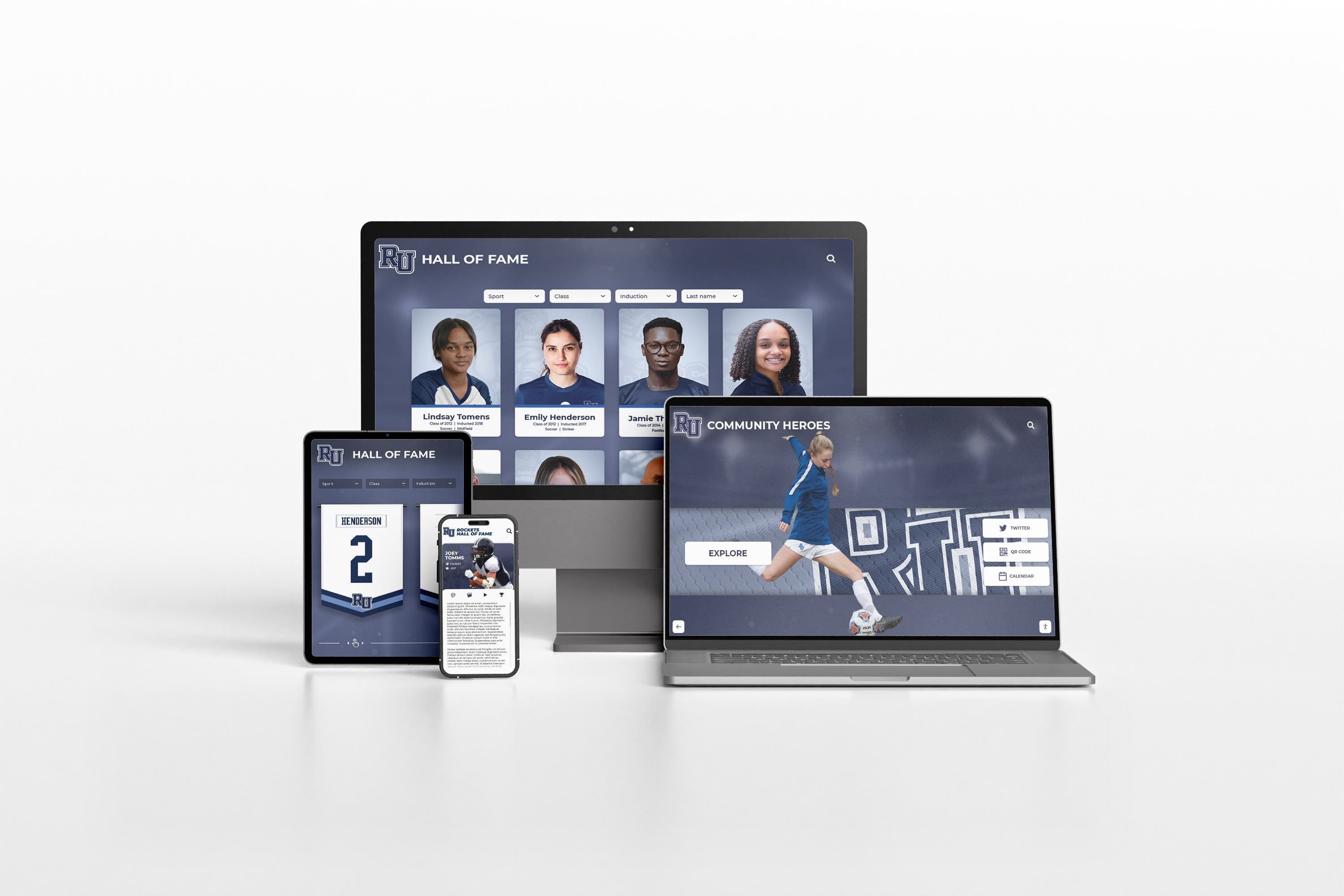
Web-based access extends recognition beyond physical displays enabling worldwide engagement through responsive design serving all device types
Implementation Timeline and Phased Deployment Strategies
Recognition program transformation represents significant undertaking requiring systematic planning, stakeholder engagement, and realistic timeline expectations for successful execution.
Traditional Case Installation Timeline
Physical trophy case implementation follows relatively straightforward procurement and installation processes:
Planning Through Installation (8-16 Weeks)
Initial planning and needs assessment requires 2-4 weeks determining recognition scope, available wall space, budget parameters, and design preferences. Vendor selection and case customization adds 2-3 weeks reviewing options, obtaining quotes, finalizing specifications, and placing orders. Manufacturing and delivery timelines span 4-8 weeks for custom cases or 2-4 weeks for stock configurations with minimal customization. Installation scheduling and execution requires 1-2 weeks coordinating contractors, completing electrical work, mounting cases, and conducting final adjustments.
Total implementation from initial planning through operational installation typically spans 2-4 months—achievable within single summer break for schools targeting fall academic year launches. The primary timeline variable involves custom millwork or architectural integration extending manufacturing phases substantially when installations require facility modifications beyond simple wall mounting.
Content Development and Initial Population
Trophy cases display physical awards already owned, minimizing content development beyond photographing current collections for archive documentation. Initial population involves physically arranging trophies within cases, creating any supplementary plaques identifying contents or providing organizational structure, and establishing maintenance protocols for ongoing updates and cleaning.
This content development typically requires 1-2 weeks of administrative time plus any required engraving or plaque production for organizational labels and context-setting signage.
Digital Display Implementation Timeline
Digital recognition involves additional complexity across hardware, software, content development, and training dimensions:
Planning Through Launch (12-20 Weeks)
Comprehensive planning spanning 3-4 weeks determines recognition scope, content availability, technical requirements, budget allocation, and stakeholder engagement strategies. Platform evaluation and vendor selection requires 2-3 weeks researching options, requesting demonstrations, checking references, and finalizing contracts. Content development represents the most time-intensive phase spanning 6-10 weeks gathering photos and achievement information, writing biographical narratives, organizing content logically, and uploading profiles to content management systems. Hardware installation and technical configuration adds 2-3 weeks for equipment delivery, professional mounting, network connectivity setup, software installation, and system testing.
Total implementation from planning initiation through public launch typically requires 3-5 months—longer than traditional cases due primarily to content development rather than technical deployment complexity. Schools can compress timelines by starting with limited content scope initially then expanding coverage systematically, or extend timelines when committed to comprehensive historical content before launch.
Phased Deployment and Iterative Expansion
Many successful digital recognition implementations follow phased approaches launching with achievable initial scope then expanding systematically as resources allow:
Phase 1: Current Recognition and Recent History (Months 1-3) Launch with current academic year achievements and 3-5 years of recent history providing immediate relevance while demonstrating system capabilities. This achievable scope enables rapid deployment proving value before investing months in comprehensive historical content development.
Phase 2: Decade-by-Decade Historical Expansion (Months 4-12) After establishing contemporary baseline, systematically add historical content decade by decade—beginning with 2010s, then 2000s, 1990s, and earlier eras as capacity allows. This structured approach prevents overwhelming initial content development while building comprehensive archives over reasonable timeframes.
Phase 3: Enhanced Multimedia and Feature Development (Ongoing) With comprehensive profile coverage established, focus shifts to enhancement through video interviews with honorees, audio recordings and oral histories, expanded statistical databases and record tracking, and advanced features like virtual tours or augmented reality integrations as technology evolves.
Phased approaches maintain momentum generating ongoing engagement through regular content additions rather than long implementation delays before launch delivering any value to communities served.
Maintenance Requirements and Long-Term Sustainability
Recognition systems require ongoing maintenance ensuring displays remain current, functional, and aligned with evolving institutional needs and technical capabilities.
Traditional Case Maintenance and Physical Upkeep
Glass trophy cases demand regular physical maintenance preserving presentation quality and structural integrity:
Cleaning and Appearance Preservation
Glass surfaces require regular cleaning removing fingerprints, dust, and environmental contamination that accumulates through daily facility usage. Quality glass cleaners and microfiber cloths should be used weekly for high-traffic displays, monthly for less prominent cases. Internal shelf surfaces need periodic dusting particularly for trophies displayed long-term where dirt accumulation dims metallic finishes and obscures engraving detail.
Trophy maintenance involves periodic metal polishing restoring luster to brass, silver, and chrome awards that oxidize over time, replacing felt or fabric backing materials when fading or deterioration occurs, and repairing damaged trophies addressing loose components or engraving plate detachment before complete failures occur.
Schools typically assign facilities staff or student workers to regular case cleaning while major maintenance requires specialized contractors or athletic department personnel with appropriate expertise and materials access.
Security and Structural Maintenance
Lock mechanisms require periodic lubrication and occasional replacement as repeated use degrades function over years of access. Glass doors need hinge adjustment maintaining proper alignment and smooth operation. Internal lighting requires bulb replacement as LEDs fail or fluorescent tubes expire, plus periodic ballast or driver replacement addressing electrical component degradation.
Security considerations involve ensuring locks function properly preventing unauthorized access and potential theft of valuable trophies, verifying case stability as building settling or wall deterioration could compromise mounting integrity, and monitoring glass condition addressing cracks or chips before failures create safety hazards.
Annual comprehensive inspections by facilities personnel identify emerging issues enabling proactive maintenance before failures occur during high-visibility periods like championship celebrations or reunion events.
Digital Display Maintenance and Content Currency
Digital recognition systems require different maintenance focusing on technical functionality and content accuracy:
Hardware Maintenance and Technical Support
Commercial-grade touchscreens require minimal physical maintenance beyond periodic screen cleaning with approved solutions that don’t damage anti-glare coatings or touch sensor surfaces. Ventilation systems need occasional inspection ensuring cooling fans operate properly and heat sinks remain dust-free preventing thermal failures that damage display electronics.
Software updates from platform providers should be applied regularly—typically quarterly or as vendors release improved versions addressing bugs, adding features, or enhancing security. Cloud-based systems often update automatically without requiring on-site technical intervention, while local-server solutions need IT department coordination ensuring updates deploy without disrupting operational displays.
Technical support agreements with vendors provide professional assistance addressing hardware failures, software issues, or connectivity problems that school IT staff cannot resolve independently. Support contracts typically cost 10-20% of annual software licensing fees, providing phone and remote support with guaranteed response times for critical issues.
Content Maintenance and Recognition Currency
Digital systems’ greatest maintenance requirement involves content updates ensuring recognition remains current. Annual induction cycles require uploading new honoree profiles including photos, biographical information, and achievement documentation. Existing content needs periodic review correcting errors discovered over time, updating individual profiles as post-graduation accomplishments occur, and enhancing historical content as additional photos or information becomes available through alumni outreach.
Schools should designate specific administrators responsible for content maintenance with clear accountability for update timelines, quality standards, and approval workflows. Without assigned ownership, recognition currency suffers as busy staff assume others handle maintenance leading to outdated displays that undermine rather than enhance institutional credibility.
Most schools invest 10-20 hours annually on content maintenance for established systems after initial population completes—manageable commitment when balanced against traditional recognition’s ongoing vendor coordination and physical update logistics.
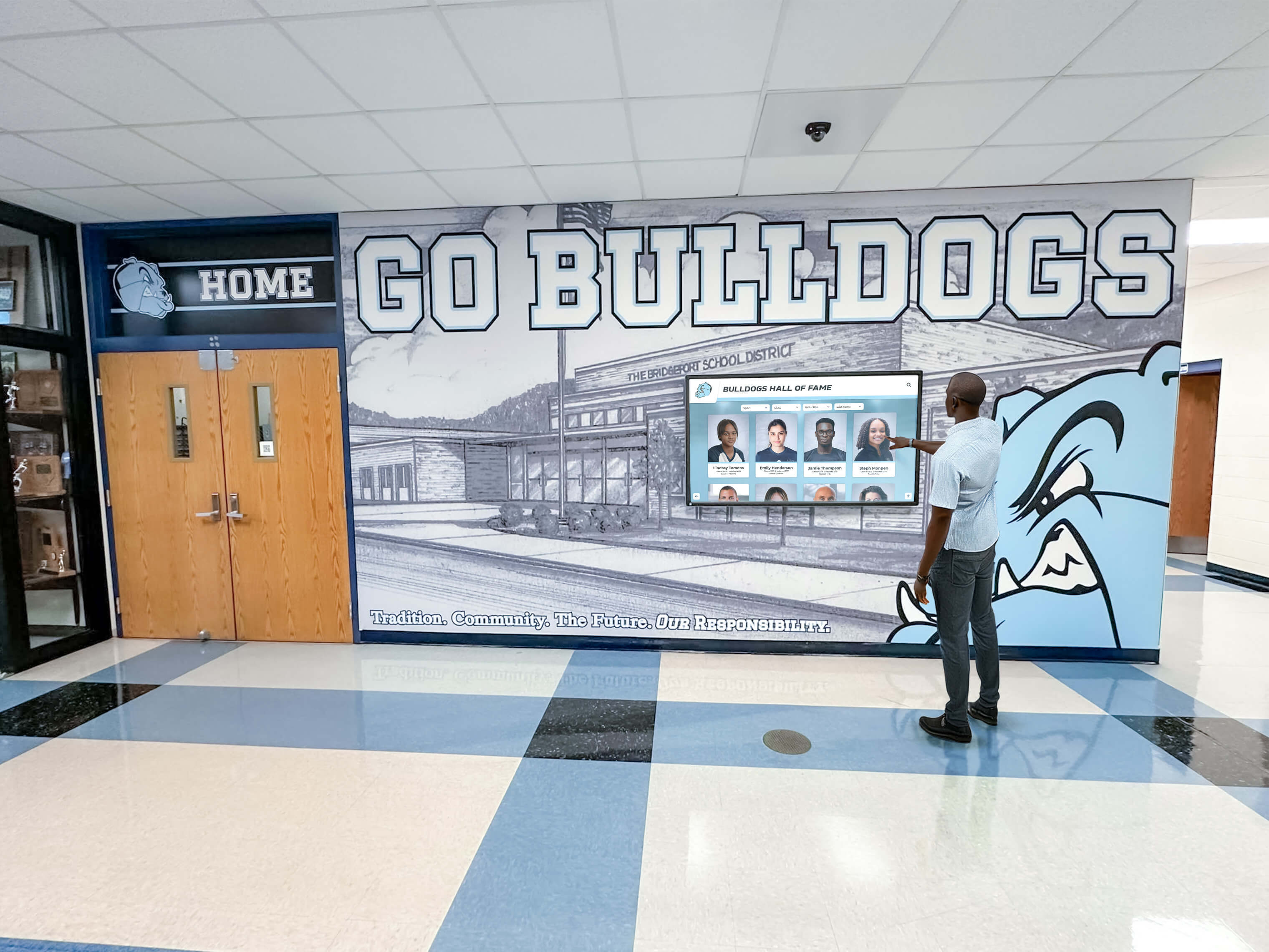
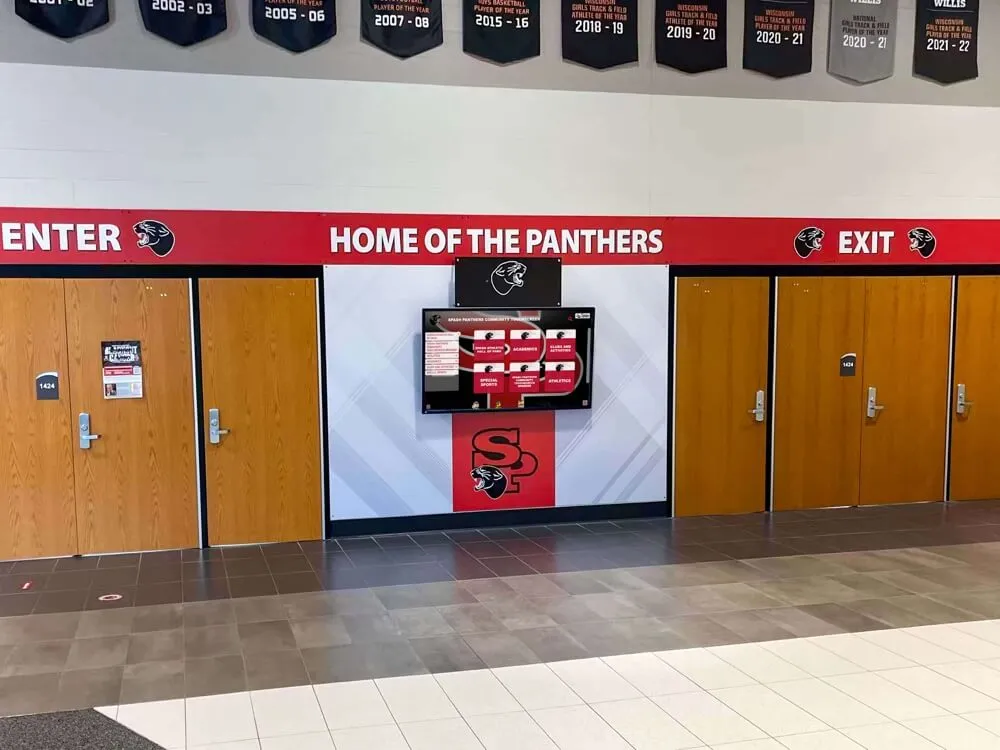
Strategic hallway placement ensures recognition reaches daily facility traffic maximizing visibility and community engagement throughout academic years
Measuring Success and Demonstrating Recognition Program Value
Quantifying recognition impact helps administrators demonstrate value to budget authorities, boards, and stakeholders while identifying improvement opportunities serving communities more effectively.
Traditional Case Impact Assessment
Physical trophy case effectiveness proves challenging to measure quantitatively requiring primarily qualitative evaluation methods:
Observational Assessment and Feedback Collection
Schools evaluate traditional case impact through informal observation monitoring how frequently visitors pause to examine displays, whether campus tour guides reference cases during prospective family visits, how alumni react encountering their recognition during reunion attendance, and general stakeholder comments during community events and meetings.
Survey instruments can query awareness and perception asking community members about recognition program familiarity, gathering feedback about display quality and location appropriateness, assessing whether recognition influences school pride and institutional identification, and collecting suggestions for recognition improvement or expansion.
These qualitative approaches provide valuable insights but lack quantitative precision making objective value demonstration difficult for budget justification or program evaluation purposes.
Indirect Impact Indicators
Rather than measuring display engagement directly, schools monitor indirect indicators potentially influenced by recognition including alumni event attendance and donation patterns, prospective student enrollment following campus tours featuring recognition displays, and community engagement metrics reflecting institutional connection and pride levels.
Establishing causal relationships between recognition displays and these outcomes remains challenging given multiple confounding factors, but patterns suggesting recognition contributes to positive trends support continued investment and potential expansion.
Digital Recognition Analytics and Engagement Metrics
Digital platforms provide comprehensive usage analytics enabling objective impact assessment and data-driven program refinement:
Quantitative Engagement Measurement
Quality digital recognition systems track total interaction sessions quantifying daily, weekly, and monthly display usage, average session duration indicating depth of engagement beyond cursory viewing, most-viewed profiles revealing popular content and community interests, search term analysis demonstrating what visitors seek and whether content meets needs, hourly usage patterns informing optimal timing for featured content promotion and new recognition launches, and return visitor identification showing sustained interest when technically feasible.
These metrics provide objective evidence of recognition value demonstrating usage levels, engagement depth, and content preferences guiding continuous improvement based on actual behavior rather than assumptions about what might interest communities.
Analytics commonly reveal surprising patterns including historical figures receiving unexpectedly high engagement decades after recognition, specific sports or achievement categories generating disproportionate interest suggesting expansion opportunities, and search behaviors demonstrating content gaps where visitor interest exceeds available information requiring development attention.
Comparative Analysis and Benchmark Development
Schools deploying digital recognition at multiple locations can compare engagement across installation sites identifying highest-performing positions and understanding why certain locations succeed while others underperform. Multi-school implementations enable peer benchmarking comparing engagement metrics across similar institutions providing context for evaluating whether usage levels meet reasonable expectations.
These comparative analyses inform strategic decisions about recognition expansion, content development priorities, and positioning strategies maximizing value relative to investment across comprehensive recognition portfolios.
Resources on digital signage content strategies demonstrate analytical frameworks schools employ measuring engagement and optimizing recognition programs through data-driven iteration rather than assumptions about effectiveness.
Future Trends and Emerging Recognition Technologies
Recognition technology continues evolving as display capabilities advance and user expectations shift. Understanding emerging trends helps schools plan investments with appropriate future-proofing balancing cutting-edge features against proven reliability.
Enhanced Multimedia and Immersive Experiences
Next-generation recognition systems leverage advancing multimedia capabilities creating increasingly engaging storytelling environments:
Video Integration and Streaming Content
Current digital recognition extensively incorporates video highlights, championship footage, and interview content. Future implementations will expand video prominence through championship game streaming from archival footage preserved digitally, live event integration displaying current competitions alongside historical recognition, interview series systematically capturing oral histories from all honorees, and virtual reality or 360-degree video creating immersive championship environment experiences.
These multimedia expansions require substantial content development investment and storage capacity for high-resolution video libraries, but dramatically enhance engagement especially for athletic recognition where visual action footage creates emotional connections text and static photos cannot match.
Interactive Elements and Gamification
Advanced implementations may incorporate interactive features beyond browsing including trivia challenges testing visitors’ knowledge of institutional history, achievement comparison tools enabling statistical analysis across eras, social sharing competitions encouraging visitor photography and online promotion, and augmented reality overlays using mobile devices to enhance physical display information with digital supplementary content.
These interactive elements particularly engage younger audiences accustomed to active participation rather than passive content consumption, though schools should ensure additions enhance rather than distract from primary recognition purpose.
Artificial Intelligence and Personalization
Emerging AI capabilities enable recognition systems adapting to individual visitors and providing intelligent assistance:
Personalized Content Recommendations
Future systems may incorporate facial recognition identifying returning visitors and suggesting content matching previous interests, alumni identification enabling automatic display of visitor’s own recognition and teammate connections, and voice-activated search replacing typed queries with conversational interaction more accessible to diverse users.
These personalization features raise privacy considerations requiring careful policy development around data collection, retention, and usage ensuring technology serves communities without inappropriate surveillance or data exploitation.
Intelligent Content Enhancement
AI tools can assist content development through automated captioning generating video transcripts and accessibility text, photograph enhancement improving historical image quality through resolution improvement and damage repair, narrative generation drafting initial profile text from achievement data that human editors refine, and translation services providing multilingual content serving diverse communities.
These AI-assisted workflows reduce content development burden enabling more comprehensive recognition with existing staff capacity, though human oversight remains essential ensuring quality and appropriateness that automated systems cannot guarantee independently.
Conclusion: Designing Recognition Environments That Inspire Excellence
School display cases represent more than simple storage for trophies and awards—they function as experiential environments shaping how communities celebrate achievement, preserve institutional heritage, and inspire continued excellence across generations. The design choice between traditional glass cases and modern digital displays fundamentally influences recognition capacity, storytelling depth, accessibility, and long-term sustainability.
Get Your Custom Recognition Design Preview
Discover how purpose-built digital recognition platforms transform school display cases into engaging interactive experiences. Rocket Alumni Solutions creates custom layouts that honor your achievements while serving all stakeholders through professional design, intuitive navigation, and unlimited recognition capacity that grows with your programs.
Schedule Your Design ConsultationTraditional trophy cases deliver tangible presence with ceremonial weight that digital representations cannot fully replicate. Physical awards command immediate attention through architectural prominence and material craftsmanship. For highest-level achievements—state championships, milestone trophies, historic artifacts—traditional displays provide irreplaceable gravitas honoring significance through physical presence. Schools committed to heritage and tradition find that selective physical displays maintain valued recognition customs satisfying constituencies appreciating tangible acknowledgment.
Yet traditional approaches face insurmountable limitations as achievement accumulates. Finite physical space forces impossible choices about which accomplishments deserve visibility and which face storage relegation. Update cycles measured in weeks and months create recognition delays that diminish psychological impact. Static presentations reduce achievements to minimal engraved facts without storytelling depth bringing excellence to life. And accessibility remains limited to those physically present at specific locations during facility hours.
Digital recognition platforms address these limitations through unlimited capacity accommodating comprehensive achievement documentation without physical expansion, instant content updates enabling real-time recognition during peak celebration moments, rich multimedia storytelling creating emotional engagement through photos, videos, and detailed narratives, and universal web-based access extending recognition to worldwide audiences beyond facility visitors. Solutions like Rocket Alumni Solutions provide purpose-built platforms designed specifically for educational recognition rather than generic digital signage adapted inadequately from commercial messaging applications.
The most effective recognition strategies combine both approaches—selective physical displays showcasing highest achievements with ceremonial presence, comprehensive digital systems documenting complete achievement histories without space limitations, hybrid installations integrating traditional and modern elements within cohesive design environments, and web extensions making all recognition universally accessible regardless of physical display capacity.
Whether implementing athletic recognition inspiring current competitors through program heritage, academic displays celebrating intellectual achievement across all performance levels, comprehensive systems honoring excellence across athletics, academics, arts, and service, or renovation projects modernizing dated recognition infrastructure, thoughtful design aligned with institutional values and stakeholder needs creates recognition environments worthy of accomplishments celebrated.
Schools investing in effective recognition—traditional, digital, or hybrid approaches—demonstrate commitment to celebrating all deserving achievements rather than limiting acknowledgment to those fitting within arbitrary constraints. This comprehensive approach communicates institutional values while building cultures where excellence across all dimensions receives systematic celebration creating motivation, pride, and lasting connection between individuals and institutions shaping their development and success.
Ready to explore recognition display options for your school? Learn more about best hall of fame recognition tools, discover donor recognition wall design strategies applicable across recognition categories, explore digital donor wall implementation guides demonstrating modern recognition approaches, and understand interactive touchscreen display strategies that transform institutional recognition from documentation into engaging experiences celebrating achievement comprehensively while inspiring continued excellence across entire school communities.